A new study finds that Great Britain’s city centers vary considerably in their green attributes—such as tree cover, vegetation, and presence of parks—with potential implications for human health, social equity, and biodiversity. Dr. Jake Robinson of Flinders University and colleagues at the University of Sheffield, U.K., present these findings in the open-access journal PLOS ONE on November 23, 2022.
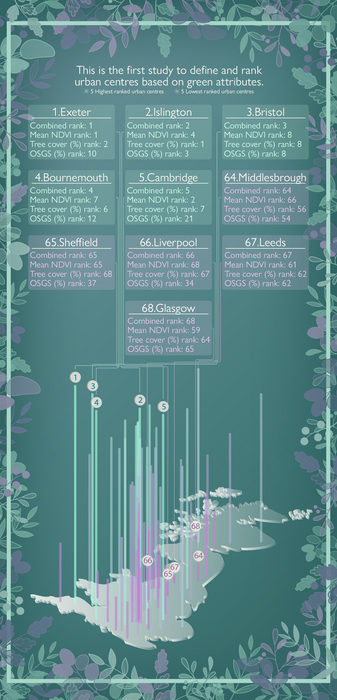
Credit: Anne-Lise Paris (www.in-graphidi.com), PLOS, CC-BY 4.0 (https://creativecommons.org/licenses/by/4.0/
A new study finds that Great Britain’s city centers vary considerably in their green attributes—such as tree cover, vegetation, and presence of parks—with potential implications for human health, social equity, and biodiversity. Dr. Jake Robinson of Flinders University and colleagues at the University of Sheffield, U.K., present these findings in the open-access journal PLOS ONE on November 23, 2022.
Trees, vegetation cover, and public greenspaces, including parks and sports fields, contribute to biodiversity and human health in urban ecosystems. While numerous prior studies have measured such “greenness” in broader suburban areas, none have focused specifically on city centers, where people of diverse backgrounds spend much time on activities such as work, recreation, and shopping.
Because many people’s lives may be affected by the greenness of city centers, Robinson and colleagues analyzed green metrics of urban centers for all 68 municipalities in Great Britain with populations of at least 100,000. Their analysis incorporated three metrics of greenness: tree cover, presence of greenspaces, and the normalized difference vegetation index (NDVI), which uses satellite observations of light reflection and absorption to measure vegetation cover in a given area.
Combining all three metrics into a single greenness score, the researchers found that Exeter’s urban center ranks highest, followed by Islington, Bristol, Bournemouth, and Cambridge. Glasgow’s urban center is least green, with Middlesbrough, Sheffield, Liverpool, and Leeds also in the lowest five. The authors note that the top five urban centers are all located in the south of England, while the bottom five urban centers relate to ex-industrial areas in the north of Great Britain.
Further analysis uncovered a statistical link between a lower greenness score and higher levels of deprivation, as measured according to crime risk, health, economics, education, and other related metrics. In addition, areas with larger populations had lower tree coverage and lower NDVI scores, but did not have fewer greenspaces.
These findings highlight disparities in greenness of city centers across Great Britain. Future research could incorporate alternative metrics of greenness or apply a similar analysis to city centers outside of Great Britain.
Dr. Robinson adds: “This work could help inform efforts by local authorities and urban planners to boost the greenness of city centers in an equitable manner.”
#####
In your coverage please use this URL to provide access to the freely available article in PLOS ONE: https://journals.plos.org/plosone/article?id=10.1371/journal.pone.0276962
Citation: Robinson JM, Mavoa S, Robinson K, Brindley P (2022) Urban centre green metrics in Great Britain: A geospatial and socioecological study. PLoS ONE 17(11): e0276962. https://doi.org/10.1371/journal.pone.0276962
Author Countries: UK, USA, Australia
Funding: The funding received for this manuscript is as follows: University of Melbourne Faculty of Medicine, Dentistry and Health Sciences Research Fellowship. Dr Suzanne Mavoa University of Sheffield, Open Access publishing agreement with PLOS ONE, Dr Jake M. Robinson and Dr. Paul Brindley.
Journal
PLoS ONE
DOI
10.1371/journal.pone.0276962
Method of Research
Observational study
Subject of Research
Not applicable
Article Title
Urban centre green metrics in Great Britain: A geospatial and socioecological study
Article Publication Date
23-Nov-2022
COI Statement
Competing Interests: The authors have declared that no competing interests exist.