• HOME
  • NEWS
  • EXPLORE
    • CAREER
      • Companies
      • Jobs
    • EVENTS
    • iGEM
      • News
      • Team
    • PHOTOS
    • VIDEO
    • WIKI
  • BLOG
  • COMMUNITY
    • FACEBOOK
    • INSTAGRAM
    • TWITTER
Saturday, February 7, 2026
BIOENGINEER.ORG
No Result
View All Result
  • Login
  • HOME
  • NEWS
  • EXPLORE
    • CAREER
      • Companies
      • Jobs
        • Lecturer
        • PhD Studentship
        • Postdoc
        • Research Assistant
    • EVENTS
    • iGEM
      • News
      • Team
    • PHOTOS
    • VIDEO
    • WIKI
  • BLOG
  • COMMUNITY
    • FACEBOOK
    • INSTAGRAM
    • TWITTER
  • HOME
  • NEWS
  • EXPLORE
    • CAREER
      • Companies
      • Jobs
        • Lecturer
        • PhD Studentship
        • Postdoc
        • Research Assistant
    • EVENTS
    • iGEM
      • News
      • Team
    • PHOTOS
    • VIDEO
    • WIKI
  • BLOG
  • COMMUNITY
    • FACEBOOK
    • INSTAGRAM
    • TWITTER
No Result
View All Result
Bioengineer.org
No Result
View All Result
Home NEWS Science News Health

Study reveals the intrinsic immune mechanism that boosts axon regeneration in the adult nervous system

Bioengineer by Bioengineer
November 18, 2022
in Health
Reading Time: 3 mins read
0
A working model of IFNγ-STAT1 signaling promoting axon regeneration in CNS and PNS.
Share on FacebookShare on TwitterShare on LinkedinShare on RedditShare on Telegram

Damages to the central nervous system (CNS), for example in the case of spinal cord injury, can result in permanent loss of sensory and motor function. It is because the severed axons are unable to regenerate. As of today, there are very limited options to help these patients regain their motor abilities. Scientists have been exploring ways to enable the regeneration of severed axons, with a view to developing viable treatments in the long term.
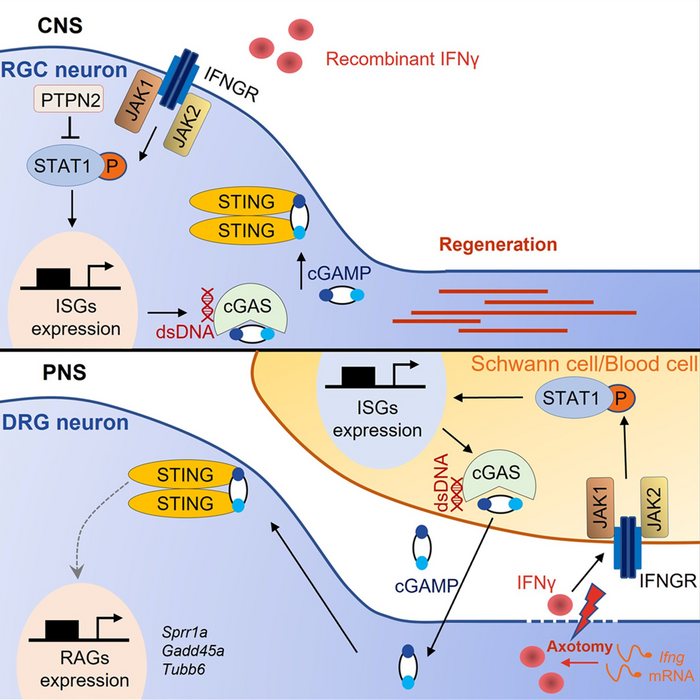
A working model of IFNγ-STAT1 signaling promoting axon regeneration in CNS and PNS.

Credit: The Hong Kong University of Science and Technology

Damages to the central nervous system (CNS), for example in the case of spinal cord injury, can result in permanent loss of sensory and motor function. It is because the severed axons are unable to regenerate. As of today, there are very limited options to help these patients regain their motor abilities. Scientists have been exploring ways to enable the regeneration of severed axons, with a view to developing viable treatments in the long term.

In a study using mice, a research team led by Cheng Associate Professor Kai LIU of the Division of Life Science, the Hong Kong University of Science and Technology (HKUST), untangled some of the complexities in the regeneration of severed axons. They found that the deletion of PTPN2, a phosphatase-coding gene, in neurons can prompt axons to regrow. When combined with the type II interferon IFNγ, it can further accelerate the process and boost the number of axons regenerated. The results have recently been published in the scientific journal Neuron.

The human nervous system is composed of two parts, namely the central and peripheral nervous systems. Unlike the central nervous system, peripheral nerves have stronger ability to regrow and repair by themselves after injury. Scientists have yet to fully understand the relationship between this self-repair and the intrinsic immune mechanism of the nervous system. Two mysteries the team wanted to resolve were how immune-related signaling pathways affected neurons after injury, and whether they could enhance axonal regeneration directly.

This study investigated whether the signaling pathway IFNγ-cGAS-STING had any role in the regeneration process of peripheral nerves. Researchers found that peripheral axons could directly modulate the immune response in their injured environment to promote self-repair after injury.

In previous research, Prof. Liu’s team had already demonstrated that elevating the neuronal activity and regulating the neuronal glycerolipid metabolism pathway could  boost axon regenerative capacity. The current study is providing further insights into the search of treatment solutions for challenging conditions such as spinal cord injuries, with one possible option being the joining of several types of different signaling pathways.

The co-first authors of this project are Drs. Xu WANG and Chao YANG of HKUST. The work was done in collaboration with Prof. Zhong-Yin ZHANG of Purdue University alongside Profs. Ruohao WU, and Peiyuan QIAN, Jiguang WANG of HKUST.


Journal

Neuron

Article Title

Driving axon regeneration by orchestrating neuronal and non-neuronal innate immune responses via the IFNγ-cGAS-STING axis

Article Publication Date

11-Nov-2022
Share12Tweet8Share2ShareShareShare2

Related Posts

Evaluating Pediatric Emergency Care Quality in Ethiopia

February 7, 2026

TPMT Expression Predictions Linked to Azathioprine Side Effects

February 7, 2026

Improving Dementia Care with Enhanced Activity Kits

February 7, 2026

Decoding Prostate Cancer Origins via snFLARE-seq, mxFRIZNGRND

February 7, 2026

POPULAR NEWS

  • Robotic Ureteral Reconstruction: A Novel Approach

    Robotic Ureteral Reconstruction: A Novel Approach

    82 shares
    Share 33 Tweet 21
  • Digital Privacy: Health Data Control in Incarceration

    63 shares
    Share 25 Tweet 16
  • Study Reveals Lipid Accumulation in ME/CFS Cells

    57 shares
    Share 23 Tweet 14
  • Breakthrough in RNA Research Accelerates Medical Innovations Timeline

    53 shares
    Share 21 Tweet 13

About

We bring you the latest biotechnology news from best research centers and universities around the world. Check our website.

Follow us

Recent News

Evaluating Pediatric Emergency Care Quality in Ethiopia

TPMT Expression Predictions Linked to Azathioprine Side Effects

Improving Dementia Care with Enhanced Activity Kits

Subscribe to Blog via Email

Success! An email was just sent to confirm your subscription. Please find the email now and click 'Confirm' to start subscribing.

Join 73 other subscribers
  • Contact Us

Bioengineer.org © Copyright 2023 All Rights Reserved.

Welcome Back!

Login to your account below

Forgotten Password?

Retrieve your password

Please enter your username or email address to reset your password.

Log In
No Result
View All Result
  • Homepages
    • Home Page 1
    • Home Page 2
  • News
  • National
  • Business
  • Health
  • Lifestyle
  • Science

Bioengineer.org © Copyright 2023 All Rights Reserved.