Cancer that splits and develops in new organs around the body becomes significantly more difficult to fight. Now, researchers at Chalmers University of Technology, Sweden, have shown that these metastatic cancers, that spread from the original, adapt their metabolism to the tissue in which they grow. The discovery represents a breakthrough for the understanding of metastatic cancer and is an important piece of the puzzle in the search for more effective treatments.
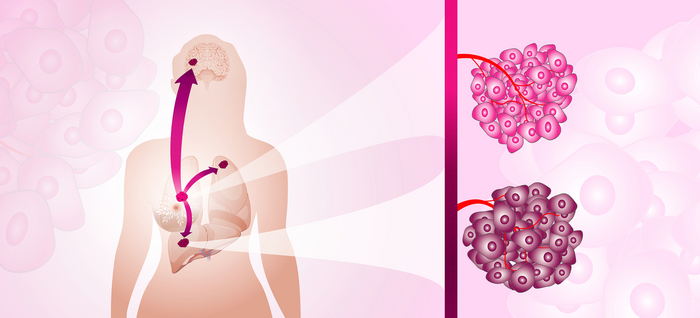
Credit: Chalmers | Fariba Roshanzamir and Yen Strandqvist
Cancer that splits and develops in new organs around the body becomes significantly more difficult to fight. Now, researchers at Chalmers University of Technology, Sweden, have shown that these metastatic cancers, that spread from the original, adapt their metabolism to the tissue in which they grow. The discovery represents a breakthrough for the understanding of metastatic cancer and is an important piece of the puzzle in the search for more effective treatments.
Metabolism in the human body can be likened to its internal engine. It is a prerequisite for our cells to grow and receive energy. Therefore, it is also an important target for cancer treatments, where the focus is on stopping the progress of cancer cells.
In a new study, which was recently presented in the scientific journal PNAS, researchers in Systems and Synthetic Biology at Chalmers have examined how metabolism works in cancer cells that have spread via metastases – also called secondary tumors – to new organs. The study gave the researchers new insights into how the metastases adapt to their new environment.
“Obviously, the local environment affects the cancer cells more than previously known. The metastatic tumours should show the same metabolic properties no matter where in the body they are located, but we discovered that the cancer cells largely adapted their metabolism to the new tissue in order to continue to develop and grow. This is important knowledge, which shows that we cannot consider the metastases as their original tumors,” says Fariba Roshanzamir, PhD in Systems and Synthetic Biology at Chalmers and the study’s lead author.
Tools for inhibiting cancer metabolism
Fariba Roshanzamir works in Professor Jens Nielsen’s research group at Chalmers and has, together with Swedish and international colleagues, been able to establish the groundbreaking results. The study focused primarily on so-called triple-negative breast cancer – a severe breast cancer that is difficult to treat with drugs – but the conclusions can, according to the researchers, be applied to all types of metastatic cancer. This opens new doors to develop more effective treatments.
“If we manage to shut down the metabolism in a tumour, it will stop working and this study provides important keys to better understand what to target. Selecting metabolic inhibitors that specifically target the metastases in the organs to which the tumour has spread, rather than treating them as their original tumours, is of great importance to be able to find good strategies for treatments in the future,” she says.
New view of the properties of metastases
Today, the spread of cancer to new organs is one of the leading causes of death in cancer patients. Jens Nielsen, Professor of Systems and Synthetic Biology at Chalmers University of Technology and one of the study’s authors, hopes that it will lead to a new view of the properties and behavior of metastases.
“This is a breakthrough in terms of our understanding of metastatic cancer and an important step on the way to more individualised drugs,” he says.
- The article “Metastatic triple negative breast cancer adapts its metabolism to destination tissues while retaining key metabolic signatures” (LINK: https://doi.org/10.1073/pnas.2205456119) has been published in the scientific journal PNAS.
- The authors are Fariba Roshanzamir, Chalmers and University of Tehran, Jonathan L. Robinson, Chalmers, Daniel Cook, Chalmers, Mohammad Hossein Karimi-Jafari, University of Tehran and Jens Nielsen, Chalmers.
- The research has been carried out with support from the Knut and Alice Wallenberg Foundation.
More about the research
The study examined metastatic tumors (also called secondary tumours) in mainly lungs, brain, and liver from triple-negative breast cancer as well as skin cancer (a smaller part). The researchers found that the metabolism of the metastatic cancer cells largely adapted to the tissue of the organ in which they grew. The adaptation varied in scope between different organs and the metastatic tumours retained certain metabolic characteristics associated with the original tumours.
For more information, please contact:
Fariba Roshanzamir, PhD, Department of Biology and Biological Engineering, Chalmers University of Technology,
+46 76 054 7653, [email protected]
Jens Nielsen, Professor, Department of Biology and Biological Engineering, Chalmers University of Technology,
+46 31 772 38 04,[email protected]
Journal
Proceedings of the National Academy of Sciences
DOI
10.1073/pnas.2205456119
Subject of Research
Cells
Article Title
Metastatic triple negative breast cancer adapts its metabolism to destination tissues while retaining key metabolic signatures.
Article Publication Date
22-Aug-2022