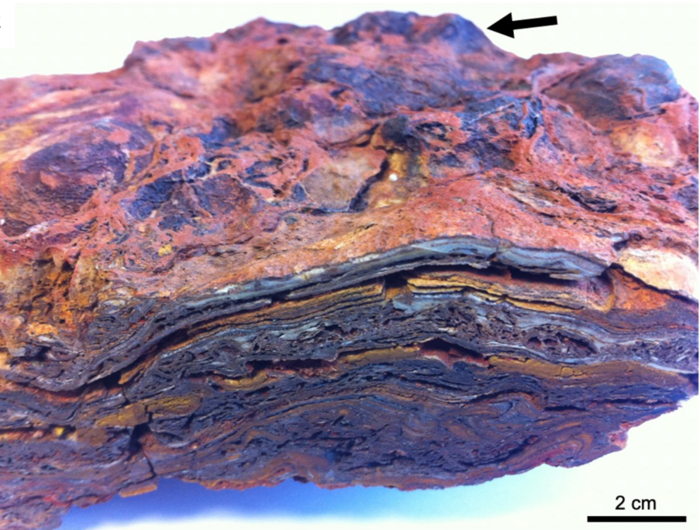
Boulder, Colo., USA: The earliest morphological traces of life on Earth are often highly controversial, both because non-biological processes can produce relatively similar structures and because such fossils have often been subjected to advanced alteration and metamorphism. Stromatolites, layered organo-sedimentary structures reflecting complex interplays between microbial communities and their environment, have long been considered key macrofossils for life detection in ancient sedimentary rocks; however, the biological origin of ancient stromatolites has frequently been criticized. An article released Friday in the Geological Society of America journal Geology uses a range of advanced two- and three-dimensional analytical techniques to establish the biological origins of Earth’s oldest stromatolites from the 3.48-billion-year-old Dresser Formation, Pilbara, Western Australia.
Credit: Keyron Hickman-Lewis and colleagues
Boulder, Colo., USA: The earliest morphological traces of life on Earth are often highly controversial, both because non-biological processes can produce relatively similar structures and because such fossils have often been subjected to advanced alteration and metamorphism. Stromatolites, layered organo-sedimentary structures reflecting complex interplays between microbial communities and their environment, have long been considered key macrofossils for life detection in ancient sedimentary rocks; however, the biological origin of ancient stromatolites has frequently been criticized. An article released Friday in the Geological Society of America journal Geology uses a range of advanced two- and three-dimensional analytical techniques to establish the biological origins of Earth’s oldest stromatolites from the 3.48-billion-year-old Dresser Formation, Pilbara, Western Australia.
Although these stromatolites have undergone severe diagenesis and weathering and preserve no organic materials, a team led by Dr. Keyron Hickman-Lewis of the Natural History Museum, London, has used optical and electron microscopy, elemental geochemistry, Raman spectroscopy, and laboratory- and synchrotron-based tomography to identify numerous characteristics indicative of a biological origin.
In addition to performing laboratory tomography of 3D stromatolitic macrostructure, the team was able to achieve the first sub-micron pixel and voxel sizes for imaging of Precambrian stromatolite microstructures via phase contrast imaging using the SYRMEP beamline at the Elettra Synchrotron, Trieste, Italy. This enabled the identification of non-uniform layer morphologies, void spaces arising from the degassing of decaying organic materials, and pillar-like vertical structures interpreted as microbial palisade structure, a common indicator of phototrophic growth.
The Dresser Formation stromatolites have been mostly replaced by hematite (iron oxide) due to recent weathering. While this renders organic geochemical analyses impossible, this composition is highly relevant for the search for life on Mars.
Sedimentary rocks at the surface of Mars have been subjected to similar pervasive oxidation and also comprise mostly iron oxides in their upper centimeters to meters. In this regard, the Dresser Formation stromatolites may be uniquely relevant materials to inform us of a precise style of biosignature preservation expected on Mars. As the Mars 2020 Perseverance rover continues its exploration of Jezero crater, we should search for morphological expressions of life resembling those identified in the Dresser Formation and prepare for advanced multi-technique analyses when Martian samples are eventually returned to Earth.
FEATURED ARTICLE
Advanced 2D-3D insights into Earth’s oldest stromatolites (~3.5 Ga): Prospects for the search for life on Mars
Keyron Hickman-Lewis and colleagues
Contact: [email protected], The Natural History Museum, Department of Earth Sciences, London, UK
URL: https://pubs.geoscienceworld.org/gsa/geology/article-abstract/doi/10.1130/G50390.1/618747/Advanced-two-and-three-dimensional-insights-into
GEOLOGY articles are online at https://geology.geoscienceworld.org/content/early/recent . Representatives of the media may obtain complimentary articles by contacting Kea Giles at the e-mail address above. Please discuss articles of interest with the authors before publishing stories on their work, and please make reference to GEOLOGY in articles published. Non-media requests for articles may be directed to GSA Sales and Service, [email protected].
https://www.geosociety.org
# # #
Journal
Geology
DOI
10.1130/G50390.1
Article Title
Advanced 2D-3D insights into Earth’s oldest stromatolites (~3.5 Ga): Prospects for the search for life on Mars
Article Publication Date
4-Nov-2022