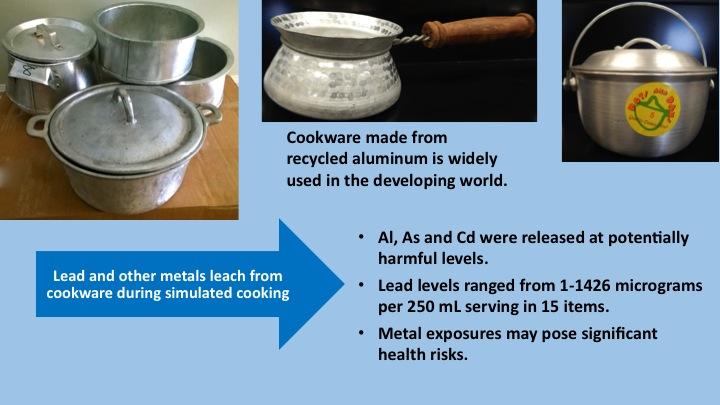
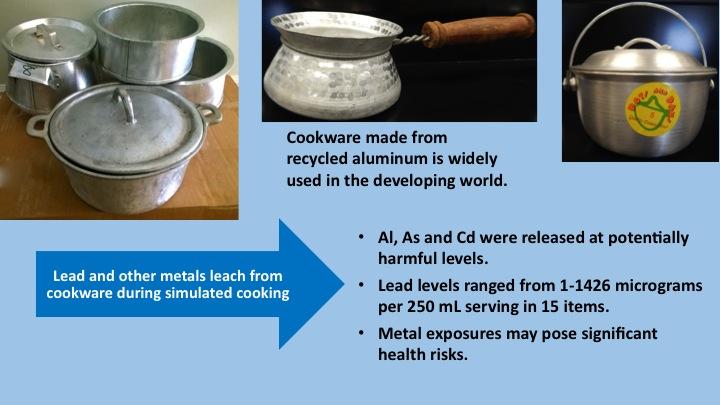
Credit: Occupational Knowledge International
SAN FRANCISCO – Aluminum cookware made from scrap metal in countries around the world poses a serious and previously unrecognized health risk to millions of people according to a new study. The highest levels were found in cookware from Vietnam including one pot that released 2,800 times more lead than California's Maximum Allowable Dose Level (MADL) of 0.5 micrograms per day.
Researchers at Ashland University and Occupational Knowledge International tested 42 samples of aluminum cookware made in 10 developing countries and more than one-third pose a lead exposure hazard. The cookware also released significant levels of aluminum, arsenic and cadmium.
This cookware is common throughout Africa and Asia and is made from recycled scrap metal including auto and computer parts, cans and other industrial debris.
The study, "Metal exposures from aluminum cookware: An unrecognized public health risk in developing countries," is published in the February 2017 issue of the journal Science of the Total Environment.
There are no regulatory standards specific to lead in cookware but the World Health Organization (WHO) and the U.S. Centers for Disease Control and Prevention (CDC) have determined that there is no safe level of exposure to lead. In fact, a scientific advisory board to the CDC recommended this week to lower the blood lead action level for children to 3.5 micrograms per deciliter (μg/dL), underlining the hazard of even low level lead exposures.
"Lead exposure from inexpensive aluminum cookware has the potential to be of much greater public health significance than lead paint or other well-known harmful sources that are common around the world," said Perry Gottesfeld, executive director of Occupational Knowledge International.
Recently conducted surveys of lead exposure in Africa and Asia have suggested that blood lead levels have remained stubbornly elevated despite the ban on lead in gasoline in most of the world. "The presence of lead in food cooked in these pots may be one contributing factor to the ongoing lead poisoning epidemic," Gottesfeld said.
"Lead and cadmium exposures from regular use of these pots will significantly reduce IQ and school performance among children, and contribute to millions of deaths due to cardiovascular disease," according to Jeffrey Weidenhamer, professor of Chemistry at Ashland University and an author of the study.
The investigation simulated cooking by boiling acidic solutions in the cookware for two hours and measuring the lead extracted in solution. The researchers also found levels of aluminum on average were six times greater than WHO dietary guidelines and significant concentrations of cadmium leached from 31 percent of the cookware tested.
Cadmium is neurotoxic in children, causes kidney damage, is linked to cardiovascular deaths and is carcinogenic. Lead exposure in children is linked to brain damage, mental retardation, lower educational performance, and a range of other health effects. Globally lead accounts for more than 853,000 deaths per year.
###
The article is available online at: http://www.sciencedirect.com/science/article/pii/S0048969716324548
About Occupation Knowledge International
OK International is a nonprofit organization based in San Francisco that works to build capacity in developing countries to identify, monitor, and mitigate environmental and occupational exposures to hazardous materials in order to protect public health and the environment. The organization seeks to address inequities in environmental standards between developed and developing countries by working in partnership with industry, government and non-governmental organizations (NGOs). For more information, visit http://www.okinternational.org.
About Ashland University
Ashland University, ranked in the top tier of colleges and universities in U.S. News and World Report's National Universities category for 2017, is a mid-sized, private university conveniently located a short distance from Akron, Cleveland and Columbus, Ohio. Ashland University values the individual student and offers a unique educational experience that combines the challenge of strong, applied academic programs with a faculty and staff who build nurturing relationships with their students.
Media Contact
Perry Gottesfeld
[email protected]
415-221-8900
@occupknowledge
http://www.okinternational.org
############
Story Source: Materials provided by Scienmag