• HOME
  • NEWS
  • EXPLORE
    • CAREER
      • Companies
      • Jobs
    • EVENTS
    • iGEM
      • News
      • Team
    • PHOTOS
    • VIDEO
    • WIKI
  • BLOG
  • COMMUNITY
    • FACEBOOK
    • INSTAGRAM
    • TWITTER
Monday, July 6, 2026
BIOENGINEER.ORG
No Result
View All Result
  • Login
  • HOME
  • NEWS
  • EXPLORE
    • CAREER
      • Companies
      • Jobs
        • Lecturer
        • PhD Studentship
        • Postdoc
        • Research Assistant
    • EVENTS
    • iGEM
      • News
      • Team
    • PHOTOS
    • VIDEO
    • WIKI
  • BLOG
  • COMMUNITY
    • FACEBOOK
    • INSTAGRAM
    • TWITTER
  • HOME
  • NEWS
  • EXPLORE
    • CAREER
      • Companies
      • Jobs
        • Lecturer
        • PhD Studentship
        • Postdoc
        • Research Assistant
    • EVENTS
    • iGEM
      • News
      • Team
    • PHOTOS
    • VIDEO
    • WIKI
  • BLOG
  • COMMUNITY
    • FACEBOOK
    • INSTAGRAM
    • TWITTER
No Result
View All Result
Bioengineer.org
No Result
View All Result
Home NEWS Science News Chemistry

Tree rings offer insight into devastating radiation storms

Bioengineer by Bioengineer
October 26, 2022
in Chemistry
Reading Time: 3 mins read
0
Composite image of tree rings and sun
Share on FacebookShare on TwitterShare on LinkedinShare on RedditShare on Telegram

A University of Queensland study has shed new light on a mysterious, unpredictable and potentially devastating kind of astrophysical event.

A team led by Dr Benjamin Pope from UQ’s School of Mathematics and Physics applied cutting edge statistics to data from millennia-old trees, to find out more about radiation ‘storms’.
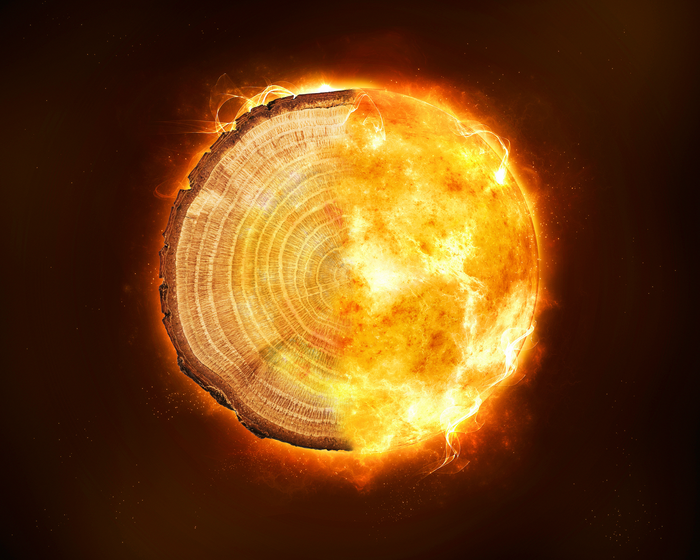
Composite image of tree rings and sun

Credit: The University of Queensland

A University of Queensland study has shed new light on a mysterious, unpredictable and potentially devastating kind of astrophysical event.

A team led by Dr Benjamin Pope from UQ’s School of Mathematics and Physics applied cutting edge statistics to data from millennia-old trees, to find out more about radiation ‘storms’.

“These huge bursts of cosmic radiation, known as Miyake Events, have occurred approximately once every thousand years but what causes them is unclear,” Dr Pope said.  

“The leading theory is that they are huge solar flares.

“We need to know more, because if one of these happened today, it would destroy technology including satellites, internet cables, long-distance power lines and transformers.

“The effect on global infrastructure would be unimaginable.”

Enter the humble tree ring.

First author UQ undergraduate maths student Qingyuan Zhang developed software to analyse every available piece of data on tree rings.

“Because you can count a tree’s rings to identify its age, you can also observe historical cosmic events going back thousands of years,” Mr Zhang said.

“When radiation strikes the atmosphere it produces radioactive carbon-14, which filters through the air, oceans, plants, and animals, and produces an annual record of radiation in tree rings.

“We modelled the global carbon cycle to reconstruct the process over a 10,000-year period, to gain insight into the scale and nature of the Miyake Events.”

The common theory until now has been that Miyake Events are giant solar flares.

“But our results challenge this,” Mr Zhang said.

“We’ve shown they’re not correlated with sunspot activity, and some actually last one or two years.

“Rather than a single instantaneous explosion or flare, what we may be looking at is a kind of astrophysical ‘storm’ or outburst.”

Dr Pope said the fact scientists don’t know exactly what Miyake Events are, or how to predict their occurrence is very disturbing.

“Based on available data, there’s roughly a one per cent chance of seeing another one within the next decade.

“But we don’t know how to predict it or what harms it may cause.

“These odds are quite alarming, and lay the foundation for further research.”

The research is published in Proceedings of the Royal Society A.

The study was also completed with undergraduate maths and physics students Utkarsh Sharma and Jordan Dennis.

The work was supported by a philanthropic donation to UQ from the Big Questions Institute.


Journal

Proceedings of the Royal Society A Mathematical Physical and Engineering Sciences

DOI

10.1098/rspa.2022.0497

Article Title

Modelling Cosmic Radiation Events in the Tree-ring Radiocarbon Record

Article Publication Date

25-Oct-2022

Share12Tweet8Share2ShareShareShare2

Related Posts

Intelligent Microgrid Management Promises Lower Household Energy Bills and Reduced Diesel Emissions — Chemistry

Intelligent Microgrid Management Promises Lower Household Energy Bills and Reduced Diesel Emissions

July 4, 2026
Graz University of Technology Deciphers the Structural Secrets of MOF Thin Films — Chemistry

Graz University of Technology Deciphers the Structural Secrets of MOF Thin Films

July 2, 2026

Breaking Thermodynamic Limits: Wavelength-Driven Catalysis Advances Ammonia Synthesis

July 2, 2026

From Quantum Mechanics to AI-Powered Materials Discovery: MARVEL Marks 12 Years of Transforming Computational Science

July 2, 2026

POPULAR NEWS

  • Detection of EDCs in Breast Milk and Infant Urine Up to Six Months Highlights Early Exposure Risks

    77 shares
    Share 31 Tweet 19
  • New Drug Candidate Developed at McMaster Shows Potential for Treating Brain Cancer

    58 shares
    Share 23 Tweet 15
  • Saying Goodbye to PGY-6: Pediatric Fellowship Realities

    103 shares
    Share 41 Tweet 26
  • KTU Researchers Explore Ultrasound’s Role in Enhancing Blood Flow Beyond Diagnostics

    53 shares
    Share 21 Tweet 13

About

We bring you the latest biotechnology news from best research centers and universities around the world. Check our website.

Follow us

Recent News

Here are a few rewritten headlines for a science magazine post, each with a slightly different tone: Intriguing & poetic: How do organs sculpt themselves? Sea stars hold the secret Direct & research-focused: Sea stars reveal the hidden rules of organ formation Metaphorical & inviting: Tiny architects beneath the waves: What sea stars teach us about building organs Short & punchy: Star-shaped clues to how our organs take shape Question-led: Could a sea star show us how organs form? Elegant & feature-style: The body’s blueprint, glimpsed in a sea star’s arm

Enzymes reveal homoharringtonine’s full plant pathway.

Tissue-resident Granzyme K+ CD8 T cells fuel Crohn’s

Subscribe to Blog via Email

Enter your email address to subscribe to this blog and receive notifications of new posts by email.

Join 83 other subscribers
  • Contact Us

Bioengineer.org © Copyright 2023 All Rights Reserved.

Welcome Back!

Login to your account below

Forgotten Password?

Retrieve your password

Please enter your username or email address to reset your password.

Log In
No Result
View All Result
  • Homepages
    • Home Page 1
    • Home Page 2
  • News
  • National
  • Business
  • Health
  • Lifestyle
  • Science

Bioengineer.org © Copyright 2023 All Rights Reserved.