An important signature of life is the existence of organic molecules that have originated from biological processes. The most common organic molecule found in all life forms are hydrocarbons. However, they need not be of biotic origin, i.e., produced from thermal decomposition of sedimentary organic matter or microbes. So, while hydrocarbons have been found in several places outside Earth, they are not necessarily indicative of extra-terrestrial life. These hydrocarbons could well have formed from abiotic, or non-biological processes. Therefore, finding out whether a hydrocarbon is of biotic or abiotic origin is key to inferring the existence of life. Unfortunately, this has proved to be tremendously challenging task so far.
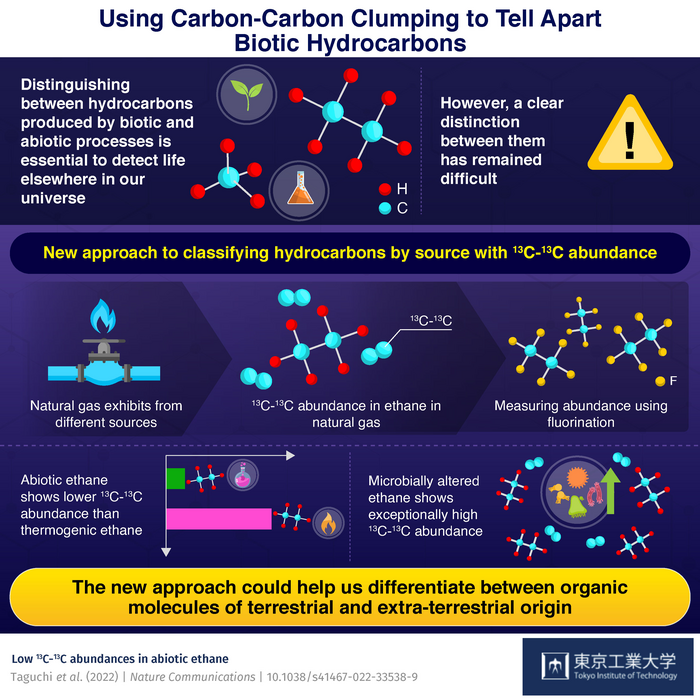
Credit: Tokyo Tech
An important signature of life is the existence of organic molecules that have originated from biological processes. The most common organic molecule found in all life forms are hydrocarbons. However, they need not be of biotic origin, i.e., produced from thermal decomposition of sedimentary organic matter or microbes. So, while hydrocarbons have been found in several places outside Earth, they are not necessarily indicative of extra-terrestrial life. These hydrocarbons could well have formed from abiotic, or non-biological processes. Therefore, finding out whether a hydrocarbon is of biotic or abiotic origin is key to inferring the existence of life. Unfortunately, this has proved to be tremendously challenging task so far.
Luckily, a team of researchers led by Professor Yuichiro Ueno from Tokyo Institute of Technology (Tokyo Tech) has now risen to the occasion. The team reports a novel and robust approach to distinguishing the sources of hydrocarbons by looking at the relative abundance of an isotope of carbon, namely 13C-13C, in organic molecules. Talking about their research, published in Nature Communications, Professor Ueno comments, “While methods to distinguish the source of the hydrocarbon, such as compound-specific isotope analysis, are available, they require a whole set of molecules, all of which are not always available to sample. In contrast, our method allows us to use the information contained in the molecule to find the source of its origin.”
To leverage this information, the team looked at the relative abundance of different isotopes of carbon in ethane. They compared the abundance of ethane molecules having both 12C atoms, having one 12C and one 13C atom, and having both 13C atoms. Based on this, the team calculated the abundance of 13C-13C in the ethane molecules in the sample. They compared the value of this abundance of 13C-13C in natural gas ethane with that synthesized in the laboratory.
They found that 13C-13C abundance in natural gas ethane, which is produced via thermal decomposition of organic matter, was relatively higher than what one would expect based on the natural abundance of 13C. According to the team, this is due to the carbon bonding in the organic molecules that produce the natural gas. This was in sharp contrast to the abiotically produced ethane, which showed significantly low 13C-13C abundance. Additionally, they observed that microbially-produced ethane had even higher 13C-13C abundance than the thermogenic ethane.
“This new approach can help us identify the origin of organic molecules, both on earth and in extraterrestrial environments. It can easily differentiate between thermogenic, abiotic, and microbially produced hydrocarbons,” highlights Professor Ueno. “While more interlaboratory work needs to be done for further calibration of the method, we believe it can potentially help detect the signatures of life elsewhere the universe.”
And we’re excited to find out!
Journal
Nature Communications
DOI
10.1038/s41467-022-33538-9
Method of Research
Experimental study
Subject of Research
Not applicable
Article Title
Low 13C–13C abundances in abiotic ethane
Article Publication Date
2-Oct-2022