• HOME
  • NEWS
  • EXPLORE
    • CAREER
      • Companies
      • Jobs
    • EVENTS
    • iGEM
      • News
      • Team
    • PHOTOS
    • VIDEO
    • WIKI
  • BLOG
  • COMMUNITY
    • FACEBOOK
    • INSTAGRAM
    • TWITTER
Saturday, February 7, 2026
BIOENGINEER.ORG
No Result
View All Result
  • Login
  • HOME
  • NEWS
  • EXPLORE
    • CAREER
      • Companies
      • Jobs
        • Lecturer
        • PhD Studentship
        • Postdoc
        • Research Assistant
    • EVENTS
    • iGEM
      • News
      • Team
    • PHOTOS
    • VIDEO
    • WIKI
  • BLOG
  • COMMUNITY
    • FACEBOOK
    • INSTAGRAM
    • TWITTER
  • HOME
  • NEWS
  • EXPLORE
    • CAREER
      • Companies
      • Jobs
        • Lecturer
        • PhD Studentship
        • Postdoc
        • Research Assistant
    • EVENTS
    • iGEM
      • News
      • Team
    • PHOTOS
    • VIDEO
    • WIKI
  • BLOG
  • COMMUNITY
    • FACEBOOK
    • INSTAGRAM
    • TWITTER
No Result
View All Result
Bioengineer.org
No Result
View All Result
Home NEWS Science News Chemistry

New study finds ways to improve light absorption in perovskite/si tandem solar cells

Bioengineer by Bioengineer
October 22, 2022
in Chemistry
Reading Time: 2 mins read
0
Professor Kyoung Jin Choi and his research team
Share on FacebookShare on TwitterShare on LinkedinShare on RedditShare on Telegram

A research team, affiliated with UNIST has succeeded in achieving a power conversion efficiency (PEC) of 23.50% in a perovskite-silicon tandem solar cell built with a special textured anti-reflective coating (ARC) polymeric film. According to the research team, the PCE of the device with the ARC film was sustained for 120 hours, maintaining 91% of its initial value.
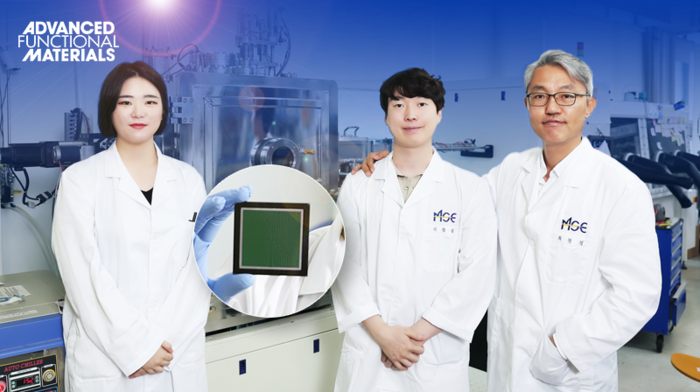
Professor Kyoung Jin Choi and his research team

Credit: UNIST

A research team, affiliated with UNIST has succeeded in achieving a power conversion efficiency (PEC) of 23.50% in a perovskite-silicon tandem solar cell built with a special textured anti-reflective coating (ARC) polymeric film. According to the research team, the PCE of the device with the ARC film was sustained for 120 hours, maintaining 91% of its initial value.

This breakthrough has been led by Professor Kyoung Jin Choi and his research team in the Department of Materials Science and Engineering at UNIST, in collaboration with Professor Jung-Kun Lee and his research team from the University of Pittsburgh in the United States.

In the work, the research team systematically demonstrated that a combination of silicon dioxide (SiO2) nanoparticles and large phosphor particles can convert ultraviolet (UV) to visible light and increase total transmittance of ARC film. Their experimental and computational results also show that SiO2 nanoparticles in the ARC film decrease the reflectance by increasing the diffuse transmittance.

Moreover, the PCE of the device with the ARC film was sustained for 120 hours, maintaining 91% of its initial value, while the PCE of existing devices dropped to 90% of its initial efficiency after 5 hours, and then decreased to 50% after 20 hours. In addition, the initial efficiency of the solar cell has also increased by nearly 4.5% compared to the previous one.

“This optically engineered ARC film successfully promotes the light absorption of the perovskite/silicon tandem solar cell, leading to the improvement of power conversion efficiency of the tandem cell from 22.48% to 23.50%,” noted the research team.

The findings of this research were made available in the online edition of Advanced Functional Materials, ahead of its publication in August 2022. This study has been jointly participated by Seongha Lee (Department of Mechanical Engineering and Material Science, University of Pittsburgh) and Chan Ul Kim (Department of Materials Science and Engineering, UNIST).

Journal Reference
Seongha Lee,Chan Ul Kim,Sumin Bae, et al., “Improving Light Absorption in a Perovskite/Si Tandem Solar Cell via Light Scattering and UV-Down Shifting by a Mixture of SiO2 Nanoparticles and Phosphors,” Adv. Funct. Mater., (2022).


Journal

Advanced Functional Materials

Article Title

Improving Light Absorption in a Perovskite/Si Tandem Solar Cell via Light Scattering and UV-Down Shifting by a Mixture of SiO2 Nanoparticles and Phosphors

Article Publication Date

25-Aug-2022

Share12Tweet8Share2ShareShareShare2

Related Posts

blank

Breakthrough in Environmental Cleanup: Scientists Develop Solar-Activated Biochar for Faster Remediation

February 7, 2026
blank

Cutting Costs: Making Hydrogen Fuel Cells More Affordable

February 6, 2026

Scientists Develop Hand-Held “Levitating” Time Crystals

February 6, 2026

Observing a Key Green-Energy Catalyst Dissolve Atom by Atom

February 6, 2026

POPULAR NEWS

  • Robotic Ureteral Reconstruction: A Novel Approach

    Robotic Ureteral Reconstruction: A Novel Approach

    82 shares
    Share 33 Tweet 21
  • Digital Privacy: Health Data Control in Incarceration

    63 shares
    Share 25 Tweet 16
  • Study Reveals Lipid Accumulation in ME/CFS Cells

    57 shares
    Share 23 Tweet 14
  • Breakthrough in RNA Research Accelerates Medical Innovations Timeline

    53 shares
    Share 21 Tweet 13

About

We bring you the latest biotechnology news from best research centers and universities around the world. Check our website.

Follow us

Recent News

Evaluating Pediatric Emergency Care Quality in Ethiopia

TPMT Expression Predictions Linked to Azathioprine Side Effects

Improving Dementia Care with Enhanced Activity Kits

Subscribe to Blog via Email

Success! An email was just sent to confirm your subscription. Please find the email now and click 'Confirm' to start subscribing.

Join 73 other subscribers
  • Contact Us

Bioengineer.org © Copyright 2023 All Rights Reserved.

Welcome Back!

Login to your account below

Forgotten Password?

Retrieve your password

Please enter your username or email address to reset your password.

Log In
No Result
View All Result
  • Homepages
    • Home Page 1
    • Home Page 2
  • News
  • National
  • Business
  • Health
  • Lifestyle
  • Science

Bioengineer.org © Copyright 2023 All Rights Reserved.