Whispering-gallery-mode (WGM) cavity is an intriguing platform for intensely enhancing light-matter interaction. It lays the foundations for ultra-low threshold lasers, ultra-sensitive sensing, nonlinear optics and quantum photonics. The conventional WGM cavity is composed of homogeneous materials with a constant refractive index both in the core and cladding. The light field is confined in the cavity through the total internal reflection (TIR) and enhanced through constructive interference. The ultrahigh-Q factor has been realized in various dielectric WGM cavities with a large mode volume (V) and angular momentum.
Credit: by Qingtao Ba, Yangyang Zhou, Jue Li, Wen Xiao, Longfang Ye, Yineng Liu, Jin-hui Chen and Huanyang Chen
Whispering-gallery-mode (WGM) cavity is an intriguing platform for intensely enhancing light-matter interaction. It lays the foundations for ultra-low threshold lasers, ultra-sensitive sensing, nonlinear optics and quantum photonics. The conventional WGM cavity is composed of homogeneous materials with a constant refractive index both in the core and cladding. The light field is confined in the cavity through the total internal reflection (TIR) and enhanced through constructive interference. The ultrahigh-Q factor has been realized in various dielectric WGM cavities with a large mode volume (V) and angular momentum.
Nevertheless, the intrinsic radiation loss in an open boundary cavity with a finite dielectric constant is ubiquitous due to the curved surface’s light tunnelling from the quantum mechanics analog. This radiation loss is remarkably increased and becomes the dominant loss mechanism when the resonant wavelength is comparable to the geometry size of the cavities. There is a relentless effort to optimize the Q/V in optical cavities, which is very important in exploring cavity quantum electrodynamics (QED).
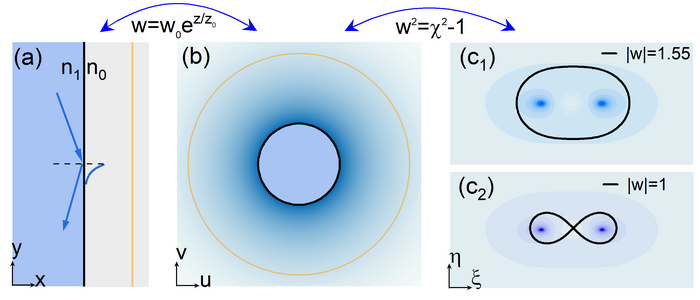
In a new paper published in eLight, scientists led by Professor Huanyang Chen and Dr Jin-hui Chen from Xiamen University investigated WGM cavities. Their paper, titled “Conformal optical black hole for cavity,” proposed and demonstrated an optical black hole (OBH) cavity based on transformation optics.
Various approaches have been proposed to manipulate the radiation loss and improve the Q-factor. For example, the plasmonic cavity was constructed employing the strong optical-field localizations of metals. However, the intrinsic ohmic loss in the plasmonic platform is unavoidable. Alternatively, the radially anisotropic claddings were implemented to compress more energy into the core of the cavity, resulting in tighter optical confinement and a substantially higher Q-factor. Unfortunately, the anisotropic parameters are still challenging to implement for natural materials.
Transformation optics (TO) offers great versatility for manipulating light rays and electromagnetic fields with novel functionalities. Many fascinating optical structures designed by TO enable light deflection and trapping to mimic the cosmology effects.
The research team utilized TO theory to construct a class of OBH cavities. The WGM fields outside the core of the circular OBH cavity are revealed to follow an unconventional decay rule from conformal mapping. Employing the effective potential model, they proved that the radiation loss of WGM in the ideal OBH cavity can be completely inhibited; thus, the radiation Q-factor is infinite.
The team also demonstrated the Q-factor enhancement and tight field confinement of the truncated OBH cavity. That was compared to a homogeneous cavity in the microwave spectra. The circular OBH cavity is further applied to the arbitrary-shaped cavities, including single-core and multi-core structures with high Q-factor.
This research paves the way to surface field manipulation with conformal transformation. It can be generalized to resonant modes of various wave systems, such as acoustic and elastic waves, and finds applications in energy harvesting and optoelectronics.
Journal
eLight
DOI
10.1186/s43593-022-00026-y