• HOME
  • NEWS
  • EXPLORE
    • CAREER
      • Companies
      • Jobs
    • EVENTS
    • iGEM
      • News
      • Team
    • PHOTOS
    • VIDEO
    • WIKI
  • BLOG
  • COMMUNITY
    • FACEBOOK
    • INSTAGRAM
    • TWITTER
Saturday, February 7, 2026
BIOENGINEER.ORG
No Result
View All Result
  • Login
  • HOME
  • NEWS
  • EXPLORE
    • CAREER
      • Companies
      • Jobs
        • Lecturer
        • PhD Studentship
        • Postdoc
        • Research Assistant
    • EVENTS
    • iGEM
      • News
      • Team
    • PHOTOS
    • VIDEO
    • WIKI
  • BLOG
  • COMMUNITY
    • FACEBOOK
    • INSTAGRAM
    • TWITTER
  • HOME
  • NEWS
  • EXPLORE
    • CAREER
      • Companies
      • Jobs
        • Lecturer
        • PhD Studentship
        • Postdoc
        • Research Assistant
    • EVENTS
    • iGEM
      • News
      • Team
    • PHOTOS
    • VIDEO
    • WIKI
  • BLOG
  • COMMUNITY
    • FACEBOOK
    • INSTAGRAM
    • TWITTER
No Result
View All Result
Bioengineer.org
No Result
View All Result
Home NEWS Science News Chemistry

Drawing data in nanometer scale

Bioengineer by Bioengineer
September 30, 2022
in Chemistry
Reading Time: 3 mins read
0
Figure 1
Share on FacebookShare on TwitterShare on LinkedinShare on RedditShare on Telegram

Frank Holzenburg, an artist with tens of thousands of followers across his social networking accounts, has attracted attention for his life-like drawings that are smaller than a fingernail. Recently, a method to draw data in an area smaller than 10 nanometers (nm; 1 nm = 1 billionth of a meter) – like drawing a small picture on paper – has been proposed.
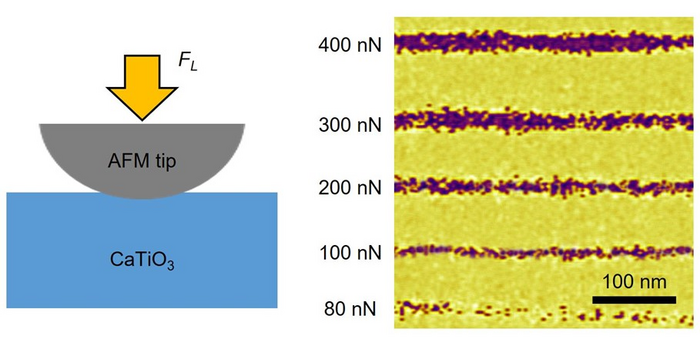
Figure 1

Credit: POSTECH

Frank Holzenburg, an artist with tens of thousands of followers across his social networking accounts, has attracted attention for his life-like drawings that are smaller than a fingernail. Recently, a method to draw data in an area smaller than 10 nanometers (nm; 1 nm = 1 billionth of a meter) – like drawing a small picture on paper – has been proposed.


A joint research team led by Professor Daesu Lee (Department of Physics) of POSTECH, Professor Se Young Park (Department of Physics) at Soongsil University, and Dr. Ji Hye Lee (Department of Physics and Astronomy) of Seoul National University has proposed a method for densely storing data by ‘poking’ with a sharp probe. This method utilizes a material in the metastable state, whose properties change easily even with slight stimulation.


A thin film of metastable ferroelectric calcium titanate (CaTiO3) enables the polarization switching of a material even with a slight pressure of a probe: A very weak force of 100 nanonewtons (nN) is more than enough. The joint research team succeeded in making the width of the polarization path smaller than 10 nm by using this force and found the way to dramatically increase the capacity of data storage. This is because the smaller the size of the path, the more data the single material can store.


The data storage capacity increased by up to 1 terabit (Tbit)/cm as a result of drawing the data storage area using a probe on the thin film. This result is 10 times greater than that of a previous study (0.11Tbit/cm²) which suggested a probe-based storage method using another material. Unlike the data storage method that uses electric fields, this probe method only requires a very small force, so the burden on the device is also small.


The results from the study are drawing attention as they have proved that materials achieve higher performance in an unstable metastable state. The findings are anticipated to be applicable in the next-generation electronic devices with improved integration and efficiency in the future.


Recently published in Physical Review Letters, one of the most authoritative journals in the field of physics, this study was supported by the Institute for Basic Science, and by the Research Center Program, the Basic Science Research Institute Fund, and the Key Research Institutes in Universities program of the National Research Foundation of Korea.


Journal

Physical Review Letters

DOI

10.1103/PhysRevLett.129.117601

Article Title

Flexoelectricity-Driven Mechanical Switching of Polarization in Metastable Ferroelectrics

Article Publication Date

8-Sep-2022

Share12Tweet8Share2ShareShareShare2

Related Posts

blank

Breakthrough in Environmental Cleanup: Scientists Develop Solar-Activated Biochar for Faster Remediation

February 7, 2026
blank

Cutting Costs: Making Hydrogen Fuel Cells More Affordable

February 6, 2026

Scientists Develop Hand-Held “Levitating” Time Crystals

February 6, 2026

Observing a Key Green-Energy Catalyst Dissolve Atom by Atom

February 6, 2026

POPULAR NEWS

  • Robotic Ureteral Reconstruction: A Novel Approach

    Robotic Ureteral Reconstruction: A Novel Approach

    82 shares
    Share 33 Tweet 21
  • Digital Privacy: Health Data Control in Incarceration

    63 shares
    Share 25 Tweet 16
  • Study Reveals Lipid Accumulation in ME/CFS Cells

    57 shares
    Share 23 Tweet 14
  • Breakthrough in RNA Research Accelerates Medical Innovations Timeline

    53 shares
    Share 21 Tweet 13

About

We bring you the latest biotechnology news from best research centers and universities around the world. Check our website.

Follow us

Recent News

Evaluating Pediatric Emergency Care Quality in Ethiopia

TPMT Expression Predictions Linked to Azathioprine Side Effects

Improving Dementia Care with Enhanced Activity Kits

Subscribe to Blog via Email

Enter your email address to subscribe to this blog and receive notifications of new posts by email.

Join 73 other subscribers
  • Contact Us

Bioengineer.org © Copyright 2023 All Rights Reserved.

Welcome Back!

Login to your account below

Forgotten Password?

Retrieve your password

Please enter your username or email address to reset your password.

Log In
No Result
View All Result
  • Homepages
    • Home Page 1
    • Home Page 2
  • News
  • National
  • Business
  • Health
  • Lifestyle
  • Science

Bioengineer.org © Copyright 2023 All Rights Reserved.