As electric vehicles grow in popularity, the spotlight shines more brightly on some of their remaining major issues. Researchers at The University of Texas at Austin are tackling two of the bigger challenges facing electric vehicles: limited range and slow recharging.
Credit: The University of Texas at Austin
As electric vehicles grow in popularity, the spotlight shines more brightly on some of their remaining major issues. Researchers at The University of Texas at Austin are tackling two of the bigger challenges facing electric vehicles: limited range and slow recharging.
The researchers fabricated a new type of electrode for lithium-ion batteries that could unleash greater power and faster charging. They did this by creating thicker electrodes – the positively and negatively charged parts of the battery that deliver power to a device – using magnets to create a unique alignment that sidesteps common problems associated with sizing up these critical components.
The result is an electrode that could potentially facilitate twice the range on a single charge for an electric vehicle, compared with a battery using an existing commercial electrode.
“Two-dimensional materials are commonly believed as a promising candidate for high-rate energy storage applications because it only needs to be several nanometers thick for rapid charge transport,” said Guihua Yu, a professor in UT Austin’s Walker Department of Mechanical Engineering and Texas Materials Institute. “However, for thick-electrode-design-based next-generation, high-energy batteries, the restacking of nanosheets as building blocks can cause significant bottlenecks in charge transport, leading to difficulty in achieving both high energy and fast charging.”
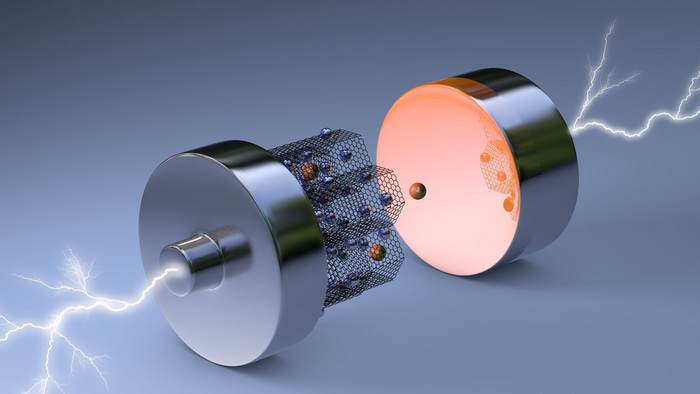
The key to the discovery, published in the Proceedings of the National Academy of Sciences, uses thin two-dimensional materials as the building blocks of the electrode, stacking them to create thickness and then using a magnetic field to manipulate their orientations. The research team used commercially available magnets during the fabrication process to arrange the two-dimensional materials in a vertical alignment, creating a fast lane for ions to travel through the electrode.
Typically, thicker electrodes force the ions to travel longer distances to move through the battery, which leads to slower charging time. The typical horizontal alignment of the layers of material that make up the electrode force the ions to snake back and forth.
“Our electrode shows superior electrochemical performance partially due to the high mechanical strength, high electrical conductivity, and facilitated lithium-ion transport thanks to the unique architecture we designed,” said Zhengyu Ju, a graduate student in Yu’s research group who is leading this project.
In addition to comparing their electrode with a commercial electrode, they also fabricated a horizontally arranged electrode using the same materials for experimental control purposes. They were able to recharge the vertical thick electrode to 50% energy level in 30 minutes, compared with 2 hours and 30 minutes with the horizontal electrode.
The researchers emphasized they are early in their work in this area. They looked at just a single type of battery electrode in this research.
Their goal is to generalize their methodology of vertically organized electrode layers to apply it to different types of electrodes using other materials. This could help the technique become more widely adopted in industry, so it could enable future fast-charging yet high-energy batteries that power electric vehicles.
The research team includes, from The University of Texas at Austin: Yu, Ju, Xiao Xu, Xiao Zhang and Kasun U. Raigama; and from Stony Brook/Brookhaven National Laboratory: Steven T. King, Kenneth J. Takeuchi, Amy C. Marschilok, Lei Wang and Esther S. Takeuchi. The research was funded by the U.S. Department of Energy through the multi-institutional Energy Frontier Research Center, the Center for Mesoscale Transport Properties.
Journal
Proceedings of the National Academy of Sciences
DOI
10.1073/pnas.2212777119
Article Title
Vertically assembled nanosheet networks for high-density thick battery electrodes
Article Publication Date
26-Sep-2022