One day in the not-too-distant future, the plastics in our satellites, cars and electronics may all be living their second, 25th or 250th lives.
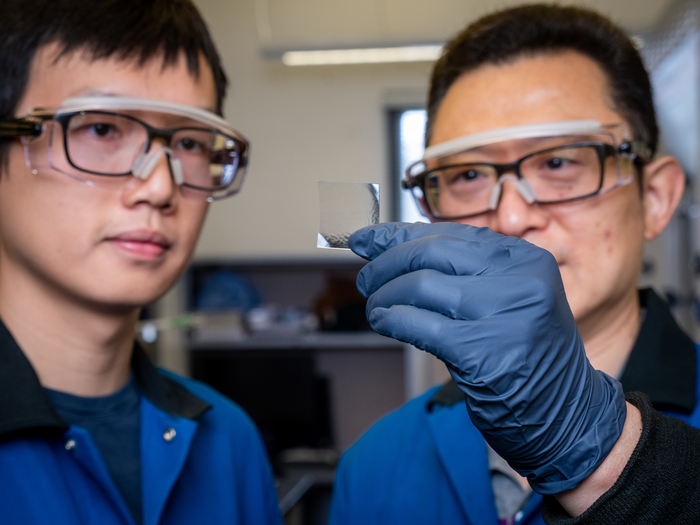
Credit: Patrick Campbell / University of Colorado Boulder
One day in the not-too-distant future, the plastics in our satellites, cars and electronics may all be living their second, 25th or 250th lives.
New research from the University of Colorado Boulder, published in Nature Chemistry, details how a class of durable plastics widely used in the aerospace and microelectronics industries can be chemically broken down into their most basic building blocks and then formed once again into the same material.
It’s a major step in the development of repairable and fully recyclable network polymers, a particularly challenging material to recycle, as it is designed to hold its shape and integrity in extreme heat and other harsh conditions. The study documents how this type of plastic can be perpetually broken down and remade, without sacrificing its desired physical properties.
“We are thinking outside the box, about different ways of breaking chemical bonds,” said Wei Zhang, lead author of the study and chair of the chemistry department. “Our chemical methods can help create new technologies and new materials, as well as be utilized to help solve the existing plastic materials crisis.”
Their results also suggest that revisiting the chemical structures of other plastic materials could lead to similar discoveries of how to fully break down and rebuild their chemical bonds, enabling the circular production of more plastic materials in our daily lives.
In the mid-20th century, plastics were ubiquitously adopted in almost every industry and part of life as they are extremely convenient, functional and cheap. But half a century later, after exponential demand and production, plastics pose a major problem to the health of the planet and to people. The production of plastics requires large amounts of oil and the burning of fossil fuels. Disposable plastics create hundreds of millions of tons of waste every year, which ends up in landfills, oceans and even in our bodies, in the form of microplastics.
Recycling, therefore, is key to reducing plastic pollution and fossil fuel emissions this century.
Conventional recycling methods mechanically break down polymers into powders, burn them or use bacterial enzymes to dissolve them. The goal is to end up with smaller pieces that can be used for something else. Think shoes made from recycled rubber tires or clothing made from recycled plastic water bottles. It’s not the same material anymore, but it doesn’t end up in a landfill or the ocean.
But what if you could rebuild a new item from the same material? What if recycling didn’t just offer a second life to plastics, but a repeat experience?
That’s exactly what Zhang and his colleagues have accomplished: They reversed a chemical method and discovered they can both break and form new chemical bonds in a particularly high-performance polymer.
“This chemistry can also be dynamic, can be reversible, and that bond can be reformed,” said Zhang. “We are thinking about a different way to form the same backbone, just from different starting points.”
They do this by breaking the polymer—”poly” meaning “many”—back into singular monomers, its molecules, a concept of reversible or dynamic chemistry. What’s especially novel about this latest method is that it has not only created a new class of polymer material that, like Legos, are easy to build, break apart and rebuild over and over, but the method can be applied to existing, especially hard-to-recycle polymers.
These new chemical methods are also ready for commercialization and can plug and play with current industrial production.
“It can really benefit future design and development of plastics to not only create new polymers, but it’s also very important to know how to convert, upcycle and recycle older polymers,” said Zhang. “By using our new approach, we can prepare many new materials—some of which could have similar properties to the plastics in our daily life.”
This advance in the closed-loop recycling of plastics is inspired by the natural world, as plants, animals and human beings alike are currently part of a planetary-level, circular system of recycling, said Zhang.
“Why can’t we make our materials the same way?”
Additional authors on this publication include: Zepeng Lei, Hongxuan Chen, Yicheng Rong and Yiming Hu, Department of Chemistry, University of Colorado Boulder; Chaoqian Luo and Kai Yu, Department of Mechanical Engineering, University of Colorado Denver; Yinghua Jin, RockyTech, Ltd. Boulder, Colorado; and Rong Long, Department of Mechanical Engineering, University of Colorado Boulder.
Journal
Nature Chemistry
DOI
10.1038/s41557-022-01046-4
Article Title
Recyclable and malleable thermosets enabled by activating dormant dynamic linkages
Article Publication Date
26-Sep-2022