CHAMPAIGN, Ill. — Tiny nets woven from DNA strands can ensnare the spike protein of the virus that causes COVID-19, lighting up the virus for a fast-yet-sensitive diagnostic test – and also impeding the virus from infecting cells, opening a new possible route to antiviral treatment, according to a new study.
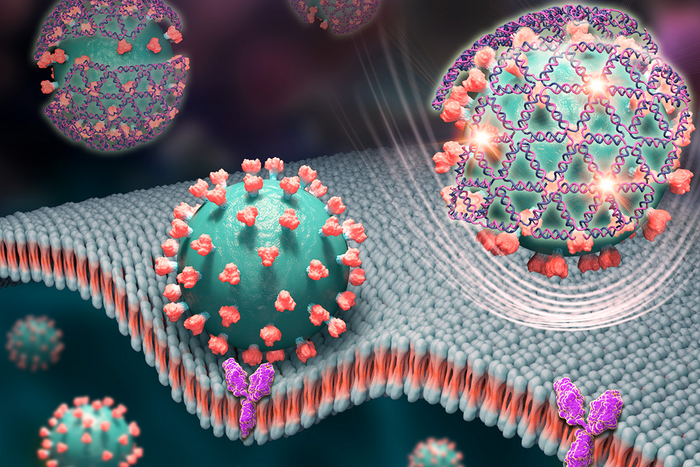
Credit: Xing Wang, University of Illinois
CHAMPAIGN, Ill. — Tiny nets woven from DNA strands can ensnare the spike protein of the virus that causes COVID-19, lighting up the virus for a fast-yet-sensitive diagnostic test – and also impeding the virus from infecting cells, opening a new possible route to antiviral treatment, according to a new study.
Researchers at the University of Illinois Urbana-Champaign and collaborators demonstrated the DNA nets’ ability to detect and impede COVID-19 in human cell cultures in a paper published in the Journal of the American Chemical Society.
“This platform combines the sensitivity of PCR and the speed and low cost of antigen tests,” said study leader Xing Wang, a professor of bioengineering and of chemistry at Illinois. “We need tests like this for a couple of reasons. One is to prepare for the next pandemic. The other reason is to track ongoing viral epidemics – not only coronaviruses, but also other deadly and economically impactful viruses like HIV or influenza.”
DNA is best known for its genetic properties, but it also can be folded into custom nanoscale structures that can perform functions or specifically bind to other structures much like proteins do. The DNA nets the Illinois group developed were designed to bind to the coronavirus spike protein – the structure that sticks out from the surface of the virus and binds to receptors on human cells to infect them. Once bound, the nets give off a fluorescent signal that can be read by an inexpensive handheld device in about 10 minutes.
The researchers demonstrated that their DNA nets effectively targeted the spike protein and were able to detect the virus at very low levels, equivalent to the sensitivity of gold-standard PCR tests that can take a day or more to return results from a clinical lab.
The technique holds several advantages, Wang said. It does not need any special preparation or equipment, and can be performed at room temperature, so all a user would do is mix the sample with the solution and read it. The researchers estimated in their study that the method would cost $1.26 per test.
“Another advantage of this measure is that we can detect the entire virus, which is still infectious, and distinguish it from fragments that may not be infectious anymore,” Wang said. This not only gives patients and physicians better understanding of whether they are infectious, but it could greatly improve community-level modeling and tracking of active outbreaks, such as through wastewater.
In addition, the DNA nets inhibited the virus’s spread in live cell cultures, with the antiviral activity increasing with the size of the DNA net scaffold. This points to DNA structures’ potential as therapeutic agents, Wang said.
“I had this idea at the very beginning of the pandemic to build a platform for testing, but also for inhibition at the same time,” Wang said. “Lots of other groups working on inhibitors are trying to wrap up the entire virus, or the parts of the virus that provide access to antibodies. This is not good, because you want the body to form antibodies. With the hollow DNA net structures, antibodies can still access the virus.”
The DNA net platform can be adapted to other viruses, Wang said, and even multiplexed so that a single test could detect multiple viruses.
“We’re trying to develop a unified technology that can be used as a plug-and-play platform. We want to take advantage of DNA sensors’ high binding affinity, low limit of detection, low cost and rapid preparation,” Wang said.
The National Institutes of Health supported this work through the Rapid Acceleration of Diagnostics program. The researchers will continue to work through the RADx program to explore and accelerate clinical applications for the DNA net platform.
Wang also is affiliated with the Holonyak Micro and Nanotechnology Lab and the Carl R. Woese Institute for Genomic Biology at Illinois.
Editor’s notes: To reach Xing Wang, email [email protected].
The paper “Net-shaped DNA nanostructures designed for rapid/sensitive detection and potential inhibition of the SARS-CoV-2 virus” is available online.
DOI: 10.1021/jacs.2c04835
Journal
Journal of the American Chemical Society
DOI
10.1021/jacs.2c04835
Method of Research
Experimental study
Subject of Research
Cells
Article Title
Net-shaped DNA nanostructures designed for rapid/sensitive detection and potential inhibition of the SARS-CoV-2 virus