The University plans to launch a 120 ECTS Master’s degree within the Faculty of Science, Technology and Medicine, and is committed to further developing the national HPC competence centre (EuroCC) and attracting world-class researchers to it. Subject to approval by the University’s governing bodies, the planned new Master’s degree is to be integrated into the first pilot HPC Master that is being set up at European level by a consortium of universities coordinated by the University of Luxembourg.
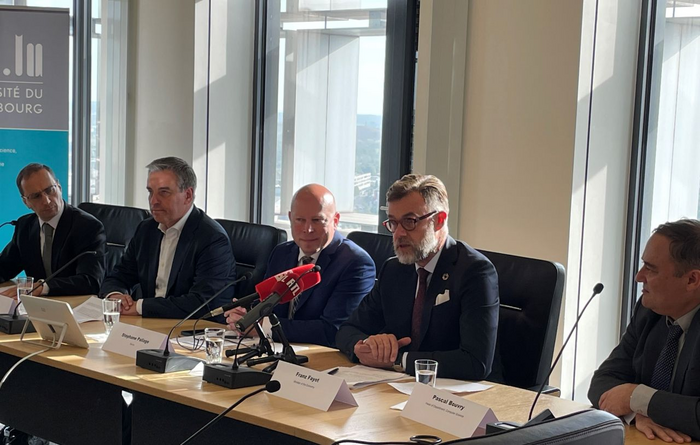
Credit: University of Luxembourg
The University plans to launch a 120 ECTS Master’s degree within the Faculty of Science, Technology and Medicine, and is committed to further developing the national HPC competence centre (EuroCC) and attracting world-class researchers to it. Subject to approval by the University’s governing bodies, the planned new Master’s degree is to be integrated into the first pilot HPC Master that is being set up at European level by a consortium of universities coordinated by the University of Luxembourg.
During a press conference on September 23, 2022, the details of the European Master in High Performance Computing, Big Data Analysis and Artificial Intelligence were presented in the presence of the Minister of the Economy, Franz Fayot, the Minister for Higher Education and Research, Claude Meisch, as well as the Rector of the University, Stéphane Pallage, the Dean of the Faculty of Science, Technology and Medicine, Prof. Jean-Marc Schlenker, and the director of the new Master within the University, Prof. Pascal Bouvry.
The planned Master aims to meet the needs of Luxembourg in its digital transformation and to allow a close collaboration with local industry actors to develop the economic and scientific activity related to the data economy.
The planned Master in HPC/HPDA/AI will be part of the EUMaster4HPC consortium, led by the University of Luxembourg and composed of 60 universities (including eight graduate universities), research centres, supercomputers, industrial partners and SMEs, and other contributing partners. It supports the development of HPC skills, education and fundamental training for European science and industry. The first courses of this European pilot Master are offered from September 2022 in several of the universities of the consortium. The first courses of the planned new Master at the University of Luxembourg are to be offered from September 2023.
Franz Fayot, Minister of the Economy, said: “High performance computing is a key technology for tackling today’s major challenges such as climate change, energy efficiency, personalised medicine and digital transformation in industry. Training employees and experts with dedicated skills has therefore become a priority, which is why the Ministry of the Economy has directly decided to support the establishment of this European Master’s degree in high performance computing, big data analysis and artificial intelligence.”
Claude Meisch, Minister for Higher Education and Research, emphasised: “Skills are at least as important as technologies. And with this new course, the University of Luxembourg is making a significant and timely contribution to fill the skills gap in the field of HPC. An approach that consists of covering the entire innovation chain, from teaching and basic research to applied research, and finally leading to practical and economic uses, is in my view indispensable if we want all stakeholders, including and especially SMEs and start-ups, to get on board HPC in the medium term.”
“Supporting the country’s digital transformation is one of the pillars of the University’s strategic framework, and high-performance computing is an essential part of it,” said Professor Stéphane Pallage, rector of the University of Luxembourg. “The University is grateful to the Ministry of Economy for its support in the realisation of this ambitious program. Through this Master’s degree, and with the support of the EUMaster4HPC consortium, we will be able to contribute to attracting and retaining the best talent in Luxembourg.”
“Training students from the start of the next academic year to design, deploy and exploit the current and future power of HPC will develop a new generation of experts and closely associate industry and the academic community,” said Professor Jens Kreisel, Vice-Rector for Research.
Press release by the Ministry of the Economy, the Ministry of Higher Education and Research and the University of Luxembourg