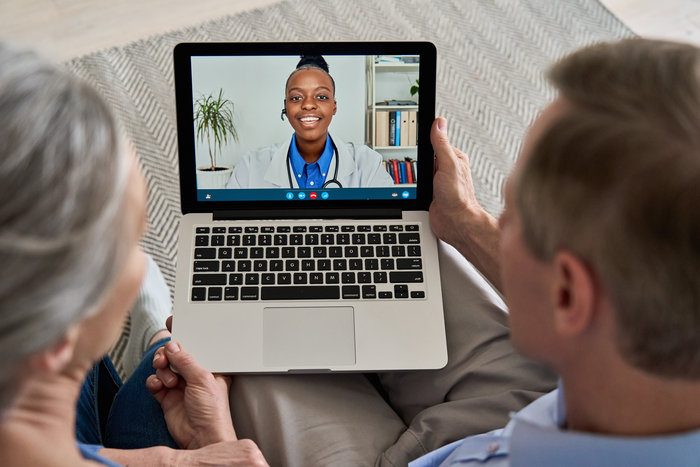
Common concerns about telemedicine don’t hold up to scrutiny, a first-of-its-kind study highlighting telemedicine’s remarkable effectiveness concludes.
Credit: University of Rochester Medical Center
Common concerns about telemedicine don’t hold up to scrutiny, a first-of-its-kind study highlighting telemedicine’s remarkable effectiveness concludes.
The paper is one of two studies on telemedicine by University of Rochester Medical Center (URMC) researchers appearing this week in NEJM Catalyst. The second study demonstrates the success of URMC’s effort to provide mental health services to nursing homes via a hybrid model that includes telemedicine.
“For patients, the message is clear and reassuring: Telemedicine is an effective and efficient way of receiving many kinds of health care,” said Kathleen Fear, Ph.D., lead author of the first paper, “Busting Myths about the Impact of Telemedicine Parity,” and director of data & analytics at the UR Health Lab. “Especially for those with transportation challenges, it is a service that really fills a gap – and, vitally, it does not compromise the quality of the care that patients receive.”
Fear and her co-authors used data generated in part by the COVID pandemic, when health care providers across the nation rapidly expanded their telemedicine services, to examine three specific concerns about telemedicine:
- That it will reduce access to care for the most vulnerable patients who may be unable to access digital services.
- That reimbursing providers for telemedicine services at the same rate as traditional services will encourage telemedicine overuse.
- That telemedicine is not an effective way to provide care.
“We really dug into the data, and it disproved all three concerns, which is really quite exciting,” Fear said. “Not only did our most vulnerable patients not get left behind—they were among those engaging the most with, and benefitting the most from, telemedicine services. We did not see worse outcomes or increased costs, or patients needing an increased amount of in-person follow up. Nor did we find evidence of overuse. This is good care, and it is equitable care for vulnerable populations.”
Michael Hasselberg, Ph.D., RN, URMC’s chief digital health officer and the study’s senior author, said the paper marks the first time anyone has published comprehensive data refuting the three myths, whose persistence has limited the adoption of telemedicine nationwide. URMC researchers were in a unique position to undertake the study because of the work of more than 3,000 providers across the health system who engage in telemedicine and the UR Health Lab’s ability to analyze the data generated by their work.
The researchers compared data from July to December of 2020, a period of relative normalcy after the pandemic’s first surge, to pre-pandemic data from July to December of 2019, using data from January to June 2021 as a follow-up period. Their analysis encompassed a review of patient demographics, outcomes, provider use, visits completed and more.
“For our providers, a major concern about telemedicine has always been, ‘What might I miss if I can’t sit in the room with the patient?’” Fear said. “But we simply didn’t find any increase in negative outcomes. This doesn’t mean telemedicine will replace in-person care, but it’s clear that it can help people access care more consistently and comfortably and that it provides a highly effective complement to traditional care.”
The second NEJM Catalyst study looked at a program URMC physicians developed to bring psychiatric and psychotherapeutic resources to nursing home patients through a combination of telehealth, on-site visits and staff education. The researchers concluded that the program improved access to care and reduced the number of residents requiring anti-psychotic medication.
“With a small team that we assembled here at URMC, we’ve been able to have a huge reach, extending care to patients in parts of the state where high-quality mental health services are scarce at best,” said Adam Simning, M.D., Ph.D., assistant professor of Psychiatry and the study’s lead author. “At a time when nursing homes nationwide are severely understaffed, and the need for mental health services among their residents is increasing, we’ve efficiently redesigned the way mental health services are provided to the more than 50 nursing homes we work with.”
Hasselberg, who was also a senior author on the nursing home study, believes both papers will resonate in the medical community, encouraging payors and policymakers to continue and expand pandemic-era policies that make the growth of telemedicine services possible.
“Hopefully, what we’ve learned here will help the rest of the country and help shape the future of health care as telemedicine becomes increasingly prominent,” said Hasselberg.
Carly Hochreiter, a senior analyst with the UR Health Lab, was an additional author on the telemedicine myths paper. Additional URMC authors on the nursing home study were psychiatry resident Zhi-Yang Tsun, M.D., Ph.D.,, Elizabeth Santos, M.D., associate professor of Psychiatry, and Lara Press-Ellingham, senior health project coordinator.
Journal
NEJM Catalyst
Method of Research
Data/statistical analysis
Subject of Research
People
Article Title
Busting Myths about the Impact of Telemedicine Parity
Article Publication Date
21-Sep-2022