Miniaturized sensors mounted upon optical fibers are widely recognized as an important future solution to instant and point-of-care medical diagnosis and on-site agricultural produce inspection. Plasmonic devices on the flat end-facets of single-mode fibers use fiber-optic devices’ convenient and rapid operation capabilities to the fullest. They can be directly dipped into minute samples or inserted with minimal invasion. However, most devices of this kind have been limited by low resonance quality factors (Q) or low coupling efficiencies when coupling the plasmons and the fiber-guided lightwaves. Consequently, the signal-to-noise ratio (SNR) of refractive index change detection has lagged far behind the free-space optics or side-coupling waveguide counterparts, preventing fiber-tip SPR devices from meeting the requirements of real applications where the target concentrations are often low.
Credit: by Xiaqing Sun, Zeyu Lei, Hao Zhong, Chenjia He, Sihang Liu, Qingfeng Meng, Qingwei Liu, Shengfu Chen, Xiangyang Kong, and Tian Yang
Miniaturized sensors mounted upon optical fibers are widely recognized as an important future solution to instant and point-of-care medical diagnosis and on-site agricultural produce inspection. Plasmonic devices on the flat end-facets of single-mode fibers use fiber-optic devices’ convenient and rapid operation capabilities to the fullest. They can be directly dipped into minute samples or inserted with minimal invasion. However, most devices of this kind have been limited by low resonance quality factors (Q) or low coupling efficiencies when coupling the plasmons and the fiber-guided lightwaves. Consequently, the signal-to-noise ratio (SNR) of refractive index change detection has lagged far behind the free-space optics or side-coupling waveguide counterparts, preventing fiber-tip SPR devices from meeting the requirements of real applications where the target concentrations are often low.
A team of scientists, led by Prof. Tian Yang from Shanghai Jiao Tong University, has reported remarkable progress in device design, fabrication technology and SNR of surface plasmon polariton (SPP) sensing devices on the end-facets of single-mode optical fibers. This work has been published in Light: Advanced Manufacturing titled “A Quasi-3D Fano Resonance Cavity on Optical Fiber End-Facet for High Signal-to-Noise Ratio Dip-and-Read Surface Plasmon Sensing.”
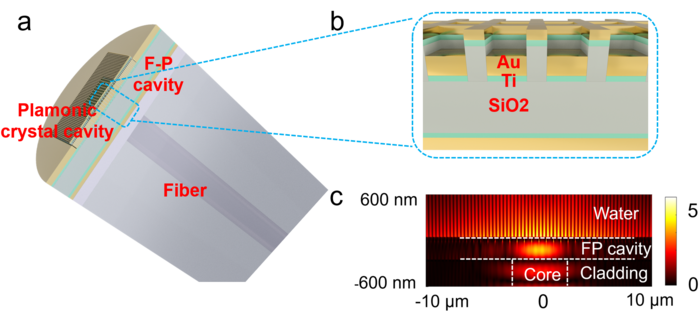
Based upon their previous work on SPP crystal microcavities (Appl. Phys. Lett. 108, 231105, 2016; Appl. Phys. Lett. 110, 171107, 2017),the researchers used a hybrid structure that produces Fano resonance between the SPP cavity and a Fabry-Pérot etalon. The SPP crystal comprises periodic nanoslit arrays in a thin gold film. The SPP cavity consists of an on-SPP-band region which sits at the center and aligns with the fiber core, and a within-SPP-bandgap region, which sits in the surroundings. The on-SPP-band region converts the normally incident light to guided waves on a second-order SPP band through the grating coupling effect. Finally, the fiber-guided lightwave is converted to an oscillating SPP surface wave on the aqueous solution side of the SPP cavity, using the F-P etalon as an intermediary so that high Qs and high coupling efficiencies can be achieved.
Arrays of the Fano-resonance structures were first fabricated on planar glass substrates, then transferred to the flat fiber end-facets and fixed by UV glue. The interface between the devices and the glass substrates must have low adhesion to ensure the quality and success rate of the transferring process. At the same time, this interface must allow efficient tunneling between the optical fields in the etalon and the SPPs on the aqueous solution side. For this purpose, the authors invented a nanocap interface in which a few nanometer thick metal layer covers the protruding dielectric nanoslits.
The fiber probes were installed in standard fiber-optic connectors and used to monitor refractive index change and physical adsorption of bovine serum albumin. The test results show that these fiber-tip SPR sensors’ noise-equivalent detection limit reaches the 10-7 RIU level. It is three orders of magnitude lower than devices of its kind based on different design approaches and is already comparable to commercial SPR instruments based on prism coupling.
Journal
Light: Advanced Manufacturing
DOI
10.37188/lam.2022.046