SAN ANTONIO — Sept. 19, 2022 — The search for extraterrestrial life just got more interesting as a team of scientists including Southwest Research Institute’s Dr. Christopher Glein has discovered new evidence for a key building block for life in the subsurface ocean of Saturn’s moon Enceladus. New modeling indicates that Enceladus’s ocean should be relatively rich in dissolved phosphorus, an essential ingredient for life.
“Enceladus is one of the prime targets in humanity’s search for life in our solar system,” said Glein, a leading expert in extraterrestrial oceanography. He is a co-author of a paper in the Proceedings of the National Academy of Sciences (PNAS) describing this research. “In the years since NASA’s Cassini spacecraft visited the Saturn system, we have been repeatedly blown away by the discoveries made possible by the collected data.”
The Cassini spacecraft discovered Enceladus’s subsurface liquid water and analyzed samples as plumes of ice grains and water vapor erupted into space from cracks in the moon’s icy surface.
“What we have learned is that the plume contains almost all the basic requirements of life as we know it,” Glein said. “While the bioessential element phosphorus has yet to be identified directly, our team discovered evidence for its availability in the ocean beneath the moon’s icy crust.”
One of the most profound discoveries in planetary science over the past 25 years is that worlds with oceans beneath a surface layer of ice are common in our solar system. Such worlds include the icy satellites of the giant planets, such as Europa, Titan and Enceladus, as well as more distant bodies like Pluto. Worlds like Earth with surface oceans must reside within a narrow range of distances from their host stars to maintain the temperatures that support surface liquid water. Interior water ocean worlds, however, can occur over a much wider range of distances, greatly expanding the number of habitable worlds likely to exist across the galaxy.
“The quest for extraterrestrial habitability in the solar system has shifted focus, as we now look for the building blocks for life, including organic molecules, ammonia, sulfur-bearing compounds as well as the chemical energy needed to support life,” Glein said. “Phosphorus presents an interesting case because previous work suggested that it might be scarce in the ocean of Enceladus, which would dim the prospects for life.”
Phosphorus in the form of phosphates is vital for all life on Earth. It is essential for the creation of DNA and RNA, energy-carrying molecules, cell membranes, bones and teeth in people and animals, and even the sea’s microbiome of plankton.
Team members performed thermodynamic and kinetic modeling that simulates the geochemistry of phosphorus based on insights from Cassini about the ocean-seafloor system on Enceladus. In the course of their research, they developed the most detailed geochemical model to date of how seafloor minerals dissolve into Enceladus’s ocean and predicted that phosphate minerals would be unusually soluble there.
“The underlying geochemistry has an elegant simplicity that makes the presence of dissolved phosphorus inevitable, reaching levels close to or even higher than those in modern Earth seawater,” Glein said. “What this means for astrobiology is that we can be more confident than before that the ocean of Enceladus is habitable.”
According to Glein, the next step is clear: “We need to get back to Enceladus to see if a habitable ocean is actually inhabited.”
The paper “Abundant phosphorus expected for possible life in Enceladus’s ocean” appears in PNAS, a peer-reviewed journal of the National Academy of Sciences (NAS).
For more information, see paper at https://doi.org/10.1073/pnas.2201388119.
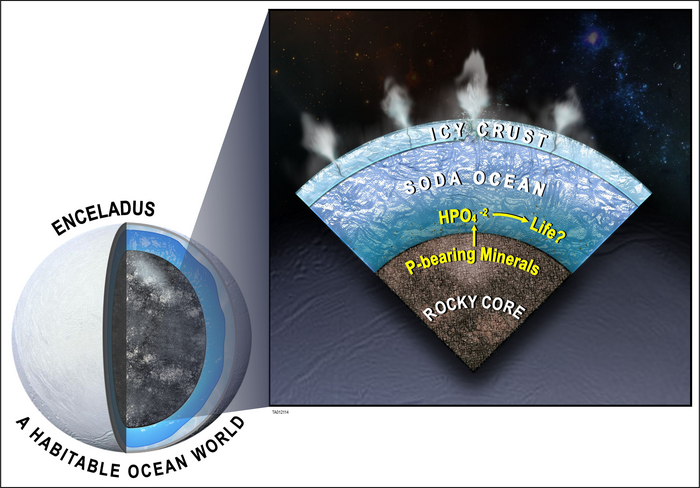
Credit: Southwest Research Institute
SAN ANTONIO — Sept. 19, 2022 — The search for extraterrestrial life just got more interesting as a team of scientists including Southwest Research Institute’s Dr. Christopher Glein has discovered new evidence for a key building block for life in the subsurface ocean of Saturn’s moon Enceladus. New modeling indicates that Enceladus’s ocean should be relatively rich in dissolved phosphorus, an essential ingredient for life.
“Enceladus is one of the prime targets in humanity’s search for life in our solar system,” said Glein, a leading expert in extraterrestrial oceanography. He is a co-author of a paper in the Proceedings of the National Academy of Sciences (PNAS) describing this research. “In the years since NASA’s Cassini spacecraft visited the Saturn system, we have been repeatedly blown away by the discoveries made possible by the collected data.”
The Cassini spacecraft discovered Enceladus’s subsurface liquid water and analyzed samples as plumes of ice grains and water vapor erupted into space from cracks in the moon’s icy surface.
“What we have learned is that the plume contains almost all the basic requirements of life as we know it,” Glein said. “While the bioessential element phosphorus has yet to be identified directly, our team discovered evidence for its availability in the ocean beneath the moon’s icy crust.”
One of the most profound discoveries in planetary science over the past 25 years is that worlds with oceans beneath a surface layer of ice are common in our solar system. Such worlds include the icy satellites of the giant planets, such as Europa, Titan and Enceladus, as well as more distant bodies like Pluto. Worlds like Earth with surface oceans must reside within a narrow range of distances from their host stars to maintain the temperatures that support surface liquid water. Interior water ocean worlds, however, can occur over a much wider range of distances, greatly expanding the number of habitable worlds likely to exist across the galaxy.
“The quest for extraterrestrial habitability in the solar system has shifted focus, as we now look for the building blocks for life, including organic molecules, ammonia, sulfur-bearing compounds as well as the chemical energy needed to support life,” Glein said. “Phosphorus presents an interesting case because previous work suggested that it might be scarce in the ocean of Enceladus, which would dim the prospects for life.”
Phosphorus in the form of phosphates is vital for all life on Earth. It is essential for the creation of DNA and RNA, energy-carrying molecules, cell membranes, bones and teeth in people and animals, and even the sea’s microbiome of plankton.
Team members performed thermodynamic and kinetic modeling that simulates the geochemistry of phosphorus based on insights from Cassini about the ocean-seafloor system on Enceladus. In the course of their research, they developed the most detailed geochemical model to date of how seafloor minerals dissolve into Enceladus’s ocean and predicted that phosphate minerals would be unusually soluble there.
“The underlying geochemistry has an elegant simplicity that makes the presence of dissolved phosphorus inevitable, reaching levels close to or even higher than those in modern Earth seawater,” Glein said. “What this means for astrobiology is that we can be more confident than before that the ocean of Enceladus is habitable.”
According to Glein, the next step is clear: “We need to get back to Enceladus to see if a habitable ocean is actually inhabited.”
The paper “Abundant phosphorus expected for possible life in Enceladus’s ocean” appears in PNAS, a peer-reviewed journal of the National Academy of Sciences (NAS).
For more information, see paper at https://doi.org/10.1073/pnas.2201388119.
Journal
Proceedings of the National Academy of Sciences
DOI
10.1073/pnas.2201388119
Method of Research
Computational simulation/modeling
Subject of Research
Not applicable
Article Title
“Abundant phosphorus expected for possible life in Enceladus’s ocean”
Article Publication Date
19-Sep-2022