Tsukuba, Japan—A new device has been fabricated that can demonstrate the quantum anomalous Hall effect, in which tiny, discrete voltage steps are generated by an external magnetic field. This work may enable extremely low-power electronics, as well as future quantum computers.
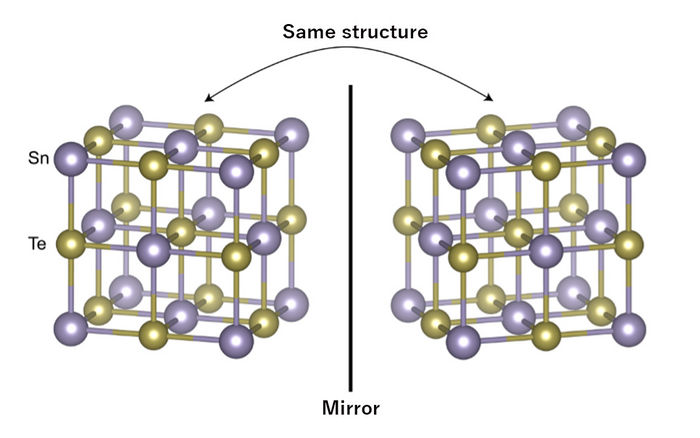
Credit: University of Tsukuba
Tsukuba, Japan—A new device has been fabricated that can demonstrate the quantum anomalous Hall effect, in which tiny, discrete voltage steps are generated by an external magnetic field. This work may enable extremely low-power electronics, as well as future quantum computers.
If you take an ordinary wire with electrical current running through it, you can create a new electrical voltage perpendicular to the flow of current by applying an external magnetic field. This so-called Hall effect has been used as part of a simple magnetic sensor, but the sensitivity can be low. There is a corresponding quantum version, called the quantum anomalous Hall effect that comes in defined increments, or quanta. This has raised the possibility of using the quantum anomalous Hall effect for the purpose of constructing new highly conductive wires or even quantum computers. However, the physics that leads to this phenomenon is still not completely understood.
Now, a team of researchers led by the Institute of Materials Science at the University of Tsukuba have used a topological insulator material, in which current flows at the interfaces but not through the bulk, to induce a quantum anomalous Hall effect. By using a ferromagnetic material, iron, as the top layer of the device, the magnetic proximity effect can produce magnetic ordering without introducing disorder that would be caused by an alternative method of doping with magnetic impurities. “Current produced by the quantum anomalous Hall effect can travel along the interface of a layer without dissipation, which might be utilized in novel energy-saving devices” says Professor Kuroda Shinji.
To manufacture the device, a thin film of a single-crystal heterostructure consisting of an iron layer on top of tin telluride was grown on a template using molecular beam epitaxy. The researchers measured the magnetization of the surface using neutrons, which have a magnetic moment but no electrical charge. They found that the ferromagnetic order penetrates about two nanometers into the tin telluride layer from the interface with iron and can exist even at room temperature. “Our research points the way towards a means for realizing next-generation spintronics and quantum computational devices,” Professor Kuroda says. These applications may require layers that exhibit the quantum anomalous Hall effect, which this research has shown is possible and can be easily produced.
###
This work was partially supported by a Grant-in-Aid for Scientific Research 16H02108, 18H01857, and 20H02616, a Grant-in-Aid for Young Scientists 26870086, a Grant-in-Aid for Challenging Exploratory Research 18K18732, and Innovative Areas “Topological Materials Science” 16H00983 and 15K21717, from Japan Society for the Promotion of Science.
Original Paper
The work is published in The Journal of Physical Chemistry Letters as “Direct Probe of the Ferromagnetic Proximity Effect at the Interface of SnTe/Fe Heterostructure by Polarized Neutron Reflectometry” (DOI:10.1021/acs.jpclett.2c01478).
Correspondence
Professor KURODA Shinji
Faculty of Pure and Applied Sciences, University of Tsukuba
Related Link
Faculty of Pure and Applied Sciences
DOI
10.1021/acs.jpclett.2c01478
Article Title
Direct Probe of the Ferromagnetic Proximity Effect at the Interface of SnTe/Fe Heterostructure by Polarized Neutron Reflectometry
Article Publication Date
28-Aug-2022