Tokyo, Japan – Researchers from Tokyo Metropolitan University have discovered that a protein excreted by type I (slow) muscle fibers, key to muscle endurance, can cause surrounding myoblasts, precursors to muscle cells, to differentiate into type I fibers. This upturns prevailing wisdom which says our fast/slow fiber ratio can’t be significantly changed. They also identified the chemical pathway by which the protein affects differentiation. Such findings may one day lead to therapies to control slow muscle health.
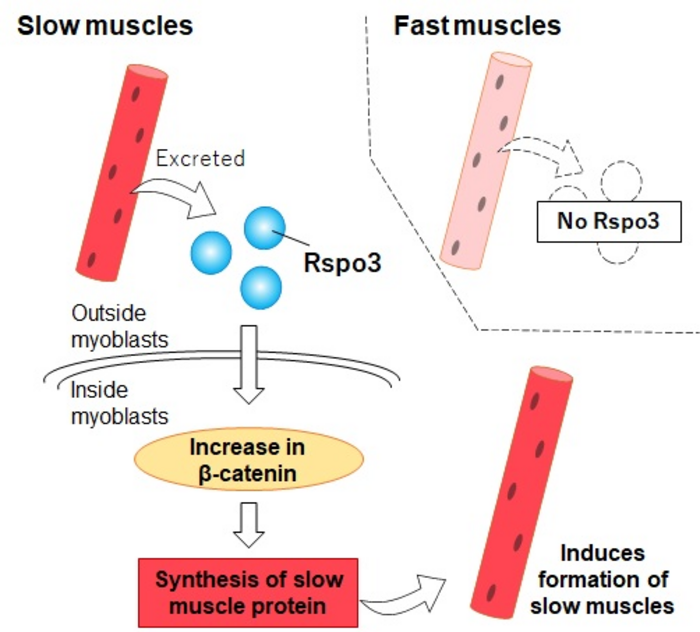
Credit: Tokyo Metropolitan University
Tokyo, Japan – Researchers from Tokyo Metropolitan University have discovered that a protein excreted by type I (slow) muscle fibers, key to muscle endurance, can cause surrounding myoblasts, precursors to muscle cells, to differentiate into type I fibers. This upturns prevailing wisdom which says our fast/slow fiber ratio can’t be significantly changed. They also identified the chemical pathway by which the protein affects differentiation. Such findings may one day lead to therapies to control slow muscle health.
Skeletal muscle tissue is made up of hundreds of thousands of fibers which contract on command. However, they are not all the same. There are “slow” type I muscle fibers, important for endurance exercise, and “fast” type II fibers which can respond much more quickly but for shorter periods of time. Type I fibers might be likened to marathon runners, while type II fibers might be called sprinters. For a long time, the prevailing wisdom has been that the ratio of type I to type II fibers in our muscles is largely determined at birth.
But scientists are beginning to find that this is not the case. A team of researchers from Tokyo Metropolitan University led by Professor Nobuharu Fujii have now discovered that a protein excreted by type I muscle known as R-spondin3 (Rspo3) may hold the key to the development of new type I fibers. When myoblasts, precursors to muscle cells, were treated with Rspo3, they began to produce significantly higher amounts of Myosin Heavy Chain I (MyHC I), a protein produced by type I muscle. The effect seemed to be unique to myoblasts in early stages of their development. This means that type I fibers actively induce the formation of more type I fibers in their vicinity, excreting Rspo3 and acting on the differentiation of nearby cells. The finding sheds new light on the role of muscles in our bodies and upturns conventional wisdom which says that the ratio of type I to type II fibers can’t be changed. The team were also able to show that this happened via a specific cascade of chemical reactions known as the Wnt/beta-catenin pathway, responsible for the necessary accumulation of beta-catenin inside cells. Experiments to artificially reduce the amount of beta-catenin in cells, for example, led to suppression of increased MyHC I expression.
Type 2 diabetes and lack of exercise are two of many reasons why slow muscle fibers may atrophy. The team’s findings suggest that it is actually possible to specifically encourage the development of type I fibers through therapeutic means. For example, Rspo3 may be used directly as a treatment, or used to differentiate muscle cells taken from a patient before the tissue is replanted. If cells can excrete Rspo3 and affect surrounding cells, the benefits will be more than just the mass that is reintroduced. Such insights promise exciting new possibilities for treatments to improve muscular function, a key challenge for aging populations and society.
This work was supported by Japan Society for the Promotion of Science Grants-in-Aid for Scientific Research (JSPS KAKENHI Grant Numbers 20J12849, 15K16489, 24700700, 26242068), a Japan Science and Technology Agency grant for Fusion Oriented Research for Disruptive Science and Technology (JST FOREST Program no. JPMJFR205K), Sumitomo Pharma Co., Ltd. through the Partnership to Realize Innovative Seeds and Medicines, and Tokyo Metropolitan University strategic research fund for innovative research project.
Journal
Scientific Reports
DOI
10.1038/s41598-022-16640-2
Article Title
R‑spondin3 is a myokine that differentiates myoblasts to type I fibres
Article Publication Date
29-Jul-2022