An international research team including astronomers at the University of Birmingham, has just announced the discovery of two “super-Earth” planets orbiting LP 890-9, a small, cool star located about 100 light-years from Earth.
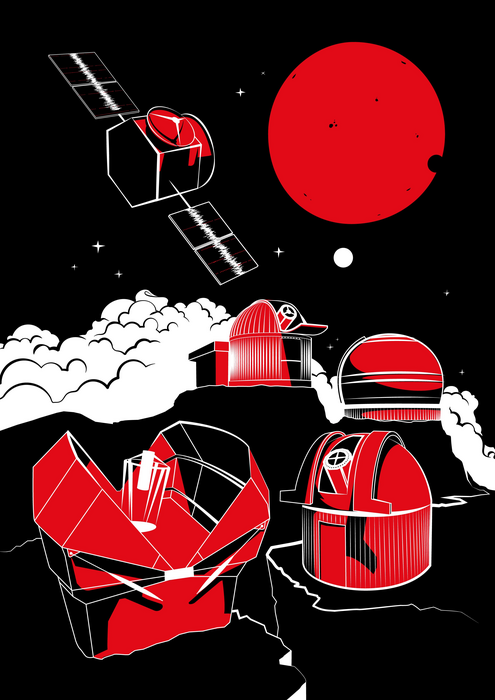
Credit: Credit: University of Birmingham / Amanda J. Smith
An international research team including astronomers at the University of Birmingham, has just announced the discovery of two “super-Earth” planets orbiting LP 890-9, a small, cool star located about 100 light-years from Earth.
The star, also called TOI-4306 or SPECULOOS-2, is the second-coolest star found to host planets, after the famous TRAPPIST-1. This rare discovery is the subject of a forthcoming publication in the journal Astronomy & Astrophysics.
The system’s inner planet, called LP 890-9b, is about 30% larger than Earth and completes an orbit around the star in just 2.7 days. This first planet was initially identified as a possible planet candidate by NASA’s Transiting Exoplanet Survey Satellite (TESS), a space mission searching for exoplanets orbiting nearby stars. This candidate was confirmed and characterized by the SPECULOOS telescopes (Search for habitable Planets EClipsing ULtra-cOOl Stars), one of which is operated by the University of Birmingham. SPECULOOS researchers then used their telescopes to seek additional transiting planets in the system that would have been missed by TESS.
“TESS searches for exoplanets using the transit method, by monitoring the brightness of thousands of stars simultaneously, looking for slight dimmings that might be caused by planets passing in front of their stars,” explains Laetitia Delrez, a postdoctoral researcher at the University of Liège, and the lead author of the article.
“However, a follow-up with ground-based telescopes is often necessary to confirm the planetary nature of the detected candidates and to refine the measurements of their sizes and orbital properties.”
This follow-up is particularly important in the case of very cold stars, such as LP 890-9, which emit most of their light in the near-infrared and for which TESS has a rather limited sensitivity.
The telescopes of the SPECULOOS project, installed at ESO’s Paranal Observatory in Chile and on the island of Tenerife, are optimised to observe this type of star with high precision, thanks to cameras that are very sensitive in the near-infrared.
“The goal of SPECULOOS is to search for potentially habitable terrestrial planets transiting some of the smallest and coolest stars in the solar neighbourhood, such as the TRAPPIST-1 planetary system, which we discovered in 2016”, recalls Michaël Gillon, from the University of Liège, and the principal investigator of the SPECULOOS project. “This strategy is motivated by the fact that such planets are particularly well suited to detailed studies of their atmospheres and to the search for possible chemical traces of life with large observatories, such as the James Webb Space Telescope (JWST).”
The observations of LP 890-9 gathered by SPECULOOS proved fruitful as they not only confirmed the first planet, but they were critical for the detection of a second, previously unknown planet. This second planet, LP 890-9c (renamed SPECULOOS-2c by the SPECULOOS researchers), is similar in size to the first (about 40% larger than Earth) but has a longer orbital period of about 8.5 days. This orbital period, later confirmed with the MuSCAT3 instrument in Hawaii, places the planet in the so-called “habitable zone” around its star.
“The habitable zone is a concept under which a planet with similar geological and atmospheric conditions as Earth, would have a surface temperature allowing water to remain liquid for billions of years” explains Amaury Triaud, a professor of Exoplanetology at University Birmingham and the leader of the SPECULOOS working group that scheduled the observations leading to the discovery of the second planet. “This gives us a license to observe more and find out whether the planet has an atmosphere, and if so, to study its content and assess its habitability.”
The next step will be to study the atmosphere of this planet, for example with the JWST, for which LP 890-9c appears to be the second-most favourable target among the potentially habitable terrestrial planets known so far, surpassed only by the TRAPPIST-1 planets (for which Professor Triaud was also co-discoverer).
“It is important to detect as many temperate terrestrial worlds as possible to study the diversity of exoplanet climates, and eventually to be in a position to measure how frequently biology has emerged in the Cosmos,” added Professor Triaud.
Journal
Astronomy and Astrophysics
DOI
10.1051/0004-6361/202244041
Method of Research
Observational study
Subject of Research
Not applicable
Article Title
Two temperate super-Earths transiting a nearby late-type M dwarf
Article Publication Date
7-Sep-2022