Saffron is the world’s most expensive spice. Usually obtained from the stigma of Crocus sativa flowers, it takes 150,000–200,000 flowers to produce one kilogram of saffron. Now, KAUST researchers have found a way to use a common garden plant to produce saffron’s active ingredient, a compound with important therapeutic and food industry applications.
Credit: © 2022 KAUST.
Saffron is the world’s most expensive spice. Usually obtained from the stigma of Crocus sativa flowers, it takes 150,000–200,000 flowers to produce one kilogram of saffron. Now, KAUST researchers have found a way to use a common garden plant to produce saffron’s active ingredient, a compound with important therapeutic and food industry applications.
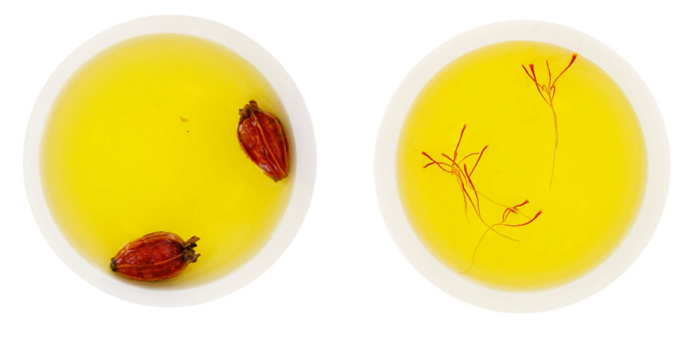
The color of saffron comes from crocins: water-soluble pigments derived from carotenoids by a process that is catalyzed by enzymes known as carotenoid cleavage dioxygenases (CCDs). Crocins also occur, albeit in much lower amounts, in the fruits of Gardenia jasminoides, an ornamental plant used in traditional Chinese medicine.
Crocins have high therapeutic potential, including their role in protecting neural cells from degradation, as well as their antidepressant, sedative and antioxidant properties. They also have an important role as natural food colorants.
Harvesting and processing hand-picked stigmas of saffron is very labor intensive. Moreover, saffron is only grown in limited areas of the Mediterranean and Asia. So, new biotechnological approaches to produce these compounds in large amounts are in great demand.
KAUST researchers identified a highly efficient carotenoid cleavage dioxygenase enzyme from Gardenia jasminoides that produces the crocin precursor crocetin dialdehyde. They have now established a system for investigating CCD enzymatic activity in plants and developed a multigene engineering approach for sustainable biotechnological production of crocins in plant tissues.
“The enzyme we have identified and the multigene engineering strategy could be used to establish a sustainable plant cell factory for crocin production in tissue culture of different plant species,” says lead author of the study Xiongie Zheng.
“Our biotechnological approach can also be used on crops, such as rice, to develop crocin-rich functional food.”
Team leader Salim Al-Babili says the study paves the way for efficient biotechnological production of crocins and other high-value compounds derived from carotenoids (apocarotenoids) as pharmaceuticals in green tissues as well as other starch-rich plant organs. It also highlights the contribution of functional diversification among CCD genes to the independent evolution of alternative apocarotenoid biosynthesis routes in different plants.
“Most of our knowledge about CCD enzymatic activity and substrate specificity comes from experiments using E.coli engineered to produce different carotenoids,” he says.
“Functional characterization in plants, for example by using a transgenic approach such as we have here, is important for deducing the role of CCDs in carotenoid metabolism and unravelling their real contribution to the carotenoid/apocarotenoid pattern.”
The platform technology could be used to produce other important carotenoid-derived compounds, including widely used scents and colorants.
“It could be used to produce safranal and picrocrocin, for example, which give rise to the taste and characteristic aroma of saffron. These could be used as flavor additives and they also have a bioactive potential awaiting exploration,” adds Zheng.
Journal
Plant Biotechnology Journal
DOI
10.1111/pbi.13901
Article Title
Gardenia carotenoid cleavage dioxygenase 4a is an efficient tool for biotechnological production of crocins in green and non-green plant tissues
Article Publication Date
29-Jul-2022