A University of Massachusetts Amherst psychologist will use a newly awarded, two-year, $428,000 grant from the National Institutes of Health (NIH) to further develop and test mobile health devices worn by parents and young children that track – and perhaps can help predict – preschoolers’ tantrums.
Credit: UMass Amherst
A University of Massachusetts Amherst psychologist will use a newly awarded, two-year, $428,000 grant from the National Institutes of Health (NIH) to further develop and test mobile health devices worn by parents and young children that track – and perhaps can help predict – preschoolers’ tantrums.
The technology may also one day be able to identify “clinically significant tantrums,” assessing kids at high risk for mental illness, says Adam Grabell, assistant professor of psychological and brain sciences, who studies early childhood development in his Self-regulation, Emotions and Early Development (SEED) Lab.
“All preschool kids have tantrums, so it’s hard to find that line – is this normative behavior or is this a sign of a kid who’s at risk for a future anxiety disorder or mood disorder or conduct disorder?” Grabell says. “We hope to use the power of mobile health and wearable technology to give parents really critical information – earlier – about their child’s risk level for psychological disorders that might change the parent’s decision-making and change the approach of their pediatrician or other providers.”
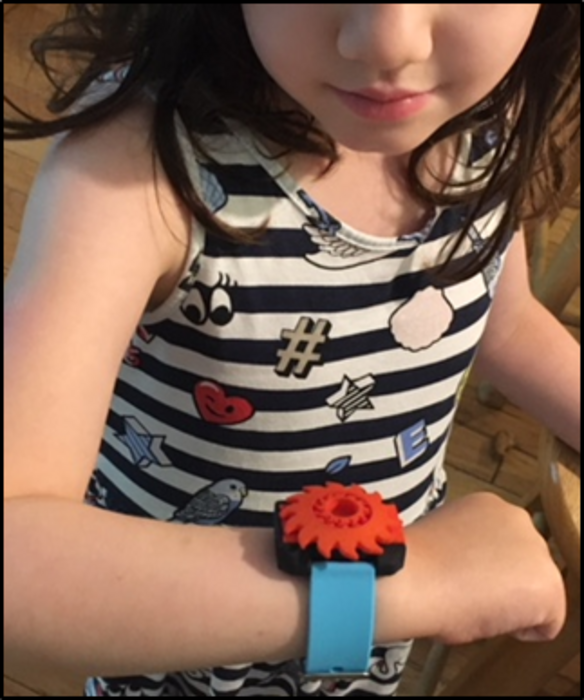
Grabell and wearable computing experts Jeremy Gummeson, assistant professor of electrical and computer engineering in the Manning College of Information and Computer Sciences, and Tauhidur Rahman, formerly of UMass Amherst who has joined the University of California San Diego, carried out a pilot study with a half-dozen families. The research was funded by a seed grant from the UMass Amherst Institute for Applied Life Sciences’ (IALS) Center for Personalized Health Monitoring. The team used a 3-D printer to create wristbands that housed an accelerometer and developed a smartwatch tracking app. They also used Spire Health sensing tags that stick to the inside of clothes to measure the respiration, heart rate and sleep of both young kids, ages 3-5, and their parents.
“The parents are a huge source of data for the problem we’re trying to address,” Grabell says. “Tantrums don’t happen in a vacuum. Parents have conflicts with their children. Their emotions are in sync together and they can ratchet each other up or calm each other down.”
The initial feasibility study confirmed that the devices could be worn for long periods and could produce important information. “The pilot data from this seed grant suggested this approach could work in the real world,” Grabell says.
Now, funded by the NIH grant, the team will expand their research, recruiting 60 preschool-caregiver pairs – with half of the children having clinically significant irritability – in an effort to create an automated home-based system that will be able to distinguish naturally occurring tantrums from psychopathology.
“We will deploy wearable and contactless devices that record continuous respiration, heart rate, actigraphy (gross motor activity), sleep and vocal features in the homes of preschoolers and caregivers for one month,” the study aims state. “Our core hypotheses are that tantrum timing and bio-behavioral characteristics in child and caregiver will identify risk for mental disorder and identify a precursor phase to tantrums.”
The home-based system ultimately could be used to help families already in therapy, providing information on when tantrums are likely to happen so that home-based interventions can be more timely and effective.
Grabell hopes the research will lead to major breakthroughs in the early diagnosis of mental illness. The sooner a young child’s mental condition can be identified, the better the potential outcome.
“For those kids who are in the high-risk category, you’re losing valuable time when you could have started an intervention to try to improve their emotion regulation skills,” he says.