• HOME
  • NEWS
  • EXPLORE
    • CAREER
      • Companies
      • Jobs
    • EVENTS
    • iGEM
      • News
      • Team
    • PHOTOS
    • VIDEO
    • WIKI
  • BLOG
  • COMMUNITY
    • FACEBOOK
    • INSTAGRAM
    • TWITTER
Saturday, February 7, 2026
BIOENGINEER.ORG
No Result
View All Result
  • Login
  • HOME
  • NEWS
  • EXPLORE
    • CAREER
      • Companies
      • Jobs
        • Lecturer
        • PhD Studentship
        • Postdoc
        • Research Assistant
    • EVENTS
    • iGEM
      • News
      • Team
    • PHOTOS
    • VIDEO
    • WIKI
  • BLOG
  • COMMUNITY
    • FACEBOOK
    • INSTAGRAM
    • TWITTER
  • HOME
  • NEWS
  • EXPLORE
    • CAREER
      • Companies
      • Jobs
        • Lecturer
        • PhD Studentship
        • Postdoc
        • Research Assistant
    • EVENTS
    • iGEM
      • News
      • Team
    • PHOTOS
    • VIDEO
    • WIKI
  • BLOG
  • COMMUNITY
    • FACEBOOK
    • INSTAGRAM
    • TWITTER
No Result
View All Result
Bioengineer.org
No Result
View All Result
Home NEWS Science News Chemistry

Understanding outsize role of nanopores

Bioengineer by Bioengineer
August 25, 2022
in Chemistry
Reading Time: 2 mins read
0
Transport in nanopores
Share on FacebookShare on TwitterShare on LinkedinShare on RedditShare on Telegram

There is an entire aqueous universe hidden within the tiny pores of many natural and engineered materials. Research from the McKelvey School of Engineering at Washington University in St. Louis has shown that when such materials are submerged in liquid, the chemistry inside the tiny pores — known as nanopores — can differ critically from that in the bulk solution.
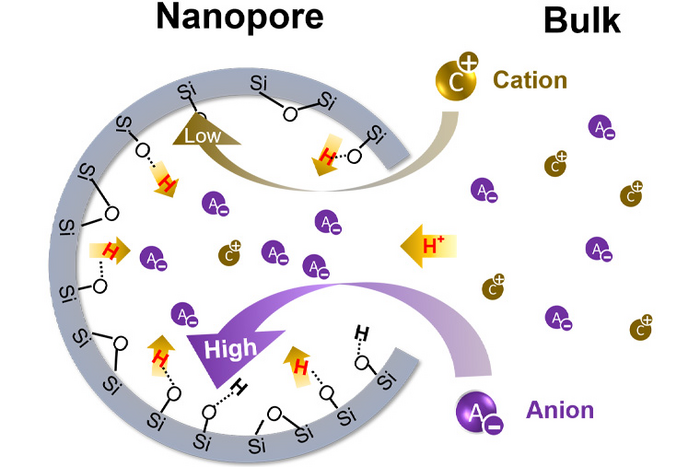
Transport in nanopores

Credit: Jun Lab

There is an entire aqueous universe hidden within the tiny pores of many natural and engineered materials. Research from the McKelvey School of Engineering at Washington University in St. Louis has shown that when such materials are submerged in liquid, the chemistry inside the tiny pores — known as nanopores — can differ critically from that in the bulk solution.

In fact, in higher-salinity solutions, the pH inside of nanopores can be as much as 100 times more acidic than in the bulk solution.

The research findings were published Aug. 22 in the journal CHEM.

A better understanding of nanopores can have important consequences for a variety of engineering processes. Think, for example, of clean-water generation using membrane processes; decarbonization technologies for energy systems, including carbon capture and sequestration; hydrogen production and storage; and batteries.

Young-Shin Jun, a professor of energy, environmental and chemical engineering, and Srikanth Singamaneni, the Lilyan & E. Lisle Hughes Professor in the Department of Mechanical Engineering & Materials Science, wanted to understand how pH — the measure of how acidic or basic a liquid is —in nanopores differed from that of the bulk liquid solution they are submerged in.

“pH is a ‘master variable’ for water chemistry,” Jun said. “When it is measured in practice, people are really measuring the pH of the bulk solution, not the pH inside the material’s nanopores.

“And if they are different, that is a big deal because the information about the little tiny space will change the entire prediction in the system.”

Read more on the engineering website.


Journal

Chem

DOI

10.1016/j.chempr.2022.07.021

Method of Research

Experimental study

Subject of Research

Not applicable

Article Title

Ionic Surface Propensity Controls pH in Nanopores

Article Publication Date

22-Aug-2022

Share12Tweet8Share2ShareShareShare2

Related Posts

blank

Breakthrough in Environmental Cleanup: Scientists Develop Solar-Activated Biochar for Faster Remediation

February 7, 2026
blank

Cutting Costs: Making Hydrogen Fuel Cells More Affordable

February 6, 2026

Scientists Develop Hand-Held “Levitating” Time Crystals

February 6, 2026

Observing a Key Green-Energy Catalyst Dissolve Atom by Atom

February 6, 2026

POPULAR NEWS

  • Robotic Ureteral Reconstruction: A Novel Approach

    Robotic Ureteral Reconstruction: A Novel Approach

    82 shares
    Share 33 Tweet 21
  • Digital Privacy: Health Data Control in Incarceration

    63 shares
    Share 25 Tweet 16
  • Study Reveals Lipid Accumulation in ME/CFS Cells

    57 shares
    Share 23 Tweet 14
  • Breakthrough in RNA Research Accelerates Medical Innovations Timeline

    53 shares
    Share 21 Tweet 13

About

We bring you the latest biotechnology news from best research centers and universities around the world. Check our website.

Follow us

Recent News

Evaluating Pediatric Emergency Care Quality in Ethiopia

TPMT Expression Predictions Linked to Azathioprine Side Effects

Improving Dementia Care with Enhanced Activity Kits

Subscribe to Blog via Email

Success! An email was just sent to confirm your subscription. Please find the email now and click 'Confirm' to start subscribing.

Join 73 other subscribers
  • Contact Us

Bioengineer.org © Copyright 2023 All Rights Reserved.

Welcome Back!

Login to your account below

Forgotten Password?

Retrieve your password

Please enter your username or email address to reset your password.

Log In
No Result
View All Result
  • Homepages
    • Home Page 1
    • Home Page 2
  • News
  • National
  • Business
  • Health
  • Lifestyle
  • Science

Bioengineer.org © Copyright 2023 All Rights Reserved.