Before Hurricane Katrina hit New Orleans in 2005, evacuation planners rarely considered the needs of carless and vulnerable populations – low-income, elderly, or young individuals with specific needs or tourists without a car while on vacation. In the aftermath of the storm, transportation planners called for a new focus on evacuation planning to meet these specific needs.
Credit: Florida Atlantic University
Before Hurricane Katrina hit New Orleans in 2005, evacuation planners rarely considered the needs of carless and vulnerable populations – low-income, elderly, or young individuals with specific needs or tourists without a car while on vacation. In the aftermath of the storm, transportation planners called for a new focus on evacuation planning to meet these specific needs.
So what has America learned since Hurricane Katrina? Not enough, according to a first-of-its-kind study by Florida Atlantic University, which reveals only marginal improvements with respect to evacuation planning in America’s 50 largest cities. Researchers found a lack of preparedness, specifically to evacuate carless and vulnerable populations.
The study is based on data extracted from plans, collected and analyzed from the years after Hurricane Katrina and then more recently during the mid-20 teens (prior to the onset of the COVID-19 pandemic). Researchers also introduce an Evacuation Preparedness Rating of five dimensions identified as best practices in evacuation planning for vulnerable populations: special needs registries; specialized transportation plans for individuals with specific needs; pick-up location plan; multimodal evacuation plan; and pedestrian evacuation plan.
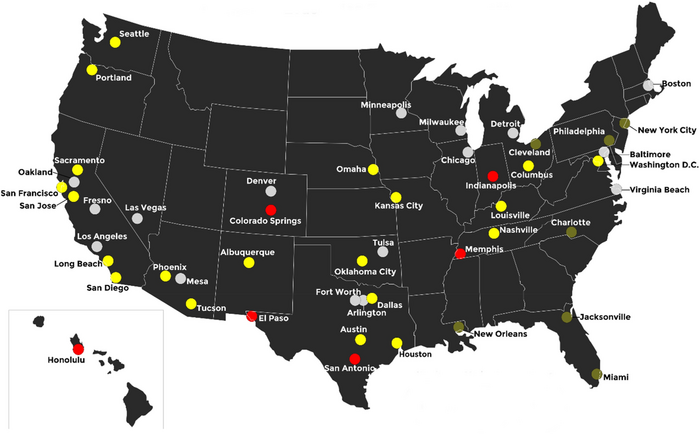
The 50 cities were scored based on the Composite Evacuation Preparedness Rating System that includes four designations: weak, 0–4 points; moderate, 5–7 points; strong, 8–10 points; and N/A, plans that were not reviewed.
Results of the study, published in the International Journal of Disaster Risk Reduction, showed that only seven cities had strong plans, including Charlotte, North Carolina; Cleveland; Jacksonville; Miami; New Orleans; New York; and Philadelphia. The researchers note that these plans should be utilized as a model for other cities. Twenty cities achieved a moderate rating, six cities had a weak rating and 17 plans were not available or do not exist. Among the cities with plans not found include Atlanta, Chicago, Detroit, Las Vegas, Los Angeles and Minneapolis.
“While it is promising that more cities are developing evacuation plans, overall, it remains disheartening that not every city was able to learn the lessons of not being prepared, especially for carless and vulnerable populations, as showcased to the nation during the aftermath of Hurricane Katrina in 2005,” said John L. Renne, Ph.D., senior author and professor and director, Center for Urban & Environmental Solutions (CUES) in FAU’s Charles E. Schmidt College of Science, who conducted the study with co-author Estefania Mayorga, a graduate of the master’s program in Urban and Regional Planning at FAU who assisted Renne on this project as part of her graduate research assistantship as a student.
The overall goal of this study was to develop a way to compare plans, across cities and over time, to work toward standardizing an approach for evaluating evacuation plans for carless and vulnerable populations across the U.S.
The Evacuation Preparedness Rating System served as a tool to allow consistent and uniform rating to test for minimum standards in all cities across the nation. Moreover, the tracking of plans over time illuminates which cities are improving and allows for a national snapshot that creates more accountability to highlight which cities are prepared and which are not.
“In answer to the question we posed in our paper, ‘what has America learned since Hurricane Katrina?’ – the answer based on our findings is clearly: NOT ENOUGH,” said Renne. “Many cities that have strong plans, including Jacksonville, Miami, New Orleans, and New York are coastal cities that have experienced strong hurricanes in the past. This study lends support to the theory that cities do not develop strong evacuation plans, ones that accommodate the needs of all people, unless they have already experienced a major disaster or are under a threat.”
– FAU –
About Florida Atlantic University:
Florida Atlantic University, established in 1961, officially opened its doors in 1964 as the fifth public university in Florida. Today, the University serves more than 30,000 undergraduate and graduate students across six campuses located along the southeast Florida coast. In recent years, the University has doubled its research expenditures and outpaced its peers in student achievement rates. Through the coexistence of access and excellence, FAU embodies an innovative model where traditional achievement gaps vanish. FAU is designated a Hispanic-serving institution, ranked as a top public university by U.S. News & World Report and a High Research Activity institution by the Carnegie Foundation for the Advancement of Teaching. For more information, visit www.fau.edu.
Journal
International Journal of Disaster Risk Reduction
DOI
10.1016/j.ijdrr.2022.103226
Method of Research
Systematic review
Subject of Research
People
Article Title
What has America learned Since Hurricane Katrina? Evaluating evacuation plans for carless and vulnerable populations in 50 large cities across the United States
Article Publication Date
1-Oct-2022