

• HOME
  • NEWS
  • EXPLORE
    • CAREER
      • Companies
      • Jobs
    • EVENTS
    • iGEM
      • News
      • Team
    • PHOTOS
    • VIDEO
    • WIKI
  • BLOG
  • COMMUNITY
    • FACEBOOK
    • INSTAGRAM
    • TWITTER
Saturday, February 7, 2026
BIOENGINEER.ORG
No Result
View All Result
  • Login
  • HOME
  • NEWS
  • EXPLORE
    • CAREER
      • Companies
      • Jobs
        • Lecturer
        • PhD Studentship
        • Postdoc
        • Research Assistant
    • EVENTS
    • iGEM
      • News
      • Team
    • PHOTOS
    • VIDEO
    • WIKI
  • BLOG
  • COMMUNITY
    • FACEBOOK
    • INSTAGRAM
    • TWITTER
  • HOME
  • NEWS
  • EXPLORE
    • CAREER
      • Companies
      • Jobs
        • Lecturer
        • PhD Studentship
        • Postdoc
        • Research Assistant
    • EVENTS
    • iGEM
      • News
      • Team
    • PHOTOS
    • VIDEO
    • WIKI
  • BLOG
  • COMMUNITY
    • FACEBOOK
    • INSTAGRAM
    • TWITTER
No Result
View All Result
Bioengineer.org
No Result
View All Result
Home NEWS Science News Biology

The Tokyo Medical and Dental University (TMDU) team succeeded with the world’s first Mini Organ transportation to a patient with “Ulcerative Colitis (UC)”

Bioengineer by Bioengineer
August 22, 2022
in Biology
Reading Time: 3 mins read
0
Autologous intestinal organoids of ulcerative colitis patients are delivered for transplantation by GI endoscopists
Share on FacebookShare on TwitterShare on LinkedinShare on RedditShare on Telegram

Tokyo Medical and Dental University (TMDU) research team announced on July 7 that it has succeeded in the world’s first clinical transplantation of a “mini organ (also called Organoid)” into a patient with “Ulcerative Colitis (UC)”. UC causes inflammation and ulcers (sores) in your digestive tract. It can be debilitating and can sometimes lead to life-threatening complications. UC belongs to a group of conditions called “Inflammatory Bowel Disease (IBD)”. The number of patients is increasing in Japan and in the world is estimated to be about 220,000 and 5,000,000. The common treatment is to suppress inflammation with drugs, but in severe cases, the entire colon may be removed.
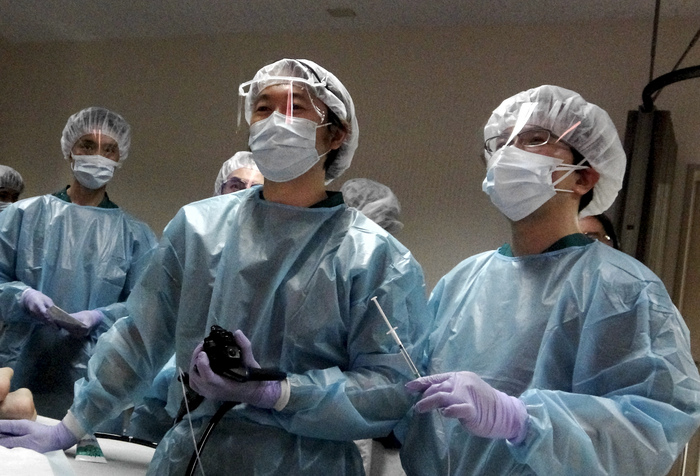
Autologous intestinal organoids of ulcerative colitis patients are delivered for transplantation by GI endoscopists

Credit: Department of Gastroenterology and Hepatology, TMDU

Tokyo Medical and Dental University (TMDU) research team announced on July 7 that it has succeeded in the world’s first clinical transplantation of a “mini organ (also called Organoid)” into a patient with “Ulcerative Colitis (UC)”. UC causes inflammation and ulcers (sores) in your digestive tract. It can be debilitating and can sometimes lead to life-threatening complications. UC belongs to a group of conditions called “Inflammatory Bowel Disease (IBD)”. The number of patients is increasing in Japan and in the world is estimated to be about 220,000 and 5,000,000. The common treatment is to suppress inflammation with drugs, but in severe cases, the entire colon may be removed.


Dr. Mamoru Watanabe, vice president and distinguished professor of Tokyo Medical & Dental University said, “If our first-in-human research using organoids transplantation yields good results, we expect that the development of organoid medicine for intractable diseases of the digestive tract such as Crohn’s disease will progress.”


Dr. Ryuichi Okamoto, a professor of the Department of Gastroenterology and Hepatology, Graduate School of Medical and Dental Sciences said, “We embarked on the path of developing new methods for treating intractable diseases. This treatment should establish the efficacy and safety as soon as possible and deliver to the patients.” If the team’s effort is successful, the mucous membrane may regenerate and lead to a radical cure of UC.


The clinical research started with collecting from the patient’s vicinity of a healthy colonic mucosa and culturing them for about one month to form spherical organoids with a diameter of about 0.1 to 0.2 mm. On July 5, an organoid was transplanted into the colon of the same patient using a colonoscopy. The patient did well and was discharged July 6.


In previous experiments using mice models, the team confirmed that the cells were cultured in organoids and then transplanted, the mucous membranes regenerated in about a month and the clinical course improved, while the stem cells alone did not transplant because they were not able to culture in vitro.


In this clinical study, since the patient’s own cells are used, there is an advantage that transplant rejection does not occur. In addition, since colonoscopy is used for collection and transplantation, there is no need for laparotomy, and the treatment can be performed in a minimally invasive method.


After this transplantation, medical examination will be conducted at the time after 4 weeks and 8 weeks. The patient will be monitored for up to a year to verify safety and efficacy. A further organoids transplantation is to be performed for up to eight patients.


Share12Tweet8Share2ShareShareShare2

Related Posts

Florida Cane Toad: Complex Spread and Selective Evolution

Florida Cane Toad: Complex Spread and Selective Evolution

February 7, 2026
New Study Uncovers Mechanism Behind Burn Pit Particulate Matter–Induced Lung Inflammation

New Study Uncovers Mechanism Behind Burn Pit Particulate Matter–Induced Lung Inflammation

February 6, 2026

DeepBlastoid: Advancing Automated and Efficient Evaluation of Human Blastoids with Deep Learning

February 6, 2026

Navigating the Gut: The Role of Formic Acid in the Microbiome

February 6, 2026

POPULAR NEWS

  • Robotic Ureteral Reconstruction: A Novel Approach

    Robotic Ureteral Reconstruction: A Novel Approach

    82 shares
    Share 33 Tweet 21
  • Digital Privacy: Health Data Control in Incarceration

    63 shares
    Share 25 Tweet 16
  • Study Reveals Lipid Accumulation in ME/CFS Cells

    57 shares
    Share 23 Tweet 14
  • Breakthrough in RNA Research Accelerates Medical Innovations Timeline

    53 shares
    Share 21 Tweet 13

About

We bring you the latest biotechnology news from best research centers and universities around the world. Check our website.

Follow us

Recent News

Evaluating Pediatric Emergency Care Quality in Ethiopia

TPMT Expression Predictions Linked to Azathioprine Side Effects

Improving Dementia Care with Enhanced Activity Kits

Subscribe to Blog via Email

Success! An email was just sent to confirm your subscription. Please find the email now and click 'Confirm' to start subscribing.

Join 73 other subscribers
  • Contact Us

Bioengineer.org © Copyright 2023 All Rights Reserved.

Welcome Back!

Login to your account below

Forgotten Password?

Retrieve your password

Please enter your username or email address to reset your password.

Log In
No Result
View All Result
  • Homepages
    • Home Page 1
    • Home Page 2
  • News
  • National
  • Business
  • Health
  • Lifestyle
  • Science

Bioengineer.org © Copyright 2023 All Rights Reserved.