• HOME
  • NEWS
  • EXPLORE
    • CAREER
      • Companies
      • Jobs
    • EVENTS
    • iGEM
      • News
      • Team
    • PHOTOS
    • VIDEO
    • WIKI
  • BLOG
  • COMMUNITY
    • FACEBOOK
    • INSTAGRAM
    • TWITTER
Saturday, February 7, 2026
BIOENGINEER.ORG
No Result
View All Result
  • Login
  • HOME
  • NEWS
  • EXPLORE
    • CAREER
      • Companies
      • Jobs
        • Lecturer
        • PhD Studentship
        • Postdoc
        • Research Assistant
    • EVENTS
    • iGEM
      • News
      • Team
    • PHOTOS
    • VIDEO
    • WIKI
  • BLOG
  • COMMUNITY
    • FACEBOOK
    • INSTAGRAM
    • TWITTER
  • HOME
  • NEWS
  • EXPLORE
    • CAREER
      • Companies
      • Jobs
        • Lecturer
        • PhD Studentship
        • Postdoc
        • Research Assistant
    • EVENTS
    • iGEM
      • News
      • Team
    • PHOTOS
    • VIDEO
    • WIKI
  • BLOG
  • COMMUNITY
    • FACEBOOK
    • INSTAGRAM
    • TWITTER
No Result
View All Result
Bioengineer.org
No Result
View All Result
Home NEWS Science News Biology

New target structure against corona

Bioengineer by Bioengineer
August 17, 2022
in Biology
Reading Time: 2 mins read
0
Cells treated against SARS-CoV-2
Share on FacebookShare on TwitterShare on LinkedinShare on RedditShare on Telegram

Fluoxetine, a common antidepressant, inhibits the SARS-CoV-2 coronavirus in cell cultures and in preparations from human lung tissue. This was demonstrated by researchers at Julius-Maximilians-Universität (JMU) Würzburg in the summer of 2020. However, the mechanism of this inhibition was utterly unclear, so the teams continued their research.
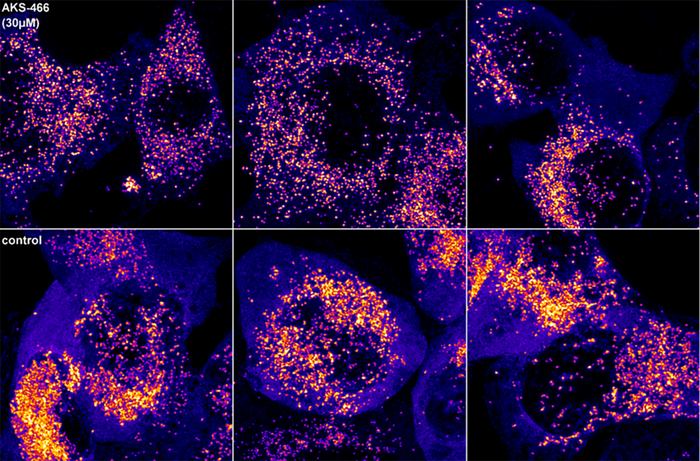
Cells treated against SARS-CoV-2

Credit: Jan Schlegel / University of Wuerzburg

Fluoxetine, a common antidepressant, inhibits the SARS-CoV-2 coronavirus in cell cultures and in preparations from human lung tissue. This was demonstrated by researchers at Julius-Maximilians-Universität (JMU) Würzburg in the summer of 2020. However, the mechanism of this inhibition was utterly unclear, so the teams continued their research.

To this end, they developed the molecule AKS466, which is very similar to fluoxetine and also suppresses coronavirus. After extensive comparative studies published in the scientific journal Cells, it is now clear how the antidepressant inhibits the replication of the coronaviruses.

Excess of ceramides inhibits the SARS-CoV-2

Fluoxetine, as well as AKS466, trap the viruses in the lysosomes of the cell. Put simply; these are small vesicles in which digestive processes take place. In the lysosomes, both active substances also suppress the activity of an enzyme group, the acid ceramidases. This increases the concentration of ceramides, a group of the body’s lipids. The excess of ceramides is ultimately responsible for preventing the SARS-CoV-2 coronavirus from reproducing.

“The enzyme ceramidase is a new, completely unexpected target structure for antiviral therapy,” says Professor Jochen Bodem from the JMU Institute of Virology and Immunobiology. His group collaborated on this project with the teams of JMU professors Jürgen Seibel (Organic Chemistry) and Markus Sauer (Biotechnology and Biophysics) intensively. The work was funded by the pharmaceutical company Novartis and the Free State of Bavaria.

Consequences for therapy research

The new findings are significant for the fight against SARS-CoV-2.

On the one hand, ceramides could be directly suitable as active agents against the virus.

On the other hand, the fluoxetine-like molecule AKS466 might be superior to the original. This is because fluoxetine inhibits the enzyme group of acid sphingomyelinases, leading to side effects when used. AKS466 does not inhibit these enzymes – it should have fewer adverse side effects.

Thus, the Würzburg researchers are showing two new ways that could lead to an improved therapy of SARS-CoV-2 infections. Next, they would like to clarify the question of how the two active substances manage to trap coronaviruses in the lysosomes.


Journal

Cells

DOI

10.3390/cells11162532

Method of Research

Experimental study

Subject of Research

Cells

Article Title

The Acid Ceramidase Is a SARS-CoV-2 Host Factor

Article Publication Date

15-Aug-2022

Share12Tweet7Share2ShareShareShare1

Related Posts

Florida Cane Toad: Complex Spread and Selective Evolution

Florida Cane Toad: Complex Spread and Selective Evolution

February 7, 2026
New Study Uncovers Mechanism Behind Burn Pit Particulate Matter–Induced Lung Inflammation

New Study Uncovers Mechanism Behind Burn Pit Particulate Matter–Induced Lung Inflammation

February 6, 2026

DeepBlastoid: Advancing Automated and Efficient Evaluation of Human Blastoids with Deep Learning

February 6, 2026

Navigating the Gut: The Role of Formic Acid in the Microbiome

February 6, 2026

POPULAR NEWS

  • Robotic Ureteral Reconstruction: A Novel Approach

    Robotic Ureteral Reconstruction: A Novel Approach

    82 shares
    Share 33 Tweet 21
  • Digital Privacy: Health Data Control in Incarceration

    63 shares
    Share 25 Tweet 16
  • Study Reveals Lipid Accumulation in ME/CFS Cells

    57 shares
    Share 23 Tweet 14
  • Breakthrough in RNA Research Accelerates Medical Innovations Timeline

    53 shares
    Share 21 Tweet 13

About

We bring you the latest biotechnology news from best research centers and universities around the world. Check our website.

Follow us

Recent News

Barriers and Boosters of Seniors’ Physical Activity in Karachi

Evaluating Pediatric Emergency Care Quality in Ethiopia

TPMT Expression Predictions Linked to Azathioprine Side Effects

Subscribe to Blog via Email

Enter your email address to subscribe to this blog and receive notifications of new posts by email.

Join 73 other subscribers
  • Contact Us

Bioengineer.org © Copyright 2023 All Rights Reserved.

Welcome Back!

Login to your account below

Forgotten Password?

Retrieve your password

Please enter your username or email address to reset your password.

Log In
No Result
View All Result
  • Homepages
    • Home Page 1
    • Home Page 2
  • News
  • National
  • Business
  • Health
  • Lifestyle
  • Science

Bioengineer.org © Copyright 2023 All Rights Reserved.