When sexual conflict results in reproductive strategies that only benefit one of the sexes, it may result in evolutionary arms races. Male spiders have evolved behavioural mating strategies to improve their chances of mating despite the risk of being cannibalised by their mates.
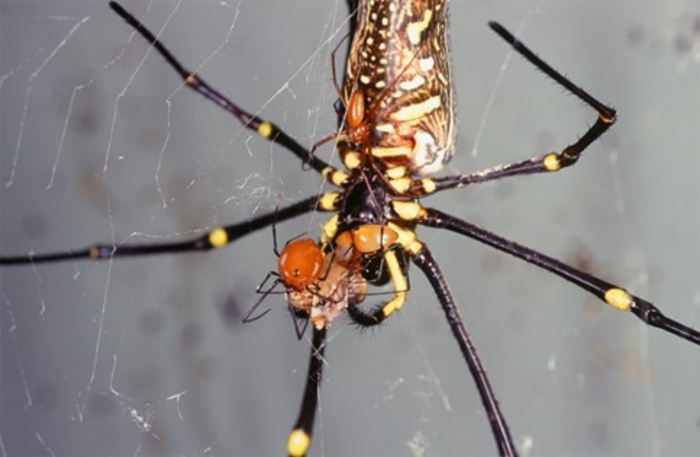
Credit: Li Daiqin
When sexual conflict results in reproductive strategies that only benefit one of the sexes, it may result in evolutionary arms races. Male spiders have evolved behavioural mating strategies to improve their chances of mating despite the risk of being cannibalised by their mates.
Researchers from the National University of Singapore (NUS) have discovered that male spiders make choices on maximising their mating success when they are at risk of being cannibalised by their female mates. Led by Associate Professor Li Daiqin from the NUS Department of Biological Sciences, the researchers found that a male chooses one of its paired sexual organs with more sperm for the first copulation with a cannibalistic female. Also, a male transfers significantly more sperm if a female is cannibalistic or when the female is of a much larger physical size.
The study was published in Communications Biology on 2 June 2022.
Increasing sperm transfer in the face of sexual cannibalism
The theory of the male mating syndrome posits that male spiders are under sexual conflict pressure in sexually cannibalistic situations, as they may only have a single chance to mate. In this study, the researchers explored whether male spiders use additional cannibalism countering strategies by focusing on two male mating tactics. One of which is the “better charged palp” hypothesis which predicts that male spiders selectively make use of one of its paired sexual organs, known as pedipalps or palps, containing more sperm for their first copulation. The other, referred to as the “fast sperm transfer” hypothesis, predicts accelerated insemination when the risk of female cannibalism is high.
The researchers performed comparative tests on five species of orb-web spiders from Singapore with varying levels of female sexual cannibalism and sexual size dimorphism. They found that male spiders choose one of the paired sexual organs with more sperm for the first copulation with a cannibalistic female. Also, a male transfers significantly more sperm if a female is cannibalistic or when the female is of a much larger physical size. Their results support both the predictions from the better charged palp and the fast sperm transfer hypotheses, providing credibility for the male mating syndrome.
The outcome also opens new research questions on the ability of a male spider to differentiate the sperm quantities between his palps and on the mechanisms involved in the palp selection after assessing his cannibalistic partner. By further studying Nephilengys malabarensis, a spider species exhibiting sexual cannibalism, the researchers have revealed that it is sperm volume detection, rather than left-right palp dominance, that plays a prominent role in the selection of the male palp.
Assoc Prof Li said, “This study sheds light on how male mating syndrome relates to the levels of sexual cannibalism and suggests that evolutionary arms races do take place, and that animal biology and diversity are importantly shaped by sexual conflict.”
Future research
The researchers are looking into future research to better understand the rationale behind male palp choice. Assuming that volume detection is the fundamental mechanism for palp selection in orb-weaving spiders, the anatomical, neuronal and hormonal aspects of male palp choice may be explored to further understand how a male spider distinguishes relatively minute differences in sperm volumes.
“The large diversity of extant spiders globally indicates that these findings may not apply to all sexually dimorphic and cannibalistic spiders. Due to sexual selection, the palpal anatomy can undergo rapid changes, such that mechanisms behind sperm transfer of various species may differ,” added Assoc Prof Li.
Journal
Communications Biology
DOI
10.1038/s42003-022-03512-8
Method of Research
Observational study
Subject of Research
Animals
Article Title
Male mating strategies to counter sexual conflict in spiders
Article Publication Date
2-Jun-2022