• HOME
  • NEWS
  • EXPLORE
    • CAREER
      • Companies
      • Jobs
    • EVENTS
    • iGEM
      • News
      • Team
    • PHOTOS
    • VIDEO
    • WIKI
  • BLOG
  • COMMUNITY
    • FACEBOOK
    • INSTAGRAM
    • TWITTER
Tuesday, May 5, 2026
BIOENGINEER.ORG
No Result
View All Result
  • Login
  • HOME
  • NEWS
  • EXPLORE
    • CAREER
      • Companies
      • Jobs
        • Lecturer
        • PhD Studentship
        • Postdoc
        • Research Assistant
    • EVENTS
    • iGEM
      • News
      • Team
    • PHOTOS
    • VIDEO
    • WIKI
  • BLOG
  • COMMUNITY
    • FACEBOOK
    • INSTAGRAM
    • TWITTER
  • HOME
  • NEWS
  • EXPLORE
    • CAREER
      • Companies
      • Jobs
        • Lecturer
        • PhD Studentship
        • Postdoc
        • Research Assistant
    • EVENTS
    • iGEM
      • News
      • Team
    • PHOTOS
    • VIDEO
    • WIKI
  • BLOG
  • COMMUNITY
    • FACEBOOK
    • INSTAGRAM
    • TWITTER
No Result
View All Result
Bioengineer.org
No Result
View All Result
Home NEWS Science News Chemistry

A simple way of sculpting matter into complex shapes

Bioengineer by Bioengineer
August 12, 2022
in Chemistry
Reading Time: 2 mins read
0
Bose-Einstein condensate
Share on FacebookShare on TwitterShare on LinkedinShare on RedditShare on Telegram

A new method for shaping matter into complex shapes, with the use of ‘twisted’ light, has been demonstrated in research at the University of Strathclyde. 
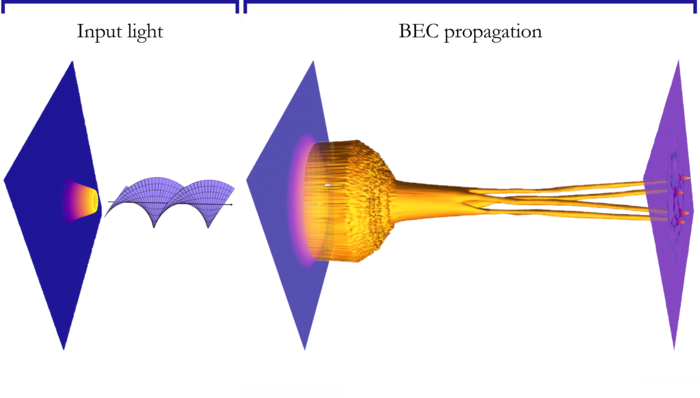
Bose-Einstein condensate

Credit: University of Strathclyde

A new method for shaping matter into complex shapes, with the use of ‘twisted’ light, has been demonstrated in research at the University of Strathclyde. 

When atoms are cooled to temperatures close to absolute zero (-273 degrees C), they stop behaving like particles and start to behave like waves.  

Atoms in this condition, which are known as Bose–Einstein condensates (BECs), are useful for purposes such as realisation of atom lasers, slow light, quantum simulations for understanding the complex behaviour of materials like superconductors and superfluids, and the precision measurement technique of atom interferometry.  

The Strathclyde study has shown that when twisted light is shone on to a moving BEC, it breaks into clusters of BEC droplets that move following the light’s features, with the number of droplets equal to twice the number of light twists. Altering the properties of the light beam can change both the number of BEC droplets and the way that they move. 

The research has been published in Physical Review Letters. 

Grant Henderson, a PhD student in Strathclyde’s Department of Physics, is lead author on the paper. He said: “By shining a laser beam on to a BEC, we can influence how it behaves. When the laser beam is ‘twisted,’ it has a helical phase profile and carries orbital angular momentum (OAM). Laser beams with OAM can trap and rotate microscopic particles, behaving like an optical spanner.  

 “This method of shining twisted light through ultracold atoms opens a new and simple way of sculpting matter into unconventional and complex shapes. It has the potential for the design of novel quantum devices such as atomtronic circuits and ultra-sensitive detectors.” 


Journal

Physical Review Letters

DOI

10.1103/PhysRevLett.129.073902

Method of Research

Experimental study

Subject of Research

Not applicable

Article Title

Control of Light-Atom Solitons and Atomic Transport by Optical Vortex Beams Propagating through a Bose-Einstein Condensate

Article Publication Date

12-Aug-2022

Share12Tweet8Share2ShareShareShare2

Related Posts

New Unified Framework Unveils Complete Hierarchy of Topological Boundary States in Floquet Crystals — Chemistry

New Unified Framework Unveils Complete Hierarchy of Topological Boundary States in Floquet Crystals

May 5, 2026
Do Icebergs Melt More Slowly When They Cluster Together? — Chemistry

Do Icebergs Melt More Slowly When They Cluster Together?

May 5, 2026

How Lasers Quickly Magnetize Fusion Plasmas: A Breakthrough in Fusion Science

May 5, 2026

CityUHK Physicist Uncovers How Magnetic Fields Reactivate Superconductivity in Nickelates

May 5, 2026

POPULAR NEWS

  • Research Indicates Potential Connection Between Prenatal Medication Exposure and Elevated Autism Risk

    835 shares
    Share 334 Tweet 209
  • New Study Reveals Plants Can Detect the Sound of Rain

    720 shares
    Share 288 Tweet 180
  • Scientists Investigate Possible Connection Between COVID-19 and Increased Lung Cancer Risk

    67 shares
    Share 27 Tweet 17
  • Salmonella Haem Blocks Macrophages, Boosts Infection

    61 shares
    Share 24 Tweet 15

About

We bring you the latest biotechnology news from best research centers and universities around the world. Check our website.

Follow us

Recent News

Gut Hormone FGF15 Influences Mice’s Response to Weight Loss

Scientists Identify Seven Distinct Pneumonia Subphenotypes Through Human Lung Analysis

Running, Weightlifting, or Both? New Study Reveals the Ideal Exercise Routine for Heart Health

Subscribe to Blog via Email

Success! An email was just sent to confirm your subscription. Please find the email now and click 'Confirm' to start subscribing.

Join 82 other subscribers
  • Contact Us

Bioengineer.org © Copyright 2023 All Rights Reserved.

Welcome Back!

Login to your account below

Forgotten Password?

Retrieve your password

Please enter your username or email address to reset your password.

Log In
No Result
View All Result
  • Homepages
    • Home Page 1
    • Home Page 2
  • News
  • National
  • Business
  • Health
  • Lifestyle
  • Science

Bioengineer.org © Copyright 2023 All Rights Reserved.