• HOME
  • NEWS
  • EXPLORE
    • CAREER
      • Companies
      • Jobs
    • EVENTS
    • iGEM
      • News
      • Team
    • PHOTOS
    • VIDEO
    • WIKI
  • BLOG
  • COMMUNITY
    • FACEBOOK
    • INSTAGRAM
    • TWITTER
Saturday, February 7, 2026
BIOENGINEER.ORG
No Result
View All Result
  • Login
  • HOME
  • NEWS
  • EXPLORE
    • CAREER
      • Companies
      • Jobs
        • Lecturer
        • PhD Studentship
        • Postdoc
        • Research Assistant
    • EVENTS
    • iGEM
      • News
      • Team
    • PHOTOS
    • VIDEO
    • WIKI
  • BLOG
  • COMMUNITY
    • FACEBOOK
    • INSTAGRAM
    • TWITTER
  • HOME
  • NEWS
  • EXPLORE
    • CAREER
      • Companies
      • Jobs
        • Lecturer
        • PhD Studentship
        • Postdoc
        • Research Assistant
    • EVENTS
    • iGEM
      • News
      • Team
    • PHOTOS
    • VIDEO
    • WIKI
  • BLOG
  • COMMUNITY
    • FACEBOOK
    • INSTAGRAM
    • TWITTER
No Result
View All Result
Bioengineer.org
No Result
View All Result
Home NEWS Science News Biology

Newly identified fossil insect used 360-degree vision and sticky feet to find and snare its meals

Bioengineer by Bioengineer
August 10, 2022
in Biology
Reading Time: 2 mins read
0
Palaeotanyrhina exophthalma
Share on FacebookShare on TwitterShare on LinkedinShare on RedditShare on Telegram

CORVALLIS, Ore. – With bulging eyes, an elongated mouth and feet that oozed resin, a fossil insect identified by Oregon State University research is so different from anything alive today that it needed to be placed in its own, extinct family.
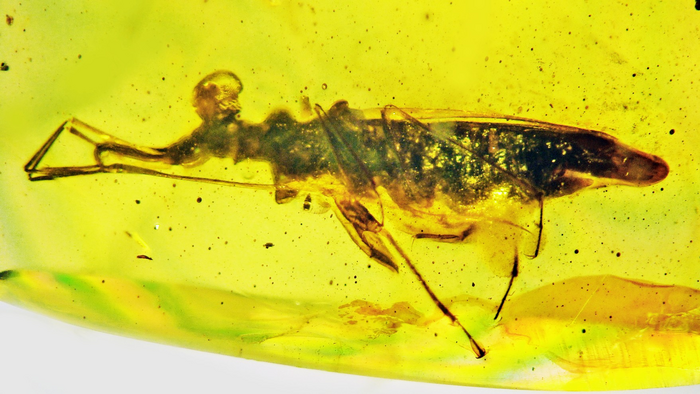
Palaeotanyrhina exophthalma

Credit: George Poinar Jr., Oregon State

CORVALLIS, Ore. – With bulging eyes, an elongated mouth and feet that oozed resin, a fossil insect identified by Oregon State University research is so different from anything alive today that it needed to be placed in its own, extinct family.

George Poinar Jr., professor emeritus in the OSU College of Science, named the insect Palaeotanyrhina exophthalma in a paper published in BioOne Complete. Encased in 100-million-year-old amber from Burma, P. exophthalma is a member of the Hemiptera order – a “true bug,” Poinar said.

“It is a small predator that used its protruding eyes to locate insect prey,” said Poinar, an international expert in using plant and animal life forms preserved in amber to learn about the biology and ecology of the distant past.

More than 80,000 species including cicadas, aphids, planthoppers, leafhoppers, bed bugs and shield bugs comprise the order of Hemiptera, an ancient Greek word meaning half-winged. True bugs’ size varies widely, from as small as 1 millimeter to as large as 15 centimeters, but they all have a similar arrangement of sucking mouthparts.

P. exophthalma has a body length of just over 5 millimeters. It shares some features with members of the Reduvoidea superfamily, which includes the assassin bug and the kissing bug, but its long labium (lower mouth), its head shape and its forewing veins disqualify it from placement in any modern Reduvoidea family, Poinar said.

Thus he assigned it to a new, extinct family: Palaeotanyrhinidae.

“Its eyes provided a clear, 360-degree view of its habitat so it could see prey that might appear from any side,” Poinar said.  

It reminded Poinar of the phrase, “Big brother is always watching you,” from George Orwell’s novel “1984” in which security cameras followed individuals’ every movement.

The other strange feature on this fossil is an extended sheath on the final leg segment of the front tarsus, he added.

 “That sheath was filled with a resinous substance,” Poinar said. “The sticky substance was produced by dermal glands and helped the insect grasp potential prey.”

Péter Kóbor of the Plant Protection Institute at the Centre for Agricultural Research in Budapest collaborated on this research, as did Alex E. Brown of Berkeley, California.


DOI

10.18476/pale.v15.a5

Method of Research

Observational study

Subject of Research

Not applicable

Article Title

Palaeotanyrhina exophthalma gen. et sp. nov. (Palaeotanyrhinidae fam. nov.) (Reduvioidea: Hemiptera) in mid-Cretaceous Burmese amber

Article Publication Date

15-Jul-2022

Share12Tweet8Share2ShareShareShare2

Related Posts

Florida Cane Toad: Complex Spread and Selective Evolution

Florida Cane Toad: Complex Spread and Selective Evolution

February 7, 2026
New Study Uncovers Mechanism Behind Burn Pit Particulate Matter–Induced Lung Inflammation

New Study Uncovers Mechanism Behind Burn Pit Particulate Matter–Induced Lung Inflammation

February 6, 2026

DeepBlastoid: Advancing Automated and Efficient Evaluation of Human Blastoids with Deep Learning

February 6, 2026

Navigating the Gut: The Role of Formic Acid in the Microbiome

February 6, 2026

POPULAR NEWS

  • Robotic Ureteral Reconstruction: A Novel Approach

    Robotic Ureteral Reconstruction: A Novel Approach

    82 shares
    Share 33 Tweet 21
  • Digital Privacy: Health Data Control in Incarceration

    63 shares
    Share 25 Tweet 16
  • Study Reveals Lipid Accumulation in ME/CFS Cells

    57 shares
    Share 23 Tweet 14
  • Breakthrough in RNA Research Accelerates Medical Innovations Timeline

    53 shares
    Share 21 Tweet 13

About

We bring you the latest biotechnology news from best research centers and universities around the world. Check our website.

Follow us

Recent News

Evaluating Pediatric Emergency Care Quality in Ethiopia

TPMT Expression Predictions Linked to Azathioprine Side Effects

Improving Dementia Care with Enhanced Activity Kits

Subscribe to Blog via Email

Success! An email was just sent to confirm your subscription. Please find the email now and click 'Confirm' to start subscribing.

Join 73 other subscribers
  • Contact Us

Bioengineer.org © Copyright 2023 All Rights Reserved.

Welcome Back!

Login to your account below

Forgotten Password?

Retrieve your password

Please enter your username or email address to reset your password.

Log In
No Result
View All Result
  • Homepages
    • Home Page 1
    • Home Page 2
  • News
  • National
  • Business
  • Health
  • Lifestyle
  • Science

Bioengineer.org © Copyright 2023 All Rights Reserved.