Scientists have cracked an enduring mystery, discovering how sauropod dinosaurs – like Brontosaurus and Diplodocus – supported their gigantic bodies on land.
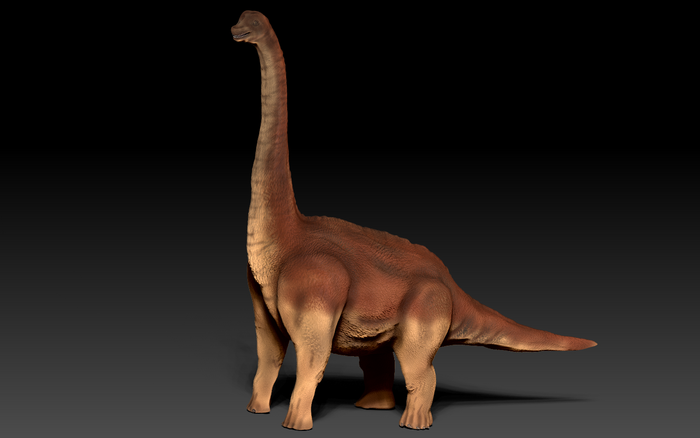
Credit: Dr Andreas Jannel
Scientists have cracked an enduring mystery, discovering how sauropod dinosaurs – like Brontosaurus and Diplodocus – supported their gigantic bodies on land.
A University of Queensland and Monash University-led team used 3D modelling and engineering methods to digitally reconstruct and test the function of foot bones of different sauropods.
Dr Andréas Jannel conducted the research during his PhD studies at UQ’s Dinosaur Lab and said the team found that the hind feet of sauropod had a soft tissue pad beneath the ‘heel’, cushioning the foot to absorb their immense weight.
“We’ve finally confirmed a long-suspected idea and we provide, for the first time, biomechanical evidence that a soft tissue pad – particularly in their back feet – would have played a crucial role in reducing locomotor pressures and bone stresses,” Dr Jannel said.
“It is mind-blowing to imagine that these giant creatures could have been able to support their own weight on land.”
Sauropods were the largest terrestrial animals that roamed the Earth for more than 100 million years.
They were first thought to have been semi-aquatic with water buoyancy supporting their massive weight, a theory disproved by the discovery of sauropod tracks in terrestrial deposits in the mid-twentieth century.
Monash University’s Dr Olga Panagiotopoulou said it had also been thought sauropods had feet similar to a modern-day elephant.
“Popular culture – think Jurassic Park or Walking with Dinosaurs – often depicts these behemoths with almost-cylindrical, thick, elephant-like feet,” Dr Panagiotopoulou said.
“But when it comes to their skeletal structure, elephants are actually ‘tip-toed’ on all four feet, whereas sauropods have different foot configurations in their front and back feet.
“Sauropod’s front feet are more columnar-like, while they present more ‘wedge high heels’ at the back supported by a large soft tissue pad.”
UQ’s Associate Professor Steve Salisbury said this was because sauropods and elephants had different evolutionary origins.
“Elephants belong to an ancient order of mammals called proboscideans, which first appeared in Africa roughly 60 million years ago as small, nondescript herbivores, ” Associate Professor Salisbury said.
“In contrast, sauropods – whose ancestors first appeared 230 million years ago – are more closely related to birds.
“They were agile, two-legged herbivores and it was only later in their evolution that they walked on all fours.
“Crucially, the transition to becoming the largest land animals to walk the earth seems to have involved the adaptation of a heel pad.”
The researchers now plan to use the 3D modelling and engineering methods to make further discoveries.
“I’m keen to apply a similar method to an entire limb and to include additional soft tissue such as muscles, which are rarely preserved in fossils,” Dr Jannel said.
“We’re also excited to study the limbs and feet of other prehistoric animals.
“This should allow us to answer different questions about the biomechanics of extinct animals and better understand their environmental adaptations, movement and lifestyle.”
Read the full paper in Science Advances (DOI: 10.1126/sciadv.abm8280).
Journal
Science Advances
DOI
10.1126/sciadv.abm8280