Osaka, Japan – Hot summer temperatures may have you reaching for a fan and an iced drink in your quest to keep cool. But now, researchers from Japan have found that some mutant proteins are even less tolerant of the heat, getting trapped in a cycle of activation that can have deadly consequences.
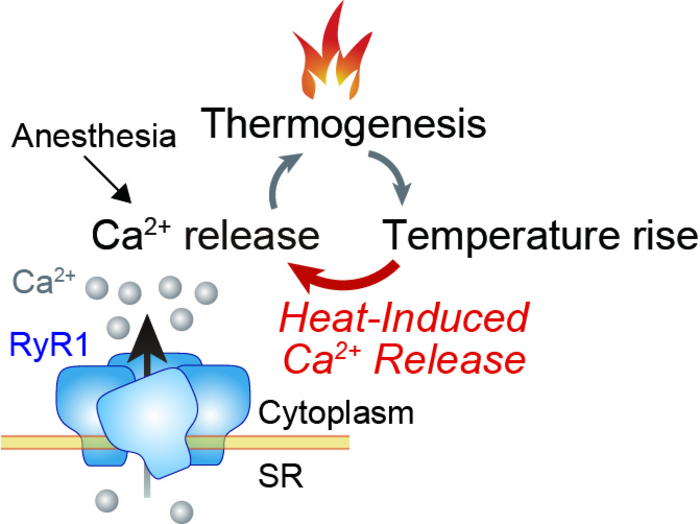
Credit: 2022, Kotaro Oyama et al, Heat-hypersensitive mutants of ryanodine receptor type 1 revealed by microscopic heating, Proceedings of the National Academy of Sciences, U.S.A.
Osaka, Japan – Hot summer temperatures may have you reaching for a fan and an iced drink in your quest to keep cool. But now, researchers from Japan have found that some mutant proteins are even less tolerant of the heat, getting trapped in a cycle of activation that can have deadly consequences.
In a study soon to be published in Proceedings of the National Academy of Sciences, a team of researchers led by Osaka University reveals that malignant hyperthermia (MH) is caused by heat-hypersensitive mutant calcium channel proteins.
MH is a condition in which the body temperature rises uncontrollably in response to anesthesia. The body temperature can increase rapidly, sometimes to over 42°C, causing symptoms that can be fatal if not treated immediately.
“Most human MH-associated mutations have been identified in the ryanodine receptor type 1 (RyR1) gene and cause increased calcium release from the sarcoplasmic reticulum, leading to hyperthermia,” explains Kotaro Oyama, one of the lead authors on the study. “Some studies have suggested that there is a positive feedback loop between calcium release and thermogenesis, but it was still unclear how this loop might work.”
To investigate this, the researchers precisely heated cultured cells expressing mutant RyR1 proteins with an infrared laser beam and assessed changes in calcium flow using fluorescence calcium imaging. This approach enabled them to quantitatively evaluate the cellular response to heat.
“The results were very clear,” says Madoka Suzuki, senior author on the study. “A local heat pulse induced an intracellular calcium burst, but even a weak heat pulse induced this response in cells expressing mutant forms of the RyR1 channels, demonstrating their hypersensitivity to heat compared with the unmutated channel.” The team named this novel response “Heat-Induced Ca2+ Release (HICR).” The HICR was also observed in skeletal muscles isolated from a mouse model of MH.
Importantly, the calcium that is released into the intracellular environment in response to heat via the HICR mechanism could possibly accelerate further thermogenesis in the cell, creating a cascade effect.
“Our findings suggest that, when calcium leakage through RyR1 mutant channels is enhanced by MH inducers such as anesthetics, a positive feedback loop is created that leads to the release of more and more calcium. One plausible explanation for the calcium leakage is that the mutant proteins are easily destabilized by heat,” states lead author Kotaro Oyama.
Given that recent studies suggest that there is a close relationship between malignant hyperthermia and heat stroke, the findings from this study could also provide insight into how exertional heat stroke occurs under extreme environmental conditions. A better understanding of this condition could help develop preventive and treatment strategies.
###
The article, “Heat-hypersensitive mutants of ryanodine receptor type 1 revealed by microscopic heating,” was published in Proceedings of the National Academy of Sciences, U.S.A. at DOI: https://doi.org/10.1073/pnas.2201286119
About Osaka University
Osaka University was founded in 1931 as one of the seven imperial universities of Japan and is now one of Japan’s leading comprehensive universities with a broad disciplinary spectrum. This strength is coupled with a singular drive for innovation that extends throughout the scientific process, from fundamental research to the creation of applied technology with positive economic impacts. Its commitment to innovation has been recognized in Japan and around the world, being named Japan’s most innovative university in 2015 (Reuters 2015 Top 100) and one of the most innovative institutions in the world in 2017 (Innovative Universities and the Nature Index Innovation 2017). Now, Osaka University is leveraging its role as a Designated National University Corporation selected by the Ministry of Education, Culture, Sports, Science and Technology to contribute to innovation for human welfare, sustainable development of society, and social transformation.
Website: https://resou.osaka-u.ac.jp/en
Journal
Proceedings of the National Academy of Sciences
DOI
10.1073/pnas.2201286119
Method of Research
Experimental study
Subject of Research
Cells
Article Title
Heat-hypersensitive mutants of ryanodine receptor type 1 revealed by microscopic heating
Article Publication Date
4-Aug-2022