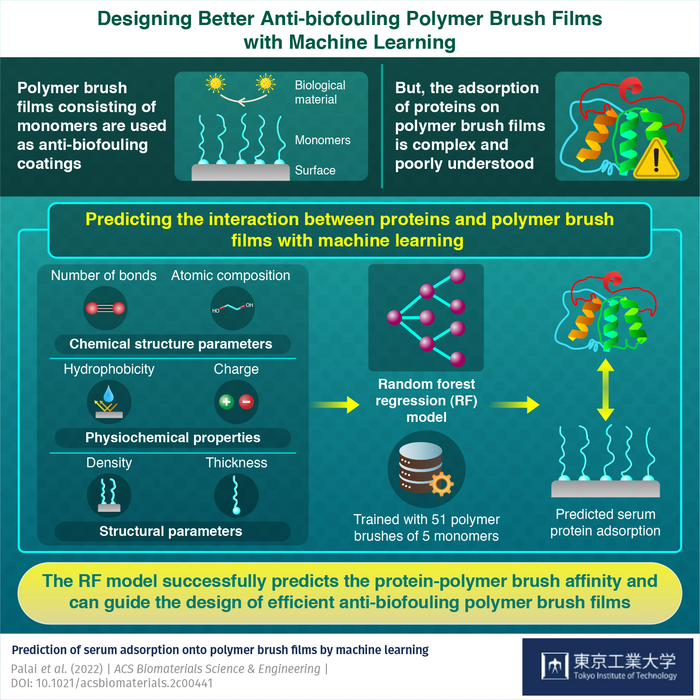
Polymer brush films consists of monomer chains grown in close proximity on a substrate. The monomers, which look like “bristles” at the nanoscale, form a highly functional and versatile coating such that it can selectively adsorb or repel a variety of chemicals or biological molecules. For instance, polymer brush films have been used as a scaffold to grow biological cells and as protective anti-biofouling coatings that repel unwanted biological organisms.
Credit: Tokyo Tech
Polymer brush films consists of monomer chains grown in close proximity on a substrate. The monomers, which look like “bristles” at the nanoscale, form a highly functional and versatile coating such that it can selectively adsorb or repel a variety of chemicals or biological molecules. For instance, polymer brush films have been used as a scaffold to grow biological cells and as protective anti-biofouling coatings that repel unwanted biological organisms.
As anti-biofouling coatings, polymer brushes have been designed based primarily on the interaction between monomers and water molecules. While this makes for simple design, quantitative prediction of the adsorption of biomolecules, such as proteins, onto monomers have proved challenging owing to the complex interactions involved.
Now, in a recent study published in ACS Biomaterials Science & Engineering, a research group led by Associate Professor Tomohiro Hayashi from Tokyo Institute of Technology (Tokyo Tech), Japan, has used machine learning to predict these interactions and identify the film characteristics that have a significant impact on protein adsorption.
In their study, the team fabricated 51 different polymer brush films of different thicknesses and densities with five different monomers to train the machine learning algorithm. They then tested several of these algorithms to see how well their predictions matched up against the measured protein adsorption. “We tested several supervised regression algorithms, namely gradient boosting regression, support vector regression, linear regression, and random forest regression, to select the most reliable and suitable model in terms of the prediction accuracy,” says Dr. Hayashi.
Out of these models, the random forest (RF) regression model showed the best agreement with the measured protein adsorption values. Accordingly, the researchers used the RF model to correlate the physical and chemical properties of the polymer brush with its ability to adsorb serum protein and allow for cell adhesion.
“Our analyses showed that the hydrophobicity index, or the relative hydrophobicity, was the most critical parameter. Next in line were thickness and density of polymer brush films, the number of C-H bonds, the net charge on monomer, and the density of the films. Monomer molecular weight and the number of O-H bonds, on the other hand, were ranked low in importance,” highlights Dr. Hayashi.
Given the highly varied nature of polymer brush films and the multiple factors that affect the monomer-protein interactions, adoption of machine learning as a way to optimize polymer brush film properties can provide a good starting point for the efficient design of anti-biofouling materials and functional biomaterials.
Journal
ACS Biomaterials Science & Engineering
DOI
10.1021/acsbiomaterials.2c00441
Method of Research
Experimental study
Subject of Research
Not applicable
Article Title
Prediction of Serum Adsorption onto Polymer Brush Films by Machine Learning
Article Publication Date
29-Jul-2022