After the ancestors of modern humans split from those of Neanderthals and Denisovans, their Asian relatives, about one hundred amino acids, the building blocks of proteins in cells and tissues, changed in modern humans and spread to almost all modern humans. The biological significance of these changes is largely unknown. However, six of those amino acid changes occurred in three proteins that play key roles in the distribution of chromosomes, the carriers of genetic information, to the two daughter cells during cell division.
Credit: Felipe Mora-Bermúdez / MPI-CBG
After the ancestors of modern humans split from those of Neanderthals and Denisovans, their Asian relatives, about one hundred amino acids, the building blocks of proteins in cells and tissues, changed in modern humans and spread to almost all modern humans. The biological significance of these changes is largely unknown. However, six of those amino acid changes occurred in three proteins that play key roles in the distribution of chromosomes, the carriers of genetic information, to the two daughter cells during cell division.
The effects of the modern human variants on brain development
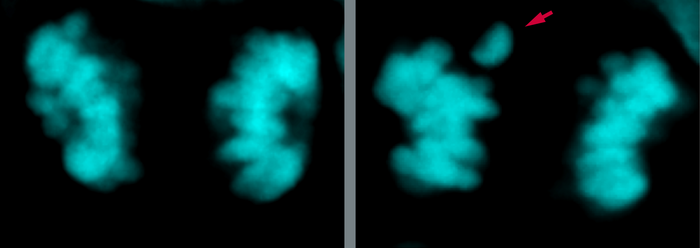
To investigate the significance of these six changes for neocortex development, the scientists first introduced the modern human variants in mice. Mice are identical to Neanderthals at those six amino acid positions, so these changes made them a model for the developing modern human brain. Felipe Mora-Bermúdez, the lead author of the study, describes the discovery: “We found that three modern human amino acids in two of the proteins cause a longer metaphase, a phase where chromosomes are prepared for cell division, and this results in fewer errors when the chromosomes are distributed to the daughter cells of the neural stem cells, just like in modern humans.” To check if the Neanderthal set of amino acids have the opposite effect, the researchers then introduced the ancestral amino acids in human brain organoids – miniature organ-like structures that can be grown from human stem cells in cell culture dishes in the lab and that mimic aspects of early human brain development. “In this case, metaphase became shorter and we found more chromosome distribution errors.” According to Mora-Bermúdez, this shows that those three modern human amino acid changes in the proteins known as KIF18a and KNL1 are responsible for the fewer chromosome distribution mistakes seen in modern humans as compared to Neanderthal models and chimpanzees. He adds that “having mistakes in the number of chromosomes is usually not a good idea for cells, as can be seen in disorders like trisomies and cancer.”
“Our study implies that some aspects of modern human brain evolution and function may be independent of brain size since Neanderthals and modern humans have similar-sized brains. The findings also suggest that brain function in Neanderthals may have been more affected by chromosome errors than that of modern humans,” summarizes Wieland Huttner, who co-supervised the study. Svante Pääbo, who also co-supervised the study, adds that “future studies are needed to investigate whether the decreased error rate affects modern human traits related to brain function.”
——-
About the MPI-CBG
The Max Planck Institute of Molecular Cell Biology and Genetics (MPI-CBG), located in Dresden, is one of more than 80 institutes of the Max Planck Society, an independent, non-profit organization in Germany. 550 curiosity-driven scientists from over 50 countries ask: How do cells form tissues? The basic research programs of the MPI-CBG span multiple scales of magnitude, from molecular assemblies to organelles, cells, tissues, organs, and organisms. The MPI-CBG invests extensively in Services and Facilities to allow research scientists shared access to sophisticated and expensive technologies. www.mpi-cbg.de
About the Max Planck Institute for Evolutionary Anthropology (MPI EVA)
The Max Planck Institute for Evolutionary Anthropology in Leipzig studies the origins and evolution of humans, by studying genes, cultures and cognitive abilities of people living today, of extinct human forms and of apes. www.eva.mpg.de
Journal
Science Advances
DOI
10.1126/sciadv.abn7702
Method of Research
Experimental study
Subject of Research
Human tissue samples
Article Title
Longer metaphase and fewer chromosome segregation errors in modern human than Neanderthal brain development
Article Publication Date
29-Jul-2022