Due to their low cost and environmental friendliness, aqueous zinc batteries have the potential to play an important role in future energy storage systems for applications like the power grid. However, a safety concern has slowed the progress of this emerging technology.
Credit: Nano Research, Tsinghua University
Due to their low cost and environmental friendliness, aqueous zinc batteries have the potential to play an important role in future energy storage systems for applications like the power grid. However, a safety concern has slowed the progress of this emerging technology.
In a July 28 study published in Nano Research, Chinese researchers presented a solution that involves chemically modifying common table sugar to stabilize the zinc ion environment and secure future applications.
From electric cars to wind and solar power systems, an increasingly diverse range of power-hungry applications continue to boost demands for large-scale, low-cost energy storage. Aqueous Zinc (Zn) batteries quickly rose to the top as one of the more promising options for sustainably meeting the demand, according to the study.
“They are high safety and cost-effective compared to current lithium-ion batteries with flammable organic electrolytes,” said paper author Meinan Liu, associate professor of nano-tech and nano-bionics at the University of Science and Technology of China. “In addition, Zn anode presents super high theoretical capacity, which makes these Zn batteries even more promising for applications like future grid energy storage.”
However, when the zinc ion (Zn2+) concentration on the surface of the anode drops to zero, dendrites start growing. Uncontrolled Zn dendrite growth deteriorates electrochemical performance and pose a serious threat to safe operation.
“These dendrites can penetrate the separator and cause the battery to short-circuit,” Liu said.
Past studies have shown that adjusting the solvent environment (called “solvation structure”) can increase the mobility of Zn2+ in response to the electric field successfully suppresses the growth of dendrites. The problem was that these previous adjustments — like introducing other salts or including fewer water molecules — ended up decreasing the ionic conductivity of the system as well.
There was a fundamental understanding gap between Zn2+ solvation structure and its mobility, explained by Liu. This was a key factor affecting the dendrite growth and stability of Zn anode.
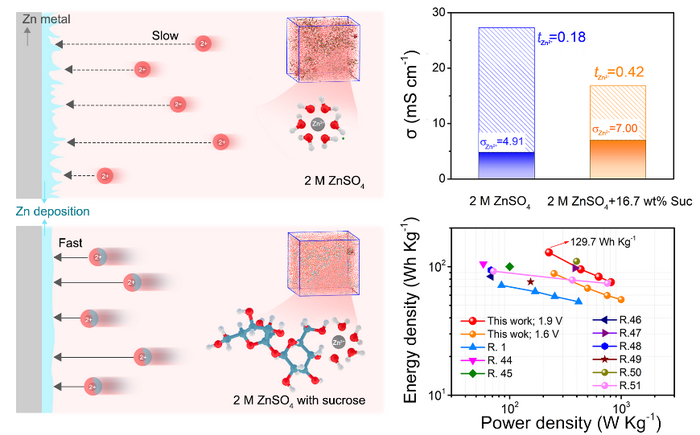
In attempt to bridge this gap, a collaborative research team from multiple Chinese institutions tried a new tack: introducing common table sugar with multiple hydroxyl groups (a hydrogen and an oxygen bound together) into the electrolyte to adjust solvation structure of Zn2+.
By conducting atomistic simulations and experiments, the research team confirmed that the sucrose molecules enhanced mobility and stopped dendrite growth without compromising stability. In fact, this method provided unlooked-for benefits as well:
“Findings confirm that sucrose molecules in the solvation sheath not only enhance the mobility, ensuring fast Zn2+ kinetics, but also protects the Zn anode from water corrosion and successfully achieves Zn dendrite-free deposition and side reaction suppression,” Liu said.
This demonstrates the great potential of using this simple sucrose-modification for future high-performance zinc batteries and brings the research field a step closer to the ultimate goal of achieving a safe, green, high-performance Zn battery.
“Hopefully this safe, low-cost Zn battery could be applied in grid energy storage,” Liu said.
This technique also lends itself to additional variations and modifications: Zn-carbon cells deliver higher energy density and improved stability, suggesting a great potential application of sucrose-modified electrolytes for future Zn batteries.
In future studies, the researchers will also be considering possible use cases and roadblocks for aqueous zinc batteries, specifically how they might handle extreme temperatures.
“The aqueous electrolyte of Zn battery will be frozen in low temperature, so we are looking into how to address the temperature influence on battery performance,” Liu said.
Other contributors include Yufang Cao, Linge Li, Haifeng Tu, Yuzhen Hu, Shuang Cheng, Hongzhen Lin, Jiangtao Di, and Yongyi Zhang from the School of Nano-Tech and Nano-Bionics, University of Science and Technology of China; Yufang Cao, Xiaohui Tang, Linge Li, Haifeng Tu, Yuzhen Hu, Shuang Cheng, Hongzhen Lin, Jiangtao Ii, and Yongyi Zhang are also affiliated with the Key Laboratory of Multifunctional Nanomaterials and Smart Systems, Advanced Materials Division, Suzhou Institute of Nano-Tech and Nano-Bionics at the Chinese Academy of Sciences, as are Xiaohui Tang, Yingying Yu, and Liwen Zhang; Yufang Cao, Liwen Zhang, Jiangtao Di, and Yongyi Zhang are also with the Division of Nanomaterials and Jiangxi Key Lab of Carbonene Materials, Jiangxi Institute of Nanotechnology.
This work was supported by the National Natural Science Foundation of China, National Key Research and Development Program of China, the Science and Technology Project of Jiangxi Province, Outstanding Youth Fund of Jiangxi Province, Jiangxi Double Thousand Talent Program, and Science Technology Major Project of Nanchang.
##
About Nano Research
Nano Research is a peer-reviewed, international and interdisciplinary research journal, sponsored by Tsinghua University and the Chinese Chemical Society. It offers readers an attractive mix of authoritative and comprehensive reviews and original cutting-edge research papers. After more than 10 years of development, it has become one of the most influential academic journals in the nano field. Rapid review to ensure quick publication is a key feature of Nano Research. In 2022 InCites Journal Citation Reports, Nano Research has an Impact Factor of 10.269 (9.136, 5 years), the total cites reached 29620, ranking first in China’s international academic journals, and the number of highly cited papers reached 120, ranked among the top 2.8% of over 9000 academic journals.
About Tsinghua University Press
Established in 1980, belonging to Tsinghua University, Tsinghua University Press (TUP) is a leading comprehensive higher education and professional publisher in China. Committed to building a top-level global cultural brand, after 41 years of development, TUP has established an outstanding managerial system and enterprise structure, and delivered multimedia and multi-dimensional publications covering books, audio, video, electronic products, journals and digital publications. In addition, TUP actively carries out its strategic transformation from educational publishing to content development and service for teaching & learning and was named First-class National Publisher for achieving remarkable results.
Journal
Nano Research
DOI
10.1007/s12274-022-4726-3
Article Title
Fast Zn2+ mobility enabled by sucrose modified Zn2+ solvation structure for dendrite-free aqueous zinc battery
Article Publication Date
28-Jul-2022