Cell, tissue, and organ structure is maintained by cell-cell adhesion molecules that connect opposing cells. Cadherins are a class of essential cell-cell adhesion molecules for tissue formation and integrity, and defects in cadherin function cause various diseases (e.g., cancer invasion). Cadherin protrudes from the cell surface and binds another cadherin on an opposing cell to mediate cell-cell adhesion. The cadherin binding process mainly comprises two dimerization steps: X-dimer formation and strand-swap (SS-) dimer formation of the extracellular domains (ectodomains) of cadherin. However, interactions other than those involving the formation of the X- and SS-dimers have also been proposed, and the precise binding mechanism of cadherin remains controversial.
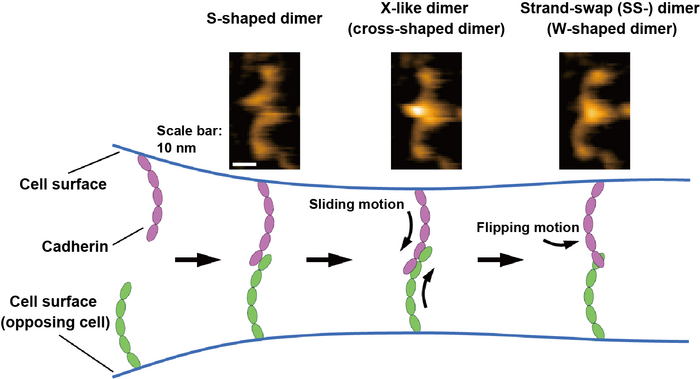
Credit: Shigetaka Nishiguchi of Scientists at the Exploratory Research Center on Life and Living Systems (ExCELLS)
Cell, tissue, and organ structure is maintained by cell-cell adhesion molecules that connect opposing cells. Cadherins are a class of essential cell-cell adhesion molecules for tissue formation and integrity, and defects in cadherin function cause various diseases (e.g., cancer invasion). Cadherin protrudes from the cell surface and binds another cadherin on an opposing cell to mediate cell-cell adhesion. The cadherin binding process mainly comprises two dimerization steps: X-dimer formation and strand-swap (SS-) dimer formation of the extracellular domains (ectodomains) of cadherin. However, interactions other than those involving the formation of the X- and SS-dimers have also been proposed, and the precise binding mechanism of cadherin remains controversial.
Shigetaka Nishiguchi of ExCELLS, Takayuki Uchihashi of ExCELLS and Nagoya University, and Tadaomi Furuta of Tokyo Tech applied high-speed atomic force microscopy (HS-AFM) to explore the binding mechanism of cadherins. HS-AFM can enable the visualization of single-molecule structures and dynamics in solution at the nanometer scale with sub-second time resolution by directly touching and scanning the surface of proteins through a sharp-tipped probe. HS-AFM revealed that cadherins existed as multiple dimeric structures, which based on their morphology may be classified as W-, cross-, and S-shaped dimers. Furthermore, the scientists conducted mutational and structural modeling analyses and found that W- and cross-shaped dimers corresponded to known SS-dimers and X-like dimers and that the S-shaped dimer is a novel conformation. The binding processes of cadherins directly visualized by HS-AFM also revealed that the dimerization process is completed within 1 second through conversion into the aforementioned three types of dimeric structures. Based on these HS-AFM observations, the scientists hypothesized that the binding mechanism progress through the sliding motion of the S-shaped dimer followed by the flipping motion of the X-dimer to form the SS-dimer, which is thought to be the final stable cadherin dimer (Fig).
To date, the binding mechanism of cadherins has been mainly investigated using structural analyses and cell and solution measurements, which can only analyze the binding states reflected by the large number of cadherins. The newly applied HS-AFM technique revealed the binding processes of individual cadherins at single-molecule resolution, which has not been achieved before. HS-AFM observation will pave the way for a deeper understanding of the binding mechanism of cadherins, which is important for tissue- and organ-level organization and cell-cell adhesion-related diseases.
Journal
Proceedings of the National Academy of Sciences
DOI
10.1073/pnas.2208067119
Method of Research
Experimental study
Subject of Research
Cells
Article Title
Multiple dimeric structures and strand-swap dimerization of E-cadherin in solution visualized by high-speed atomic force microscopy
Article Publication Date
18-Jul-2022