

• HOME
  • NEWS
  • EXPLORE
    • CAREER
      • Companies
      • Jobs
    • EVENTS
    • iGEM
      • News
      • Team
    • PHOTOS
    • VIDEO
    • WIKI
  • BLOG
  • COMMUNITY
    • FACEBOOK
    • INSTAGRAM
    • TWITTER
Saturday, February 7, 2026
BIOENGINEER.ORG
No Result
View All Result
  • Login
  • HOME
  • NEWS
  • EXPLORE
    • CAREER
      • Companies
      • Jobs
        • Lecturer
        • PhD Studentship
        • Postdoc
        • Research Assistant
    • EVENTS
    • iGEM
      • News
      • Team
    • PHOTOS
    • VIDEO
    • WIKI
  • BLOG
  • COMMUNITY
    • FACEBOOK
    • INSTAGRAM
    • TWITTER
  • HOME
  • NEWS
  • EXPLORE
    • CAREER
      • Companies
      • Jobs
        • Lecturer
        • PhD Studentship
        • Postdoc
        • Research Assistant
    • EVENTS
    • iGEM
      • News
      • Team
    • PHOTOS
    • VIDEO
    • WIKI
  • BLOG
  • COMMUNITY
    • FACEBOOK
    • INSTAGRAM
    • TWITTER
No Result
View All Result
Bioengineer.org
No Result
View All Result
Home NEWS Science News Health

The health effects of hookahs

Bioengineer by Bioengineer
July 7, 2022
in Health
Reading Time: 2 mins read
0
From left, Ziyad Ben Taleb, Danny Dabroy and Farjana Yesmin
Share on FacebookShare on TwitterShare on LinkedinShare on RedditShare on Telegram

Led by Ziyad Ben Taleb, assistant professor of public health in the College of Nursing and Health Innovation and director of UTA’s Nicotine and Tobacco Research Laboratory (NTRL), the team will study how the size of a hookah device—also known as a water pipe—impacts its user’s health. It’s an area of research that Ben Taleb says is largely unexplored.
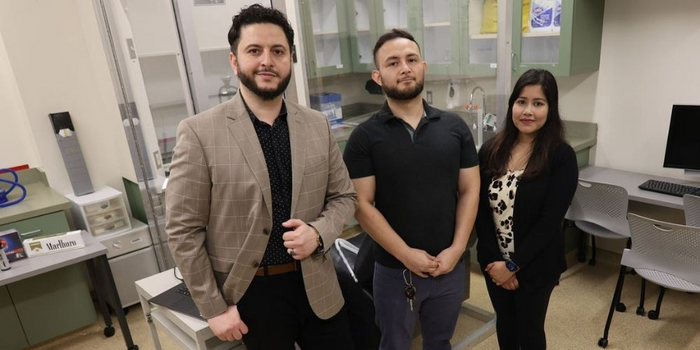
From left, Ziyad Ben Taleb, Danny Dabroy and Farjana Yesmin

Credit: The University of Texas at Arlington

Led by Ziyad Ben Taleb, assistant professor of public health in the College of Nursing and Health Innovation and director of UTA’s Nicotine and Tobacco Research Laboratory (NTRL), the team will study how the size of a hookah device—also known as a water pipe—impacts its user’s health. It’s an area of research that Ben Taleb says is largely unexplored.

“There is not much research about hookah use, unlike cigarettes,” he said. “In order for the Food and Drug Administration to regulate it, there is a need to gather evidence regarding health effects, behavior, addiction and toxicant exposure, and how that is related to smoking hookah.”

Ben Taleb’s study will be two-pronged. First it will focus on the idea that hookah use is less harmful than tobacco products—a misconception that he says stems from users’ belief that the smoke is filtered through water. Second, it will cover the marketing aspect.

“Retailers try to market smaller hookah products as best for beginners, making them appear like a perfect ‘starter size’ for otherwise water pipe- or hookah-naïve people. That was the logic behind me thinking about running this study,” Ben Taleb said. “I want to know how different hookah sizes affect health outcomes.”

During the two-year study, funded by a National Institute on Drug Abuse grant, participants who identify as regular hookah users will make three visits to the NTRL. During each, they will use a particular size of hookah, either small, medium or large, with Ben Taleb and his team taking several measurements before and after use, including carbon monoxide levels and nicotine concentration in the user’s body.

Ben Taleb will also use a device, designed by American University of Beirut, that, when integrated into the hookah itself, can measure real time statistics, such as the number of puffs, total volume inhaled and breaks taken between each puff.

Danny Dabroy is assisting in the research. He is a recent graduate of UTA’s Bachelor of Science in public health program and a current UTA Master’s in Public Health student. As a former smoker himself, he took immediate interest in the lab and hopes that the study helps create healthier habits.

“At the end of our research sessions, we usually give participants a pamphlet with facts about smoking and quitting,” Dabroy said. “We want to change behavior, ultimately, which is why we collect data.”

Ben Taleb said he hopes this research will help people decide whether hookah use is right for them.

“When these results are published, it will show the public the effects hookah smoking can have, regardless of size,” he said. “It will raise more awareness and correct misperceptions around it.”



Share12Tweet8Share2ShareShareShare2

Related Posts

Evaluating Pediatric Emergency Care Quality in Ethiopia

February 7, 2026

TPMT Expression Predictions Linked to Azathioprine Side Effects

February 7, 2026

Improving Dementia Care with Enhanced Activity Kits

February 7, 2026

Decoding Prostate Cancer Origins via snFLARE-seq, mxFRIZNGRND

February 7, 2026

POPULAR NEWS

  • Robotic Ureteral Reconstruction: A Novel Approach

    Robotic Ureteral Reconstruction: A Novel Approach

    82 shares
    Share 33 Tweet 21
  • Digital Privacy: Health Data Control in Incarceration

    63 shares
    Share 25 Tweet 16
  • Study Reveals Lipid Accumulation in ME/CFS Cells

    57 shares
    Share 23 Tweet 14
  • Breakthrough in RNA Research Accelerates Medical Innovations Timeline

    53 shares
    Share 21 Tweet 13

About

We bring you the latest biotechnology news from best research centers and universities around the world. Check our website.

Follow us

Recent News

Evaluating Pediatric Emergency Care Quality in Ethiopia

TPMT Expression Predictions Linked to Azathioprine Side Effects

Improving Dementia Care with Enhanced Activity Kits

Subscribe to Blog via Email

Success! An email was just sent to confirm your subscription. Please find the email now and click 'Confirm' to start subscribing.

Join 73 other subscribers
  • Contact Us

Bioengineer.org © Copyright 2023 All Rights Reserved.

Welcome Back!

Login to your account below

Forgotten Password?

Retrieve your password

Please enter your username or email address to reset your password.

Log In
No Result
View All Result
  • Homepages
    • Home Page 1
    • Home Page 2
  • News
  • National
  • Business
  • Health
  • Lifestyle
  • Science

Bioengineer.org © Copyright 2023 All Rights Reserved.