CORVALLIS, Ore. – Songbirds learning from nearby birds that food supplies might be growing short respond by changing their physiology as well as their behavior, research by the Oregon State University College of Science shows.
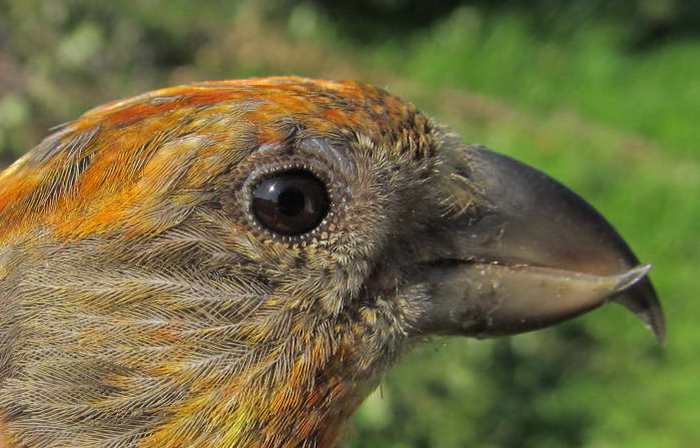
Credit: Provided by Jamie Cornelius, Oregon State
CORVALLIS, Ore. – Songbirds learning from nearby birds that food supplies might be growing short respond by changing their physiology as well as their behavior, research by the Oregon State University College of Science shows.
After receiving social information from food-restricted neighbors for three days, the red crossbills in the study raised their pace of consumption, increased their gut mass and maintained the size of the muscle responsible for flight when their own eating opportunities were subsequently limited to two short feeding periods per day.
Findings of the study by OSU’s Jamie Cornelius, published in the journal Proceedings of the Royal Society B, suggest that birds can use social information about food shortages to effect an adaptive advantage for survival.
“This is an entirely new form of physiological plasticity in birds and builds on prior work showing that social cues during stress can actually change how the brain processes stressors,” said Cornelius, assistant professor of integrative biology.
Cornelius, an ecophysiologist, looks at the mechanisms that wild animals, particularly songbirds, use as they cope with unpredictable and extreme events in their environment, including fluctuations in food availability. Her research combines natural history, endocrinology and biotelemetry to probe for a better understanding of what limits an animal’s fitness under difficult conditions.
“Animals have all kinds of strategies for dealing with challenging environments, ranging from seasonal avoidance strategies like hibernation or migration to behaviors like caching or altered foraging activity,” she said. “Physiological adjustments in metabolic rate, digestive capacity and energy reserves can sometimes accompany behavioral changes, but those things can take time to execute. That means unpredictable environmental conditions are particularly challenging for many animals.”
Cornelius showed in earlier research that a red crossbill with a food-restricted neighbor will secrete higher than usual levels of the stress hormone corticosterone during its own food-stress periods and also undergo brain activity changes that prepare the bird to respond more strongly to the challenge.
The red crossbill, known scientifically as Loxia curvirostra, is a nomadic species that migrates based on food availability and incorporates other birds’ calls or behavior into its decision-making on how to respond to food deprivation.
Found throughout Europe and North America, the crossbill is a member of the finch family. It is known, as its name suggests, for upper and lower beak tips that cross, a feature that helps it pull seeds from conifer cones and other fruits.
“Crossbills are an interesting study system because of their dependence on conifer seeds,” Cornelius said. “Conifer seed crops are somewhat unpredictable both in where seed crops develop each year and in how long a seed crop might support birds. We use crossbills as a study system to try to understand what strategies birds might have available when food suddenly declines because crossbills may have to cope with this more often than other species.”
In this research, which involved crossbills in captivity, some of the birds received three days of social information from food-deprived birds prior to their own food limitations; other birds received three days of social information from food-deprived birds at the same time as their own food deprivation.
Cornelius refers to the former collection of birds as the social predictive focal group and the latter as the social parallel focal group.
“The birds did better at maintaining body mass during food restriction if the social information was predictive of the decline in food resources,” she said. “Social information is important to animals in many different contexts, and this study demonstrates a novel benefit: Advance warning about declining food can lead to better outcomes during times of scarcity.”
Journal
Proceedings of the Royal Society B Biological Sciences
DOI
10.1098/rspb.2022.0516
Method of Research
Experimental study
Subject of Research
Animals
Article Title
Advance social information allows red crossbills (Loxia curvirostra) to better conserve body mass and intestinal mass during food stress
Article Publication Date
18-May-2022
COI Statement
I declare I have no competing interests.