BUFFALO, NY- June 30, 2022 – A new research paper was published in Aging (Aging-US) on the cover of Volume 14, Issue 12, entitled, “Time makes histone H3 modifications drift in mouse liver.”
Credit: Hillje et al.
BUFFALO, NY- June 30, 2022 – A new research paper was published in Aging (Aging-US) on the cover of Volume 14, Issue 12, entitled, “Time makes histone H3 modifications drift in mouse liver.”
Aging is known to involve epigenetic histone modifications, which are associated with transcriptional changes, occurring throughout the entire lifespan of an individual.
“So far, no study discloses any drift of histone marks in mammals which is time-dependent or influenced by pro-longevity caloric restriction treatment.”
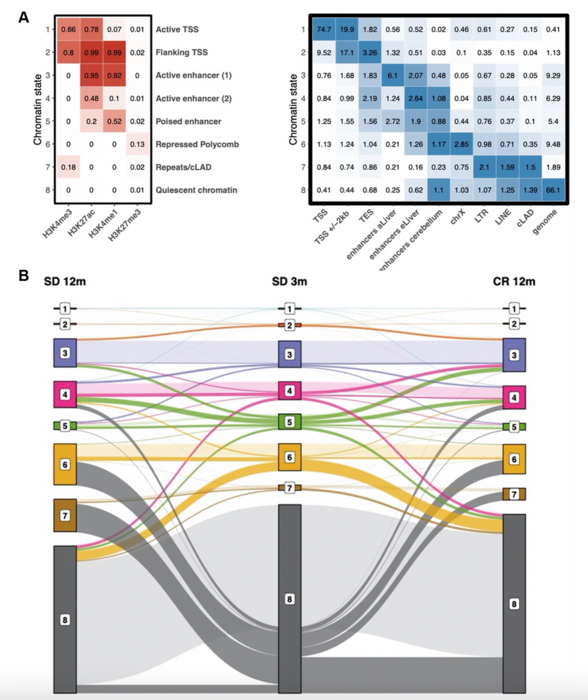
To detect the epigenetic drift of time passing, researchers—from Istituto di Ricovero e Cura a Carattere Scientifico, University of Urbino ‘Carlo Bo’, University of Milan, and University of Padua—determined the genome-wide distributions of mono- and tri-methylated lysine 4 and acetylated and tri-methylated lysine 27 of histone H3 in the livers of healthy 3, 6 and 12 months old C57BL/6 mice.
“In this study, we used chromatin immunoprecipitation sequencing technology to acquire 108 high-resolution profiles of H3K4me3, H3K4me1, H3K27me3 and H3K27ac from the livers of mice aged between 3 months and 12 months and fed 30% caloric restriction diet (CR) or standard diet (SD).”
The comparison of different age profiles of histone H3 marks revealed global redistribution of histone H3 modifications with time, in particular in intergenic regions and near transcription start sites, as well as altered correlation between the profiles of different histone modifications. Moreover, feeding mice with caloric restriction diet, a treatment known to retard aging, reduced the extent of changes occurring during the first year of life in these genomic regions.
“In conclusion, while our data do not establish that the observed changes in H3 modification are causally involved in aging, they indicate age, buffered by caloric restriction, releases the histone H3 marking process of transcriptional suppression in gene desert regions of mouse liver genome most of which remain to be functionally understood.”
DOI: https://doi.org/10.18632/aging.204107
Corresponding Author: Marco Giorgio – [email protected]
Keywords: epigenetics, aging, histones, ChIP-seq, diet
Sign up for free Altmetric alerts about this article: https://aging.altmetric.com/details/email_updates?id=10.18632%2Faging.204107
About Aging-US:
Launched in 2009, Aging (Aging-US) publishes papers of general interest and biological significance in all fields of aging research and age-related diseases, including cancer—and now, with a special focus on COVID-19 vulnerability as an age-dependent syndrome. Topics in Aging go beyond traditional gerontology, including, but not limited to, cellular and molecular biology, human age-related diseases, pathology in model organisms, signal transduction pathways (e.g., p53, sirtuins, and PI-3K/AKT/mTOR, among others), and approaches to modulating these signaling pathways.
Follow Aging on social media:
- SoundCloud – https://soundcloud.com/Aging-Us
- Facebook – https://www.facebook.com/AgingUS/
- Twitter – https://twitter.com/AgingJrnl
- Instagram – https://www.instagram.com/agingjrnl/
- YouTube – https://www.youtube.com/agingus
- LinkedIn – https://www.linkedin.com/company/aging/
- Pinterest – https://www.pinterest.com/AgingUS/
For media inquiries, please contact [email protected].
Aging (Aging-US) Journal Office
6666 E. Quaker Str., Suite 1B
Orchard Park, NY 14127
Phone: 1-800-922-0957, option 1
###
Journal
Aging-US
DOI
10.18632/aging.204107
Method of Research
Experimental study
Subject of Research
Animals
Article Title
Time makes histone H3 modifications drift in mouse liver
Article Publication Date
10-Jun-2022
COI Statement
The authors declare no conflicts of interest related to this study.