• HOME
  • NEWS
  • EXPLORE
    • CAREER
      • Companies
      • Jobs
    • EVENTS
    • iGEM
      • News
      • Team
    • PHOTOS
    • VIDEO
    • WIKI
  • BLOG
  • COMMUNITY
    • FACEBOOK
    • INSTAGRAM
    • TWITTER
Saturday, February 7, 2026
BIOENGINEER.ORG
No Result
View All Result
  • Login
  • HOME
  • NEWS
  • EXPLORE
    • CAREER
      • Companies
      • Jobs
        • Lecturer
        • PhD Studentship
        • Postdoc
        • Research Assistant
    • EVENTS
    • iGEM
      • News
      • Team
    • PHOTOS
    • VIDEO
    • WIKI
  • BLOG
  • COMMUNITY
    • FACEBOOK
    • INSTAGRAM
    • TWITTER
  • HOME
  • NEWS
  • EXPLORE
    • CAREER
      • Companies
      • Jobs
        • Lecturer
        • PhD Studentship
        • Postdoc
        • Research Assistant
    • EVENTS
    • iGEM
      • News
      • Team
    • PHOTOS
    • VIDEO
    • WIKI
  • BLOG
  • COMMUNITY
    • FACEBOOK
    • INSTAGRAM
    • TWITTER
No Result
View All Result
Bioengineer.org
No Result
View All Result
Home NEWS Science News Biology

Oxytocin spreads cooperation in social networks

Bioengineer by Bioengineer
June 27, 2022
in Biology
Reading Time: 2 mins read
0
Oxytocin Spreads Cooperation in Social Networks
Share on FacebookShare on TwitterShare on LinkedinShare on RedditShare on Telegram

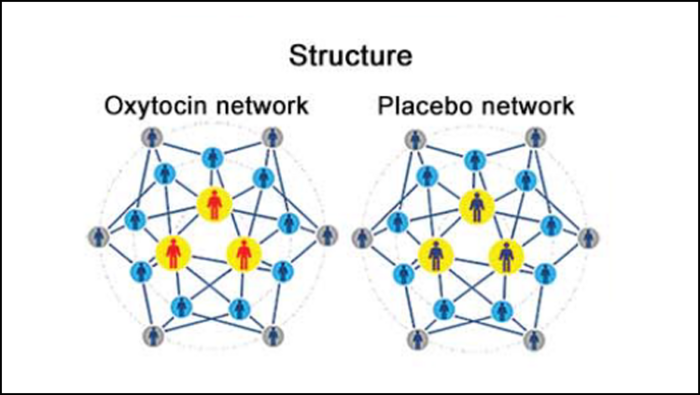
Administering oxytocin to the central members of a social network spreads cooperation via increased punishment of uncooperative behavior, according to new research published in JNeurosci.
Oxytocin Spreads Cooperation in Social Networks

Credit: Li et al., JNeurosci 2022

Administering oxytocin to the central members of a social network spreads cooperation via increased punishment of uncooperative behavior, according to new research published in JNeurosci.

Large groups of people cannot peacefully coexist without cooperation — more social and cooperative people tend to end up as leaders in formal organizations and informal social groups. Yet cooperation can conflict with individual goals. Oxytocin, known for its involvement in bonding, may explain how humans evolved the cooperation needed to live in groups.

Li et al. gave intranasal oxytocin or a saline placebo to participants who occupied the most influential, or central, role in artificial social networks. The participants played a series of virtual games with strangers. In one game, the central members received money from peripheral members and set a threshold for the minimum offer they’d accept. When the central members received oxytocin, cooperation spread through the network; after many rounds of the game, the offer and acceptance threshold evolved into a fifty-fifty split, a sign of cooperation. In another game, oxytocin increased the likelihood central members would choose to cooperate and then punish peripheral members for uncooperative behavior, which tracked with the group increase in cooperation. These results indicate cooperation from influential group members spreads to the rest of the group, likely through increased enforcement of social norms.

###

Paper title: Oxytocin and the Punitive Hub — Dynamic Spread of Cooperation in Human Social Networks


Please contact [email protected] for the full-text PDF and to join SfN’s journals media list.

About JNeurosci

JNeurosci, the Society for Neuroscience’s first journal, was launched in 1981 as a means to communicate the findings of the highest quality neuroscience research to the growing field. Today, the journal remains committed to publishing cutting-edge neuroscience that will have an immediate and lasting scientific impact, while responding to authors’ changing publishing needs, representing breadth of the field and diversity in authorship.

About The Society for Neuroscience

The Society for Neuroscience is the world’s largest organization of scientists and physicians devoted to understanding the brain and nervous system. The nonprofit organization, founded in 1969, now has nearly 37,000 members in more than 90 countries and over 130 chapters worldwide.


Journal

JNeurosci

DOI

10.1523/JNEUROSCI.2303-21.2022

Method of Research

Experimental study

Subject of Research

People

Article Title

Oxytocin and the punitive hub — Dynamic spread of cooperation in human social networks

Article Publication Date

27-Jun-2022

Share12Tweet8Share2ShareShareShare2

Related Posts

Florida Cane Toad: Complex Spread and Selective Evolution

Florida Cane Toad: Complex Spread and Selective Evolution

February 7, 2026
New Study Uncovers Mechanism Behind Burn Pit Particulate Matter–Induced Lung Inflammation

New Study Uncovers Mechanism Behind Burn Pit Particulate Matter–Induced Lung Inflammation

February 6, 2026

DeepBlastoid: Advancing Automated and Efficient Evaluation of Human Blastoids with Deep Learning

February 6, 2026

Navigating the Gut: The Role of Formic Acid in the Microbiome

February 6, 2026

POPULAR NEWS

  • Robotic Ureteral Reconstruction: A Novel Approach

    Robotic Ureteral Reconstruction: A Novel Approach

    82 shares
    Share 33 Tweet 21
  • Digital Privacy: Health Data Control in Incarceration

    63 shares
    Share 25 Tweet 16
  • Study Reveals Lipid Accumulation in ME/CFS Cells

    57 shares
    Share 23 Tweet 14
  • Breakthrough in RNA Research Accelerates Medical Innovations Timeline

    53 shares
    Share 21 Tweet 13

About

We bring you the latest biotechnology news from best research centers and universities around the world. Check our website.

Follow us

Recent News

Barriers and Boosters of Seniors’ Physical Activity in Karachi

Evaluating Pediatric Emergency Care Quality in Ethiopia

TPMT Expression Predictions Linked to Azathioprine Side Effects

Subscribe to Blog via Email

Enter your email address to subscribe to this blog and receive notifications of new posts by email.

Join 73 other subscribers
  • Contact Us

Bioengineer.org © Copyright 2023 All Rights Reserved.

Welcome Back!

Login to your account below

Forgotten Password?

Retrieve your password

Please enter your username or email address to reset your password.

Log In
No Result
View All Result
  • Homepages
    • Home Page 1
    • Home Page 2
  • News
  • National
  • Business
  • Health
  • Lifestyle
  • Science

Bioengineer.org © Copyright 2023 All Rights Reserved.