The average office worker often endures pain in many parts of the body as a side effect to sedentary desk jobs. It is not rare to see even young people suffer from shoulder pain, which previously had been mainly experienced by older people. Once shoulder pain is inflicted, changing clothes, let alone freely moving parts of the body, is difficult. Falling asleep is also not easy. While the rotator cuffs are commonly damaged naturally with aging, regenerating it has proved to be challenging.
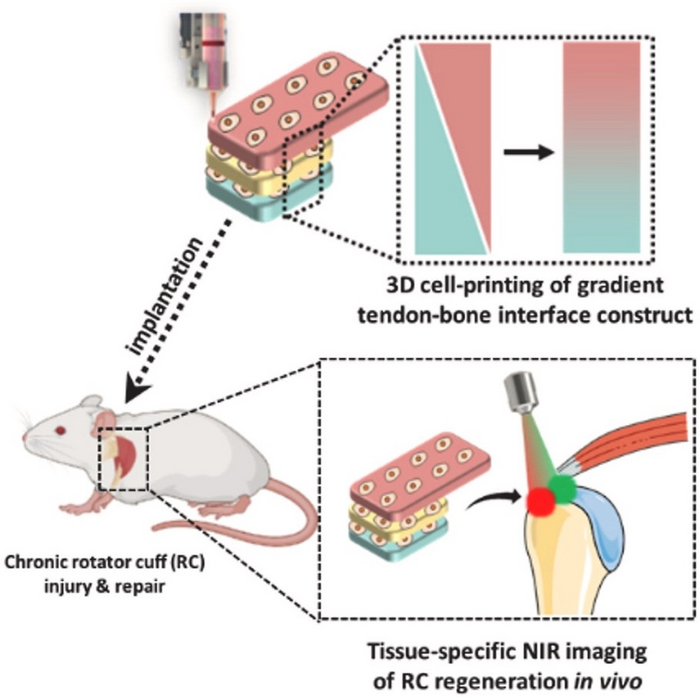
A POSTECH research team, comprised of Professor Dong-Woo Cho and Dr. Suhun Chae in the Department of Mechanical Engineering, and Professor Jinah Jang and Ph.D. candidate Uijung Yong in the Department of Convergence IT Engineering, has developed a complex tissue platform that can restore damaged rotator cuffs through a joint study with Professor Hak Soo Choi inthe Harvard Medical School. Tissue-specific extracellular matrix bioink is used to 3D-bioprint this platform, which can accurately mimic the complex structure of rotator cuffs.
This research outcome, which can give new hope to patients suffering from chronic shoulder pain, was recently published in the international journal Bioactive Materials.
The research team transplanted this platform to rats with full-thickness tears of the rotator cuffs, and observed regeneration of their tissues and shoulder function recovery. As a result, it was confirmed that this platform, which includes stem cells, can indeed regenerate rotator cuffs.
Notably, the team succeeded in visualizing this process by using near-infrared fluorescence imaging coupled with tissue-specific bioimaging agents. With this, the researchers were able to monitor anatomic change and regeneration processes in the animal model in real time in a non-invasive manner.
This platform offers a microenvironment and components similar to those of the actual tissue. Therefore, once applied to patients, it is expected to have high treatment benefits and eventual recovery of shoulder function. It is particularly beneficial for those patients who cannot use autologous tissues to regenerate rotator cuffs by providing a customized treatment option.
This study was supported by the Nano-materials Core Technology Development project of the National Research Foundation of Korea and the National Institute of Biomedical Imaging and Bioengineering (NIBIB) in the U.S.
Credit: POSTECH
The average office worker often endures pain in many parts of the body as a side effect to sedentary desk jobs. It is not rare to see even young people suffer from shoulder pain, which previously had been mainly experienced by older people. Once shoulder pain is inflicted, changing clothes, let alone freely moving parts of the body, is difficult. Falling asleep is also not easy. While the rotator cuffs are commonly damaged naturally with aging, regenerating it has proved to be challenging.
A POSTECH research team, comprised of Professor Dong-Woo Cho and Dr. Suhun Chae in the Department of Mechanical Engineering, and Professor Jinah Jang and Ph.D. candidate Uijung Yong in the Department of Convergence IT Engineering, has developed a complex tissue platform that can restore damaged rotator cuffs through a joint study with Professor Hak Soo Choi inthe Harvard Medical School. Tissue-specific extracellular matrix bioink is used to 3D-bioprint this platform, which can accurately mimic the complex structure of rotator cuffs.
This research outcome, which can give new hope to patients suffering from chronic shoulder pain, was recently published in the international journal Bioactive Materials.
The research team transplanted this platform to rats with full-thickness tears of the rotator cuffs, and observed regeneration of their tissues and shoulder function recovery. As a result, it was confirmed that this platform, which includes stem cells, can indeed regenerate rotator cuffs.
Notably, the team succeeded in visualizing this process by using near-infrared fluorescence imaging coupled with tissue-specific bioimaging agents. With this, the researchers were able to monitor anatomic change and regeneration processes in the animal model in real time in a non-invasive manner.
This platform offers a microenvironment and components similar to those of the actual tissue. Therefore, once applied to patients, it is expected to have high treatment benefits and eventual recovery of shoulder function. It is particularly beneficial for those patients who cannot use autologous tissues to regenerate rotator cuffs by providing a customized treatment option.
This study was supported by the Nano-materials Core Technology Development project of the National Research Foundation of Korea and the National Institute of Biomedical Imaging and Bioengineering (NIBIB) in the U.S.
Journal
Bioactive Materials
DOI
10.1016/j.bioactmat.2022.05.004
Article Title
3D cell-printing of gradient multi-tissue interfaces for rotator cuff regeneration
Article Publication Date
11-May-2022