Anyone who has seen a cat experience catnip knows that it makes them go a bit wild – they rub in it, roll on it, chew it, and lick it aggressively. It is widely accepted that this plant, and its Asian counterpart, silvervine, have intoxicative properties, but this might not be the only reason that cats rub on and chew the plants so enthusiastically. Researchers in Japan have found that when cats damage catnip, much higher amounts of strong insect repellents are released, indicating that the cats’ behavior protects them from pests. This study appears in the journal iScience on June 14.
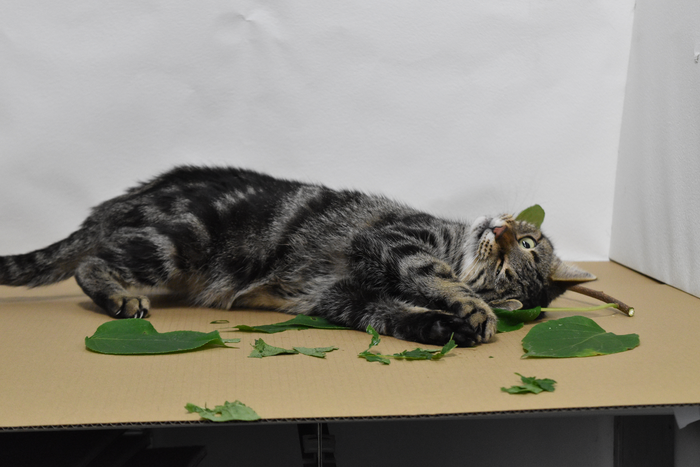
Credit: Masao Miyazaki
Anyone who has seen a cat experience catnip knows that it makes them go a bit wild – they rub in it, roll on it, chew it, and lick it aggressively. It is widely accepted that this plant, and its Asian counterpart, silvervine, have intoxicative properties, but this might not be the only reason that cats rub on and chew the plants so enthusiastically. Researchers in Japan have found that when cats damage catnip, much higher amounts of strong insect repellents are released, indicating that the cats’ behavior protects them from pests. This study appears in the journal iScience on June 14.
Cats’ reaction to catnip and silvervine is so ubiquitous that lead author Masao Miyazaki, an animal behavior researcher at Iwate University, had to know what was going on. “Even in the famous musical Cats there are scenes where you see a cat intoxicate another cat using catnip powder,” he says. Miyazaki began his career in veterinary medicine and developed an interest in how chemicals, such as pheromones, drive companion animals’ instinctual behaviors.
Catnip and silvervine leaves contain the compounds nepetalactol and nepetalactone, iridoids that protect the plants from pests. To see how cats’ behavior was affecting the chemicals released by the plants, Miyazaki worked with chemists at Nagoya University. “We found that physical damage of silvervine by cats promoted the immediate emission of total iridoids, which was 10-fold higher than from intact leaves,” says Miyazaki.
Not only were more iridoids released, but their composition changed in ways that seemed to encourage the cats. “Nepetalactol accounts for over 90% of total iridoids in intact leaves, but this drops to about 45% in damaged leaves as other iridoids greatly increase,” says Miyazaki. “The altered iridoid mixture corresponding to damaged leaves promoted a much more prolonged response in cats.”
In previous work, Miyazaki and his team showed that these compounds effectively repel Aedes albopictus mosquitoes. Now the team has shown that when cats damage the plants by rubbing, rolling, licking, and chewing, the repellent properties are even more effective. The diversification of iridoids in damaged silver vine leaves makes it more repellent to mosquitoes at low concentration.
To test if the felines were reacting to these compounds specifically, the cats were given dishes with pure nepetalactone and nepetalactol. “Cats show the same response to iridoid cocktails and natural plants except for chewing,” says Miyazaki. They lick the chemicals on the plastic dish and rub against and roll over on the dish.”
“When iridoid cocktails were applied on the bottom of dishes that were then covered by a punctured plastic cover, cats still exhibited licking and chewing even though they couldn’t contact the chemicals directly,” says Miyazaki. “This means that licking and chewing is an instinctive behavior elicited by olfactory stimulation of iridoids.”
Next, Miyazaki and his team want to understand which gene is responsible for cats’ reaction to catnip and silvervine. “Our future studies promise to answer the key remaining questions of why this response is limited to Felidae species, and why some cats don’t respond to these plants,” says Miyazaki.
###
This research was funded by JSPS KAKENHI, the Suntory Foundation for Life Sciences, and the Sasakawa Scientific Research Grant from The Japan Science Society.
iScience, Uenoyama et al. “Domestic cat damage to plant leaves containing iridoids enhances chemical repellency to pests” https://www.cell.com/iscience/fulltext/S2589-0042(22)00726-X
iScience (@iScience_CP) is an open-access journal from Cell Press that provides a platform for original research and interdisciplinary thinking in the life, physical, and earth sciences. The primary criterion for publication in iScience is a significant contribution to a relevant field combined with robust results and underlying methodology. Visit: http://www.cell.com/iscience. To receive Cell Press media alerts, contact [email protected].
Journal
iScience
DOI
10.1016/j.isci.2022.104455
Method of Research
Experimental study
Subject of Research
Animals
Article Title
Domestic cat damage to plant leaves containing iridoids enhances chemical repellency to pests
Article Publication Date
14-Jun-2022