


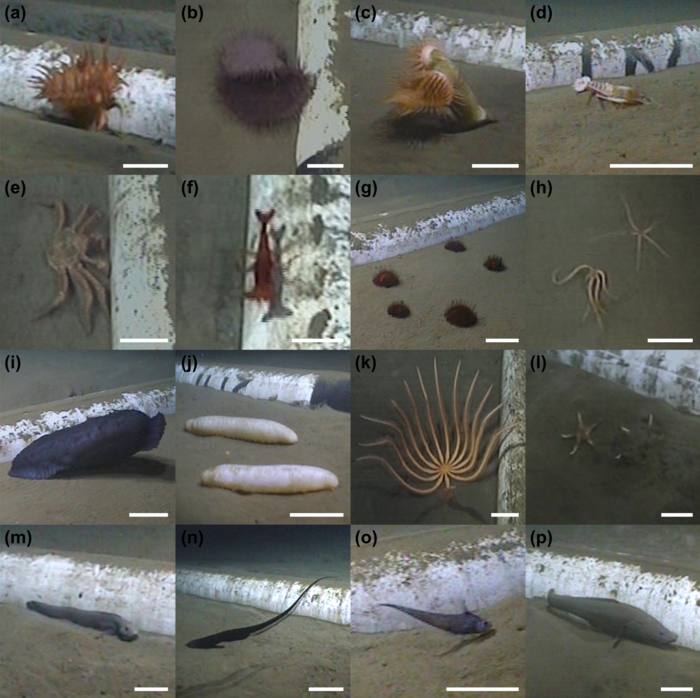
An underwater survey west of Africa, off the Angolan coast, found that both the abundance and types of animals on the deep-sea floor increased significantly in response to the installation of a pipeline. Published in Frontiers in Marine Science, the study also revealed a large increase in the amount of litter on the seafloor, which was trapped against the pipeline.
Credit: Biede, Jones, Gates, Pfeifer, Collins, and Santos
An underwater survey west of Africa, off the Angolan coast, found that both the abundance and types of animals on the deep-sea floor increased significantly in response to the installation of a pipeline. Published in Frontiers in Marine Science, the study also revealed a large increase in the amount of litter on the seafloor, which was trapped against the pipeline.
“In a short space of time the installation of a pipeline led to increases in the abundance and diversity of marine life in most areas,” said Daniel Jones, associate head of ocean biogeosciences at the National Oceanography Centre, UK, and author of this study.
“We believe this could be related to the pipeline providing shelter and trapping organic matter that the animals feed on.”
He adds, “It was also surprising to see the huge amount of litter, which consisted of plastic bags, bottles and aluminum cans, as this is a remote area ranging from 700 to 1400 meters deep.”
Industry partnership
A collaboration between the deep-sea researchers and the oil and gas industry, the study emerged from a routine industry inspection of the seafloor and pipeline.
“We have a long-running collaboration with BP in Angola to use survey imagery material for science,” explained Andrew Gates, coauthor of this study, who is also based at the National Oceanography Centre.
“We realized as soon as we saw the footage that it would allow us to explore how the marine life changed after the introduction of a pipeline. Doing this sort of survey is very difficult and expensive, so we were pleased to be able to make use of the footage to understand the deep-sea biology a bit better. This adds real value to video footage originally collected to inspect the pipeline”
“The video was collected by an ROV – a remotely operated vehicle,” continues Jones.
“An ROV is a car-sized robot that works deep under the sea and is controlled via an umbilical cable that is connected to a ship on the surface.”
The team of researchers used video footage from the ROV and identified all the animals that they could see. This included sea cucumbers, star fish, anemones, and fishes.
“This study provides valuable information on the poorly known seafloor animals off the Angolan coast. In addition, studies like ours help to predict the possible consequences and management of a range of human activities in the deep ocean, including oil and gas extraction and the decommissioning of marine structures like oil rigs. The information also helps us understand the potential for the restoration of marine environments after they have been impacted by human activities,” explained Gates.
Potentially new species
In the future, the researchers would like to go back and collect some of the animals they saw in the video.
“It is generally not possible to identify animals in images to species level, as you can’t see their important distinctive details. We expect that some of the animals living in the area will be new to science, and by making collections we would be able to determine and describe the species found,” says Gates.
Jones continues, “We would also like to continue to monitor the pipeline to see how the animals respond over time to the presence of the structure. As time goes on, we would expect to see some impressive animals, such as deep-sea corals and sponges, growing on the structure. Knowing how long this process takes would be really valuable.”
Journal
Frontiers in Marine Science
DOI
10.3389/fmars.2022.880453
Method of Research
Observational study
Subject of Research
Animals
Article Title
Short-term response of deep-water benthic megafauna to installation of a pipeline over a depth gradient on the Angolan slope
Article Publication Date
14-Jun-2022
COI Statement
The authors declare that the research was conducted in the absence of any commercial or financial relationships that could be construed as a potential conflict of interest.

