• HOME
  • NEWS
  • EXPLORE
    • CAREER
      • Companies
      • Jobs
    • EVENTS
    • iGEM
      • News
      • Team
    • PHOTOS
    • VIDEO
    • WIKI
  • BLOG
  • COMMUNITY
    • FACEBOOK
    • INSTAGRAM
    • TWITTER
Tuesday, October 6, 2026
BIOENGINEER.ORG
No Result
View All Result
  • Login
  • HOME
  • NEWS
  • EXPLORE
    • CAREER
      • Companies
      • Jobs
        • Lecturer
        • PhD Studentship
        • Postdoc
        • Research Assistant
    • EVENTS
    • iGEM
      • News
      • Team
    • PHOTOS
    • VIDEO
    • WIKI
  • BLOG
  • COMMUNITY
    • FACEBOOK
    • INSTAGRAM
    • TWITTER
No Result
View All Result
Bioengineer.org
No Result
View All Result
Home NEWS Science News

Our galaxy’s black hole is spewing out planet-size ‘spitballs’

Bioengineer by Bioengineer
January 11, 2017
in Science News
Reading Time: 2 mins read
0
Share on FacebookShare on TwitterShare on LinkedinShare on RedditShare on Telegram
IMAGE

Credit: Mark A. Garlick / CfA

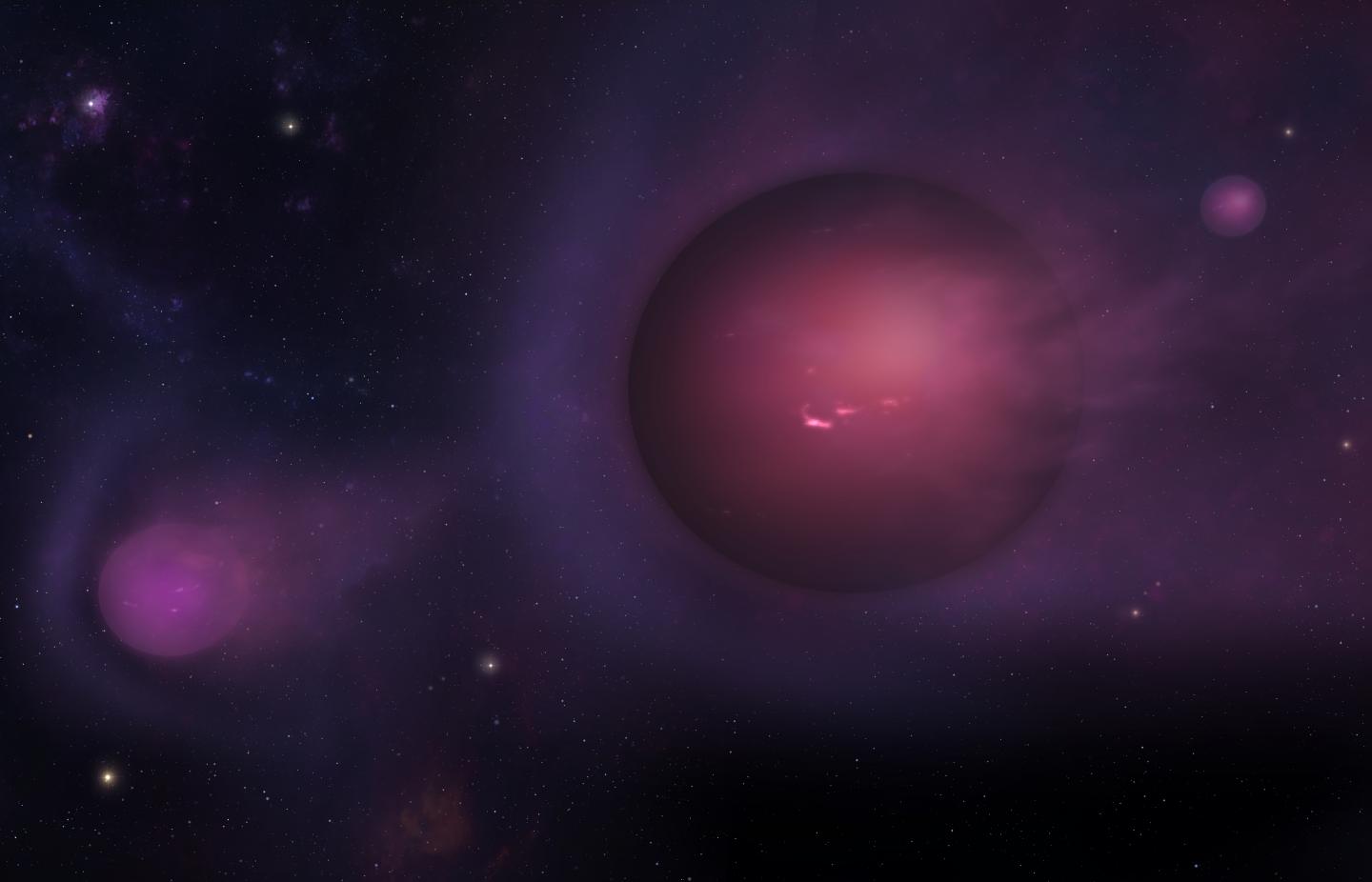
Every few thousand years, an unlucky star wanders too close to the black hole at the center of the Milky Way. The black hole's powerful gravity rips the star apart, sending a long streamer of gas whipping outward. That would seem to be the end of the story, but it's not. New research shows that not only can the gas gather itself into planet-size objects, but those objects then are flung throughout the galaxy in a game of cosmic "spitball."

"A single shredded star can form hundreds of these planet-mass objects. We wondered: Where do they end up? How close do they come to us? We developed a computer code to answer those questions," says lead author Eden Girma, an undergraduate student at Harvard University and a member of the Banneker/Aztlan Institute.

Girma presented her findings at a Wednesday poster session and Friday press conference at a meeting of the American Astronomical Society.

Girma's calculations show that the closest of these planet-mass objects might be within a few hundred light-years of Earth. It would have a weight somewhere between Neptune and several Jupiters. It would also glow from the heat of its formation, although not brightly enough to have been detected by previous surveys. Future instruments like the Large Synoptic Survey Telescope and James Webb Space Telescope might spot these far-flung oddities.

She also finds that the vast majority of the planet-mass objects – 95 percent – will leave the galaxy entirely due to their speeds of about 20 million miles per hour (10,000 km/s). Since most other galaxies also have giant black holes at their cores, it's likely that the same process is at work in them.

"Other galaxies like Andromeda are shooting these 'spitballs' at us all the time," says co-author James Guillochon of the Harvard-Smithsonian Center for Astrophysics (CfA).

Although they might be planet-size, these objects would be very different from a typical planet. They are literally made of star-stuff, and since different ones would develop from different pieces of the former star, their compositions could vary.

They also form much more rapidly than a normal planet. It takes only a day for the black hole to shred the star (in a process known as tidal disruption), and only about a year for the resulting fragments to pull themselves back together. This is in contrast to the millions of years required to create a planet like Jupiter from scratch.

Once launched, it would take about a million years for one of these objects to reach Earth's neighborhood. The challenge will be to tell it apart from free-floating planets that are created during the more mundane process of star and planet formation.

"Only about one out of a thousand free-floating planets will be one of these second-generation oddballs," adds Girma.

###

Media Contact

Christine Pulliam
[email protected]
617-495-7463
@saoastro

http://cfa-www.harvard.edu

############

Story Source: Materials provided by Scienmag

Share12Tweet8Share2ShareShareShare2

Related Posts

Platelet-Powered Cartilage Cells Move Closer to the Clinic With a New GMP Blueprint

Platelet-Powered Cartilage Cells Move Closer to the Clinic With a New GMP Blueprint

October 6, 2026
New AI Explainer Finds Extreme Data Archetypes That SHAP and LIME Miss

New AI Explainer Finds Extreme Data Archetypes That SHAP and LIME Miss

October 6, 2026

Huntsman Cancer Institute Names Theresa Werner Chief of Oncology Division

October 6, 2026

Fermentation Waste Duo Rescues Pak Choi From Salt Stress at Just the Right Dose

October 6, 2026
Please login to join discussion

POPULAR NEWS

  • Alloys That Shrink Their Own Grains: New PIX Mechanism Refines Metals With Heat Alone

    Alloys That Shrink Their Own Grains: New PIX Mechanism Refines Metals With Heat Alone

    29 shares
    Share 12 Tweet 7
  • Endurance Exercise Reshapes the Liver in Males and Females Through Distinct Molecular Routes

    29 shares
    Share 12 Tweet 7
  • Single Transcription Factor PU.1 Rapidly Converts Fibroblasts into Macrophage-Lineage Cells

    29 shares
    Share 12 Tweet 7
  • New Scale Measures How Ready Nurse Educators Really Are for the AI Era

    29 shares
    Share 12 Tweet 7

About

We bring you the latest biotechnology news from best research centers and universities around the world. Check our website.

Follow us

Recent News

Alloys That Shrink Their Own Grains: New PIX Mechanism Refines Metals With Heat Alone

Endurance Exercise Reshapes the Liver in Males and Females Through Distinct Molecular Routes

Single Transcription Factor PU.1 Rapidly Converts Fibroblasts into Macrophage-Lineage Cells

Subscribe to Blog via Email

Success! An email was just sent to confirm your subscription. Please find the email now and click 'Confirm' to start subscribing.

Join 85 other subscribers
  • Contact Us

Bioengineer.org © Copyright 2023 All Rights Reserved.

Welcome Back!

Login to your account below

Forgotten Password?

Retrieve your password

Please enter your username or email address to reset your password.

Log In
No Result
View All Result
  • Homepages
    • Home Page 1
    • Home Page 2
  • News
  • National
  • Business
  • Health
  • Lifestyle
  • Science

Bioengineer.org © Copyright 2023 All Rights Reserved.