During fetal development, before the biological clock starts ticking on its own, genes within the fetus’s developing clock respond to rhythmic behavior in the mother, according to a new study publishing May 24th in the open-access journal PLOS Biology by Alena Sumová and colleagues of the Czech Academy of Sciences in Prague. The findings contribute to our understanding of the development of the internal clock, and may have implications for the treatment of premature babies.
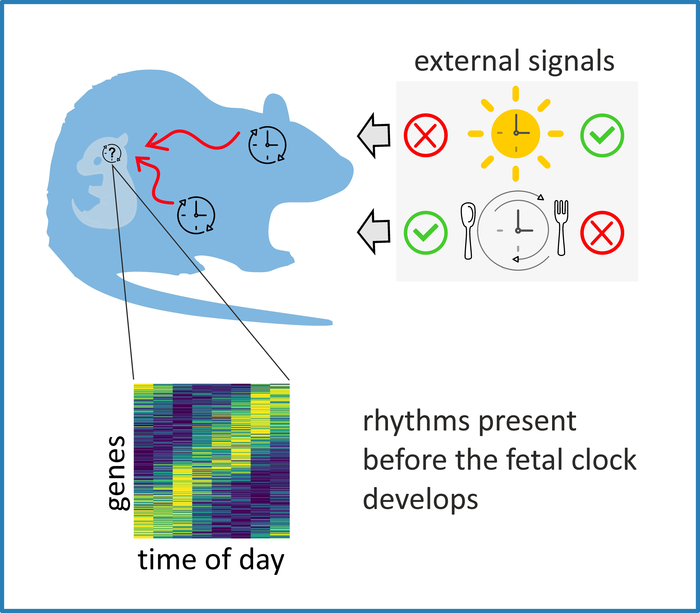
Credit: Alena Sumová and Martin Sládek (CC-BY 4.0, https://creativecommons.org/licenses/by/4.0/)
During fetal development, before the biological clock starts ticking on its own, genes within the fetus’s developing clock respond to rhythmic behavior in the mother, according to a new study publishing May 24th in the open-access journal PLOS Biology by Alena Sumová and colleagues of the Czech Academy of Sciences in Prague. The findings contribute to our understanding of the development of the internal clock, and may have implications for the treatment of premature babies.
The suprachiasmatic nuclei (SCN), structures within the hypothalamus, are the master timekeepers for the body. Rhythmic activity of genes in SCN cells in turn governs the activity of many other genes both locally and elsewhere in the body, ultimately influencing a wide variety of circadian rhythmic behavior, including feeding and sleeping. But that rhythmic gene activity begins in earnest relatively late in fetal development, raising the question of whether maternal influences entrain gene activity within the SCN prior to birth.
To explore that question, the authors compared the pattern of gene activity in SCN tissue from fetuses developing within pregnant rats kept in the dark, under two sets of conditions. Control rats had intact SCNs and free access to food, while lesioned rats had their SCNs disrupted but their access to food was limited to eight hours per day, to impose a circadian rhythm in their activity that their SCNs could no longer sustain.
They found that, within SCNs of both sets of fetuses, there was a very small set of genes whose timing pattern differed between the two groups, and a much larger set whose activity oscillated in sync with each other. Many of these latter genes could be assigned to two major processes—neuronal development and neuronal function, likely reflecting in the first case the ongoing development of the SCN as it wires itself up for mature function, and in the second case the earliest manifestation of that function.
“Our data reveal that in development in the fetal suprachiasmatic nuclei, maternal stimuli may substitute for an absent inter-cellular web of synapses and drive cell-population rhythms before the SCN clock fully matures,” Sumová said. Because the rats used in these experiments have a gestational period of about 21 days, and the fetuses were examined at 19 days, these results may have implications for premature human babies, she added.
“The unexpected broadness and specificity of responsiveness of the SCN cells to maternal signals stresses the importance of a healthy maternal circadian system during pregnancy, and points at the potential impact of the absence of such signals in prematurely delivered children.”
Sumová adds, “Our study reveals that distinct maternal signals rhythmically control a variety of neuronal processes in the fetal rat suprachiasmatic nuclei before they begin to operate as the central circadian clock. The results indicate the importance of a well-functioning maternal biological clock in providing rhythmic environment during the fetal brain development.”
#####
In your coverage, please use this URL to provide access to the freely available paper in PLOS Biology: http://journals.plos.org/plosbiology/article?id=10.1371/journal.pbio.3001637
Citation: Greiner P, Houdek P, Sládek M, Sumová A (2022) Early rhythmicity in the fetal suprachiasmatic nuclei in response to maternal signals detected by omics approach. PLoS Biol 20(5): e3001637. https://doi.org/10.1371/journal.pbio.3001637
Author Countries: Czech Republic
Funding: The study was supported by the Czech Science Foundation grant number 19-01845S (to A.S.) and the Research Project RV0: 67985823. The funders had no role in study design, data collection and analysis, decision to publish, or preparation of the manuscript.
Journal
PLoS Biology
DOI
10.1371/journal.pbio.3001637
Method of Research
Experimental study
Subject of Research
Animals
COI Statement
Competing interests: The authors have declared that no competing interests exist.