WASHINGTON, May 10, 2022 – Medical interventions, such as improving diet, lowering blood lipids, or controlling blood pressure and blood sugar, can only do so much when it comes to treating atherosclerotic disease. Is it possible to make earlier predictions for risk factors for plaque formation within the carotid arteries via characteristics of vascular structure and the dynamics of blood flow before the disease progresses?
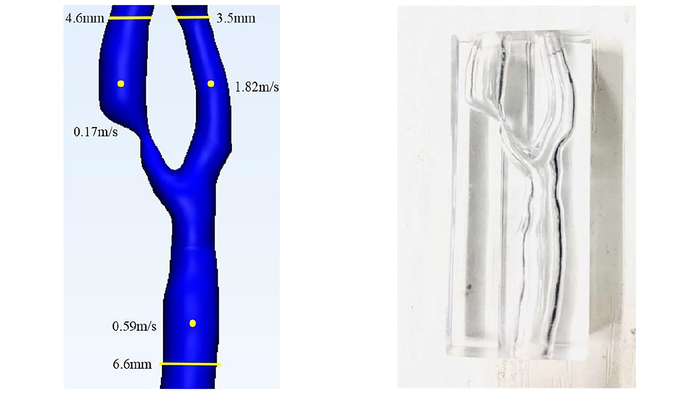
Credit: Zhiyong Song, Pengrui Zhu, Lianzhi Yang, Zhaohui Liu, Hua Li, and Weiyao Zhu
WASHINGTON, May 10, 2022 – Medical interventions, such as improving diet, lowering blood lipids, or controlling blood pressure and blood sugar, can only do so much when it comes to treating atherosclerotic disease. Is it possible to make earlier predictions for risk factors for plaque formation within the carotid arteries via characteristics of vascular structure and the dynamics of blood flow before the disease progresses?
In Physics of Fluids, from AIP Publishing, researchers in China present clinicians with information about the risk factors for atherosclerotic plaque formation from a mechanical point of view. The scientists are exploring whether it is possible to screen and intervene early for people at risk for atherosclerotic disease from the perspective of hemodynamics, using color Doppler ultrasound, coronary computed tomography angiography, and other screenings.
“Carotid endarterectomy and carotid artery stenting are the main methods for treatment of carotid artery stenosis,” said Zhiyong Song, from the University of Science and Technology Beijing. “Changes of postoperative vascular structure and fluid mechanics are important for restenosis, so determining how to minimize risk factors of postoperative flow is important for improving the therapeutic effect.”
A multipoint, noncontact laser flow measurement method called microparticle image velocimetry (Micro-PIV) was used by the researchers, something they said has been continuously improved during the past few decades and exceeds the limitations of single-point measurement technologies.
“It could record speed distribution information on a large number of spatial points within the same transient state to provide rich spatial structure of flow field and flow characteristics,” said Song.
The researchers discovered a significant gap between their study and the clinical method in terms of wall shear strength calculation, which could lead to confusion about the physiological mechanism.
“Based on the plateau-like distribution of the velocity field at the central carotid stenosis location shown by Micro-PIV and simulations, the current clinical estimation method of wall shear stress at the stenosis location could result in a difference of up to 60%,” Song said.
The group’s hemodynamic study of carotid atherosclerotic plaque has important clinical significance for understanding the formation and development mechanism of atherosclerotic disease, improving surgical treatment technology, and researching and developing future medical devices.
###
The article “Study on the radial sectional velocity distribution and wall shear stress associated with carotid artery stenosis” is authored by Zhiyong Song, Pengrui Zhu, Lianzhi Yang, Zhaohui Liu, Hua Li, and Weiyao Zhu. The article will appear in Physics of Fluids on May 10, 2022 (DOI: 10.1063/5.0085796). After that date, it can be accessed at https://aip.scitation.org/doi/10.1063/5.0085796.
ABOUT THE JOURNAL
Physics of Fluids is devoted to the publication of original theoretical, computational, and experimental contributions to the dynamics of gases, liquids, and complex fluids. See https://aip.scitation.org/journal/phf.
###
Journal
Physics of Fluids
DOI
10.1063/5.0085796
Article Title
Study on the radial sectional velocity distribution and wall shear stress associated with carotid artery stenosis
Article Publication Date
10-May-2022