

• HOME
  • NEWS
  • EXPLORE
    • CAREER
      • Companies
      • Jobs
    • EVENTS
    • iGEM
      • News
      • Team
    • PHOTOS
    • VIDEO
    • WIKI
  • BLOG
  • COMMUNITY
    • FACEBOOK
    • INSTAGRAM
    • TWITTER
Wednesday, April 1, 2026
BIOENGINEER.ORG
No Result
View All Result
  • Login
  • HOME
  • NEWS
  • EXPLORE
    • CAREER
      • Companies
      • Jobs
        • Lecturer
        • PhD Studentship
        • Postdoc
        • Research Assistant
    • EVENTS
    • iGEM
      • News
      • Team
    • PHOTOS
    • VIDEO
    • WIKI
  • BLOG
  • COMMUNITY
    • FACEBOOK
    • INSTAGRAM
    • TWITTER
  • HOME
  • NEWS
  • EXPLORE
    • CAREER
      • Companies
      • Jobs
        • Lecturer
        • PhD Studentship
        • Postdoc
        • Research Assistant
    • EVENTS
    • iGEM
      • News
      • Team
    • PHOTOS
    • VIDEO
    • WIKI
  • BLOG
  • COMMUNITY
    • FACEBOOK
    • INSTAGRAM
    • TWITTER
No Result
View All Result
Bioengineer.org
No Result
View All Result
Home NEWS Science News Biology

Chemistry professor utilizes virtual reality to give UTSA students unique look at proteins

Bioengineer by Bioengineer
May 10, 2022
in Biology
Reading Time: 2 mins read
0
UTSA students use virtual reality headsets in biochemistry lab
Share on FacebookShare on TwitterShare on LinkedinShare on RedditShare on Telegram

Francis Yoshimoto, assistant professor in the UTSA College of Sciences’ Department of Chemistry, is introducing his Biochemistry II laboratory students to a new way of learning—using virtual reality headsets to observe and analyze protein structures.
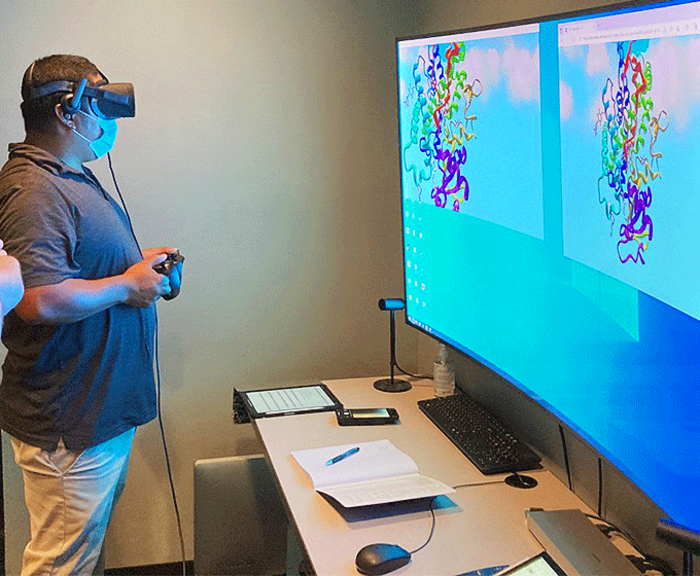
UTSA students use virtual reality headsets in biochemistry lab

Credit: The University of Texas at San Antonio

Francis Yoshimoto, assistant professor in the UTSA College of Sciences’ Department of Chemistry, is introducing his Biochemistry II laboratory students to a new way of learning—using virtual reality headsets to observe and analyze protein structures.

Yoshimoto’s students utilized the Department of Computer Science’s VizLab to set up these virtual reality (VR) headsets. Students created snapshots of a protein using traditional computer software—such as Chimera or Pymol—and then went to the same region of the protein in ProteinVR, a web-based molecular visualization program that allows one to see proteins with a VR headset.

After comparing the two images, the students prepared 3D snapshots of other proteins and their interactions with ligands or protein partners by searching the protein databank for other human health-related proteins, such as the SARS CoV-2 spike protein, which the coronavirus uses to invade human cells.

The 3D VR headsets proved an effective way to instruct students about protein structures—immersing them in a unique learning experience. Under the ProteinVR viewer with the Oculus headset, students could change their viewing angles of the protein and navigate forward and backward using the joystick on the Oculus hand controller. With the headset on, students could travel inside the protein. If they wanted to move in a different direction around the protein, they could simply tilt their heads while wearing the headset and continue to move forward and backward with the joystick.

“For over 15 years, I have been looking at proteins just on my computer screen,” Yoshimoto said. “Putting a virtual reality headset on to go inside an actual protein was truly an eye-opening experience for both myself and my students.”

Virtual reality technology is already in use in the biomedical industry. It has, for example, been used to aid pharmaceutical businesses in their work designing novel drugs—a recent advancement for developing new medicines. By receiving exposure and training in VR technology, Yoshimoto’s students were able to apply the skills they learn in the classroom in a way that is relevant to a future career in biomedical research. The project is representative of UTSA’s commitment to programs that provide students with a greater understanding of marketable skills needed in the workplace and are particularly important in linking classroom success to life after graduation for historically underserved populations.

Yoshimoto and his lab instructors partnered with the university’s Research Computing Support Group to arrange this VR learning experience.

UTSA is a Tier One research university and a Hispanic Serving Institution specializing in cyber, health, fundamental futures, and social-economic transformation. The university aspires to become a model for student success, a great public research university, and an exemplar for strategic growth and innovative excellence.



Share12Tweet8Share2ShareShareShare2

Related Posts

Do Your Genes Influence How Lifestyle Choices Affect Aging?

Do Your Genes Influence How Lifestyle Choices Affect Aging?

April 1, 2026
Combining Single-Cell Multiomics Unlocks Precise Identification of Rare Cell Types and States

Combining Single-Cell Multiomics Unlocks Precise Identification of Rare Cell Types and States

March 31, 2026

Genetically Engineered Marmosets Pave the Way for Advancements in Human Deafness Research

March 31, 2026

How Great Hammerhead Sharks Outsmart Ocean Temperature Swings: Insights from FIU Researchers

March 31, 2026

POPULAR NEWS

  • blank

    Revolutionary AI Model Enhances Precision in Detecting Food Contamination

    96 shares
    Share 38 Tweet 24
  • Imagine a Social Media Feed That Challenges Your Views Instead of Reinforcing Them

    1006 shares
    Share 398 Tweet 249
  • Promising Outcomes from First Clinical Trials of Gene Regulation in Epilepsy

    51 shares
    Share 20 Tweet 13
  • Popular Anti-Aging Compound Linked to Damage in Corpus Callosum, Study Finds

    43 shares
    Share 17 Tweet 11

About

We bring you the latest biotechnology news from best research centers and universities around the world. Check our website.

Follow us

Recent News

Frailty, Malnutrition Link Falls to Daily Functioning

Dactylides D, E: Novel 22-Membered Polyol Macrolides

Longer Leukocyte Telomeres Linked to Premature Membrane Rupture

Subscribe to Blog via Email

Enter your email address to subscribe to this blog and receive notifications of new posts by email.

Join 78 other subscribers
  • Contact Us

Bioengineer.org © Copyright 2023 All Rights Reserved.

Welcome Back!

Login to your account below

Forgotten Password?

Retrieve your password

Please enter your username or email address to reset your password.

Log In
No Result
View All Result
  • Homepages
    • Home Page 1
    • Home Page 2
  • News
  • National
  • Business
  • Health
  • Lifestyle
  • Science

Bioengineer.org © Copyright 2023 All Rights Reserved.