Individual traits seem to drive our learning success: for instance, conscientious individuals often show higher academic performance. A group of cognitive and behavioural biologists from University of Vienna conducted personality assessments and a battery of learning tests with common marmosets and found that such a link, intertwined with family group membership, exists in these monkeys, too. The study results were recently published in the journal Scientific Reports.
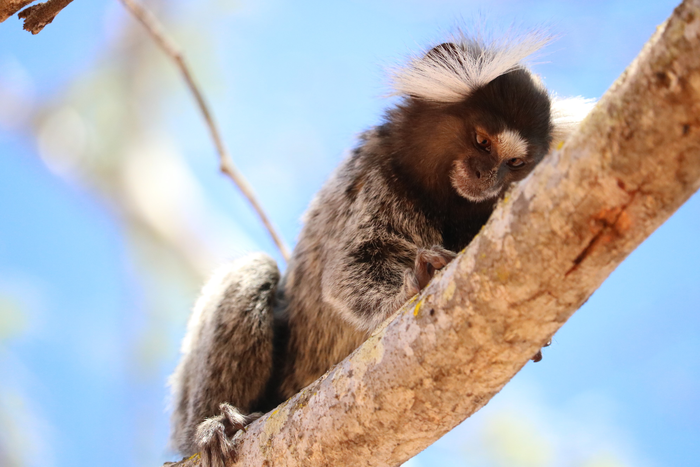
Credit: © Vedrana Šlipogor
Individual traits seem to drive our learning success: for instance, conscientious individuals often show higher academic performance. A group of cognitive and behavioural biologists from University of Vienna conducted personality assessments and a battery of learning tests with common marmosets and found that such a link, intertwined with family group membership, exists in these monkeys, too. The study results were recently published in the journal Scientific Reports.
It has long been thought that only humans have personalities, but in recent decades personalities have been found in animals from spiders to apes. Similar personality traits are often shared between animals characterized as “friends” and sometimes even their whole social groups. Personalities have been linked to many life-history traits, but also to cognitive capabilities, like academic or work performance in humans. In animals, it has been suggested that more explorative and/or bolder individuals learn to solve various learning tasks faster. However, once they form these associations, they may be less flexible in reversing the learned links (as per the speed-accuracy trade-off model). Thus, in the new research article, Vedrana Šlipogor and colleagues from University of Vienna focused on exploring whether such a link is also present in common marmosets, cooperatively breeding monkey species that parallel humans in many socio-cognitive traits, and to which extent this is interlinked with their family group membership.
The researchers first individually assessed personality of these monkeys by measuring their reactions in various tasks, like their engagement with novel or strange objects, new types of food, or time needed to approach a toy snake. With help of these tasks, they found that some monkeys were very explorative and bold, whereas others rather tried to avoid the stimuli and keep a distance. The researchers then assessed the monkeys’ learning performance in several learning tasks. For instance, in the simpler learning tasks, the monkeys were trained to hold a ‘target’ training stick, to stand on a weighing scale while holding a ‘target’ stick, and to reach the furthest point in the test set-up. The monkeys’ learning skills were also tested in other tasks, that were more challenging, where they had to either form an association between objects of the same size, but of different colours and shape, or between objects that had the same features, but had different sizes.
Female marmosets learned overall faster than male marmosets
Similar to findings in other animal species, marmoset monkeys learned consistently well across different cognitive tasks. The tested females learned overall faster than males. The authors’ results largely supported the speed-accuracy trade-off framework: personality (in particular, trait Boldness-Shyness) predicted learning speed in these monkeys. However, social factors were also important: family group membership of these monkeys, especially when interlinked with their bold-shy tendencies seemed to affect how quickly they learn, across different tasks. In particular, bolder monkeys learned faster than shy ones, which was especially evident for members of some family groups. The effect that belonging to certain family groups influenced learning speed may be due to shared social environment, previous mutual experiences, but also genetics. In evolutionary sense, that both personality and social environment affect learning is indeed plausible as bolder individuals are usually those that act upon new situations, and/or new or challenging physical and social environments. Such complex environments could then select for higher socio-cognitive performance.
“It seems that both certain personality traits as well as social environment have an effect on individual variation in cognition in marmoset monkeys”, Šlipogor says. “In our future studies we aim to see whether these findings hold with other tasks that are perhaps more cognitively demanding for the monkeys, and whether this effect can be found in other highly social animals with similar socio-ecological features.”
Journal
Scientific Reports
DOI
10.1038/s41598-022-10296-8
Article Title
Personality and social environment predict cognitive performance in common marmosets (Callithrix jacchus)
Article Publication Date
5-May-2022