• HOME
  • NEWS
  • EXPLORE
    • CAREER
      • Companies
      • Jobs
    • EVENTS
    • iGEM
      • News
      • Team
    • PHOTOS
    • VIDEO
    • WIKI
  • BLOG
  • COMMUNITY
    • FACEBOOK
    • INSTAGRAM
    • TWITTER
Wednesday, April 1, 2026
BIOENGINEER.ORG
No Result
View All Result
  • Login
  • HOME
  • NEWS
  • EXPLORE
    • CAREER
      • Companies
      • Jobs
        • Lecturer
        • PhD Studentship
        • Postdoc
        • Research Assistant
    • EVENTS
    • iGEM
      • News
      • Team
    • PHOTOS
    • VIDEO
    • WIKI
  • BLOG
  • COMMUNITY
    • FACEBOOK
    • INSTAGRAM
    • TWITTER
  • HOME
  • NEWS
  • EXPLORE
    • CAREER
      • Companies
      • Jobs
        • Lecturer
        • PhD Studentship
        • Postdoc
        • Research Assistant
    • EVENTS
    • iGEM
      • News
      • Team
    • PHOTOS
    • VIDEO
    • WIKI
  • BLOG
  • COMMUNITY
    • FACEBOOK
    • INSTAGRAM
    • TWITTER
No Result
View All Result
Bioengineer.org
No Result
View All Result
Home NEWS Science News

Hubble’s front row seat when galaxies collide

Bioengineer by Bioengineer
January 10, 2017
in Science News
Reading Time: 1 min read
0
Share on FacebookShare on TwitterShare on LinkedinShare on RedditShare on Telegram
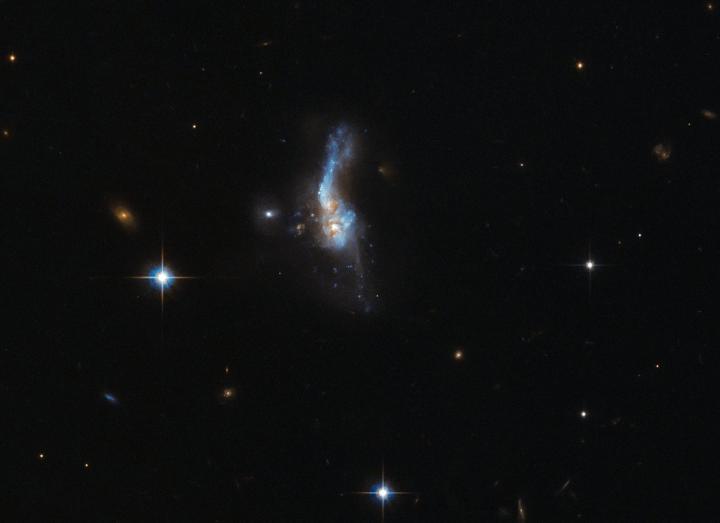
IMAGE

Credit: ESA/Hubble & NASA

This delicate smudge in deep space is far more turbulent than it first appears. Known as IRAS 14348-1447 — a name derived in part from that of its discoverer, the Infrared Astronomical Satellite (IRAS for short) — this celestial object is actually a combination of two gas-rich spiral galaxies. This doomed duo approached one another too closely in the past, gravity causing them to affect and tug at each other and slowly, destructively, merge into one. The image was taken by Hubble's Advanced Camera for Surveys (ACS).

IRAS 14348-1447 is located over a billion light-years away from us. It is one of the most gas-rich examples known of an ultraluminous infrared galaxy, a class of cosmic objects that shine characteristically — and incredibly — brightly in the infrared part of the spectrum. Almost 95% of the energy emitted by IRAS 14348-1447 is in the far-infrared! The huge amount of molecular gas within IRAS 14348-1447 fuels its emission, and undergoes a number of dynamical processes as it interacts and moves around; these very same mechanisms are responsible for IRAS 14348-1447's own whirling and ethereal appearance, creating prominent tails and wisps extending away from the main body of the galaxy.

###

Media Contact

Rob Gutro
[email protected]
@NASAGoddard

http://www.nasa.gov/goddard

############

Story Source: Materials provided by Scienmag
Share12Tweet8Share2ShareShareShare2

Related Posts

FSHR and LHR Compensation Unveils Ovarian Hyperstimulation Mechanisms

April 1, 2026
Creating Desktop Particle Accelerators to Open New Frontiers in Scientific Research

Creating Desktop Particle Accelerators to Open New Frontiers in Scientific Research

April 1, 2026

Do Your Genes Influence How Lifestyle Choices Affect Aging?

April 1, 2026

Urban Systems and Traffic: Unequal Two-Way Links

April 1, 2026
Please login to join discussion

POPULAR NEWS

  • blank

    Revolutionary AI Model Enhances Precision in Detecting Food Contamination

    96 shares
    Share 38 Tweet 24
  • Imagine a Social Media Feed That Challenges Your Views Instead of Reinforcing Them

    1006 shares
    Share 398 Tweet 249
  • Promising Outcomes from First Clinical Trials of Gene Regulation in Epilepsy

    51 shares
    Share 20 Tweet 13
  • Popular Anti-Aging Compound Linked to Damage in Corpus Callosum, Study Finds

    43 shares
    Share 17 Tweet 11

About

We bring you the latest biotechnology news from best research centers and universities around the world. Check our website.

Follow us

Recent News

FSHR and LHR Compensation Unveils Ovarian Hyperstimulation Mechanisms

Creating Desktop Particle Accelerators to Open New Frontiers in Scientific Research

Do Your Genes Influence How Lifestyle Choices Affect Aging?

Subscribe to Blog via Email

Enter your email address to subscribe to this blog and receive notifications of new posts by email.

Join 78 other subscribers
  • Contact Us

Bioengineer.org © Copyright 2023 All Rights Reserved.

Welcome Back!

Login to your account below

Forgotten Password?

Retrieve your password

Please enter your username or email address to reset your password.

Log In
No Result
View All Result
  • Homepages
    • Home Page 1
    • Home Page 2
  • News
  • National
  • Business
  • Health
  • Lifestyle
  • Science

Bioengineer.org © Copyright 2023 All Rights Reserved.