Organisms such as plants, mammals and insects undergo a carefully orchestrated developmental program as they transition from single-celled embryos to their multicellular adult forms. In a paper that appeared May 4, 2022 in the journal Nature, researchers at Princeton University demonstrate how specialized genetic sequences coordinate the exquisite choreography of gene expression required for normal development of the early fly embryo.
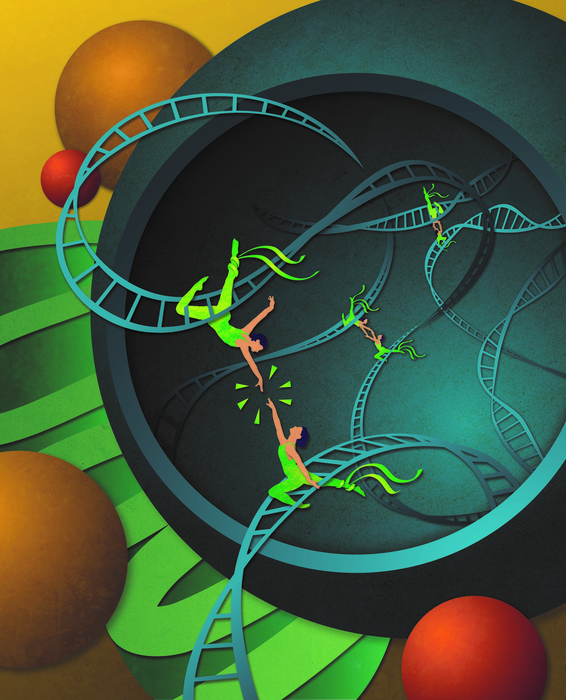
Credit: Image by Jeremy Guay at Peregrine Creative for Princeton University.
Organisms such as plants, mammals and insects undergo a carefully orchestrated developmental program as they transition from single-celled embryos to their multicellular adult forms. In a paper that appeared May 4, 2022 in the journal Nature, researchers at Princeton University demonstrate how specialized genetic sequences coordinate the exquisite choreography of gene expression required for normal development of the early fly embryo.
During embryonic development, specific sets of genes must be expressed during narrow windows of time in order to support the growth of the different embryonic tissues. Frequently, these genes consist of pairs or multiple copies of highly similar genes that are specialized for unique but interconnected roles in embryonic development. These genes are typically found on the same region of a chromosome, but the linear distances between them can be quite large.
To envision this situation, think of a chromosome as an unclasped bracelet and the genes as its decorative gemstone beads. The bracelet may be sparsely decorated so that the beads are far apart along the length of the bracelet. In addition, the beads may be located in such a way that two similar ones—genes with related functions—are separated by a bead of a different type that is used in a different developmental process.
“Genes are historically thought of as independent agents in controlling cell activities, organismal phenotypes, and inherited traits,” said Michael Levine, Princeton’s Anthony B. Evnin ’62 Professor in Genomics, professor in the Department of Molecular Biology, and director of the Lewis-Sigler Institute for Integrative Genomics. “Our study provides the first convincing evidence that three-dimensional proximity coordinates the activities of genes that are distant from each other along the length of the chromosome.”
Researchers believe that gene expression is controlled by regulatory sequences consisting of short stretches of DNA, called enhancers, that serve as attachment sites for the enzymes that promote gene expression. In the bracelet analogy, each gene’s bead would be accompanied by a smaller bead, often immediately adjacent, that works as an enhancer.
“It is commonly thought that in genomes of complex organisms, each gene has its own dedicated regulatory sequences that drives its precise activation at the right time and in the right cell,” said Michal Levo, the study’s co-first author and an associate research scholar working with Levine and Gregor. “However, cellular processes often involve multiple genes with overlapping activities, so the question is, how is such coordination obtained?” Levo said.
Levo, working with fellow associate research scholar and co-first author João Raimundo, tackled this question by investigating embryonic development in the fruit fly Drosophila melanogaster. Earlier work by researchers working with Levine had shown that genes and enhancers found at distant linear locations along a chromosome are brought into close physical proximity with each other via interactions between short stretches of DNA located nearby. These stretches of DNA constitute a novel type of regulatory elements, called tethering elements. They help genes that are otherwise located long genomic stretches apart on the same chromosome to come together in three-dimensional space. Working in pairs, tethering elements can hook different parts of the chromosomal bracelet together.
“Using high-resolution, whole-genome chromosome conformation capture assays, we identified 56 instances of long-range gene coupling in a one-hour period of Drosophila development,” said Thomas Gregor, a professor in the Department of Physics and the Lewis-Sigler Institute for Integrative Genomics, who collaborated with Levine’s team on their work.
“We show that across the genome, several genes can come into contact with each other and coordinate their activity by sharing the same enhancer,” Raimundo said.
That is, tethering elements dispense with the requirement for each gene to have its own independently regulated enhancer by physically bringing together related but distantly located genes together during development. This strategy allows multiple genes to come under the influence of the same enhancer, facilitating their co-expression.
“Remarkably, mutations in tethering elements near one gene cause dramatic alterations in the dynamics of the other gene over great linear distances, an observation without precedent,” Gregor said.
“In this study, the authors provide evidence that the co-regulation of genes through shared elements may be a general feature of animal genomes,” said Justin Crocker, a group leader at EMBL Heidelberg. Dr. Crocker was not involved in the work.
“This could represent a general strategy to integrate and coordinate the activities of distant regulatory genes, which could have far-ranging consequences for animal development and disease,” said Crocker.
The insights provided by this work help explain how the intricate dance of gene expression during embryonic development is choreographed, but the Princeton researchers are interested in expanding their studies even further. Although they have so far studied tethering elements only in the fly, Levo, Raimundo and colleagues anticipate that similar mechanisms are at work in other organisms, including humans, so they would like to expand their investigations to mammalian embryos. They’re also interested in probing whether tethering elements are involved in forming yet-undiscovered—and unexpected—connections in the genome that could lead to new discoveries about the origin and function of complex tissues.
The study, “Transcriptional coupling of distant regulatory genes in living embryos,” by Michal Levo, João Raimundo, Xin Yang Bing, Zachary Sisco, Philippe J. Batut, Sergey Ryabichko, Thomas Gregor and Michael S. Levine, was published in the journal Nature. DOI: 10.1038/s41586-022-04680-7
The work described in this story was supported in part by grants from the US National Science Foundation, through the Center for the Physics of Biological Function (PHY-1734030); the US National Institutes of Health Grants R01GM097275, U01DA047730, U01DK127429, R35 GM118147; a Human Frontier Science Program fellowship (LT000852/2016-L); an EMBO long-term postdoctoral fellowship (ALTF 1401-2015); and a Rothschild postdoctoral fellowship.
Journal
Nature
DOI
10.1038/s41586-022-04680-7
Method of Research
Experimental study
Subject of Research
Not applicable
Article Title
Transcriptional coupling of distant regulatory genes in living embryos
Article Publication Date
4-May-2022