• HOME
  • NEWS
  • EXPLORE
    • CAREER
      • Companies
      • Jobs
    • EVENTS
    • iGEM
      • News
      • Team
    • PHOTOS
    • VIDEO
    • WIKI
  • BLOG
  • COMMUNITY
    • FACEBOOK
    • INSTAGRAM
    • TWITTER
Thursday, April 9, 2026
BIOENGINEER.ORG
No Result
View All Result
  • Login
  • HOME
  • NEWS
  • EXPLORE
    • CAREER
      • Companies
      • Jobs
        • Lecturer
        • PhD Studentship
        • Postdoc
        • Research Assistant
    • EVENTS
    • iGEM
      • News
      • Team
    • PHOTOS
    • VIDEO
    • WIKI
  • BLOG
  • COMMUNITY
    • FACEBOOK
    • INSTAGRAM
    • TWITTER
  • HOME
  • NEWS
  • EXPLORE
    • CAREER
      • Companies
      • Jobs
        • Lecturer
        • PhD Studentship
        • Postdoc
        • Research Assistant
    • EVENTS
    • iGEM
      • News
      • Team
    • PHOTOS
    • VIDEO
    • WIKI
  • BLOG
  • COMMUNITY
    • FACEBOOK
    • INSTAGRAM
    • TWITTER
No Result
View All Result
Bioengineer.org
No Result
View All Result
Home NEWS Science News Biology

Neuronal plasticity in chronic pain-induced anxiety revealed

Bioengineer by Bioengineer
April 27, 2022
in Biology
Reading Time: 2 mins read
0
Neuronal circuit involved in chronic pain-induced maladaptive anxiet
Share on FacebookShare on TwitterShare on LinkedinShare on RedditShare on Telegram

Hokkaido University researchers have shown how chronic pain leads to maladaptive anxiety in mice, with implications for treatment of chronic pain-related psychiatric disorders in humans.
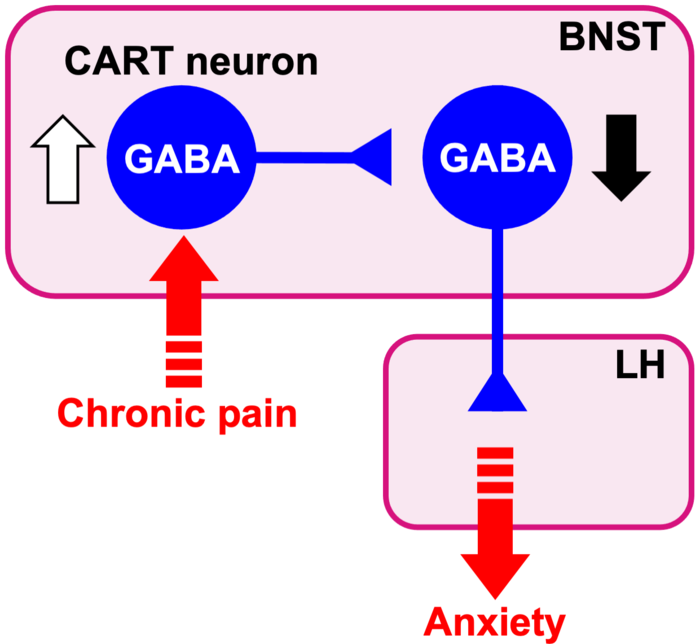
Neuronal circuit involved in chronic pain-induced maladaptive anxiet

Credit: Naoki Yamauchi, et al. Science Advances. April 27, 2022

Hokkaido University researchers have shown how chronic pain leads to maladaptive anxiety in mice, with implications for treatment of chronic pain-related psychiatric disorders in humans.

Chronic pain is persistent and inescapable, and can lead to maladaptive emotional states. It is often comorbid with psychiatric disorders, such as depression and anxiety disorders. It is thought that chronic pain causes changes in neural circuits, and gives rise to depression and anxiety.

Researchers at Hokkaido University have identified the neuronal circuit involved in chronic pain-induced anxiety in mice. Their research, which was recently published in Science Advances, could lead to the development of new treatments for chronic pain and psychiatric disorders such as anxiety disorders and major depressive disorder. 

“Clinicians have known for a long time that chronic pain often leads to anxiety and depression, however the brain mechanism for this was unclear,” said Professor Masabumi Minami of the Faculty of Pharmaceutical Sciences at Hokkaido University, the corresponding author of the paper.

The researchers looked at how neuronal circuits were affected by chronic pain in mice. They used an electrophysiological technique to measure the activities of neurons after four weeks of chronic pain. They found that chronic pain caused the neuroplastic change which suppressed the neuronal pathway projecting from the brain region called bed nucleus of the stria terminalis (BNST) to the region called lateral hypothalamus (LH).

Using chemogenetics, an advanced technique to manipulate neuronal activity, they showed that restoration of the suppressed activity of this neuronal pathway attenuated the chronic pain-induced anxiety. These findings indicate that chronic pain-induced functional changes in the neuronal circuits within the BNST leads to maladaptive anxiety.

“These findings could not only lead to improved treatment of chronic pain, but also to new therapeutics for anxiety disorders,” says Minami.


Journal

Science Advances

DOI

10.1126/sciadv.abj5586

Method of Research

Experimental study

Subject of Research

Animals

Article Title

Chronic pain-induced neuronal plasticity in the bed nucleus of the stria terminalis causes maladaptive anxiety

Article Publication Date

27-Apr-2022

Share12Tweet8Share2ShareShareShare2

Related Posts

“’Stemness Checkpoint’ Key to Regulating Stem Cell Identity”

“’Stemness Checkpoint’ Key to Regulating Stem Cell Identity”

April 9, 2026
Temperate Region Studies Lead in Robustness Despite Majority of Discoveries in Tropical Mammals

Temperate Region Studies Lead in Robustness Despite Majority of Discoveries in Tropical Mammals

April 8, 2026

Zebrafish Uncover Breakthrough Insights into Autism Biology

April 8, 2026

New Glassfrog Species Discovered, Honoring Ecuador’s First Female Olympic Gold Medalist

April 8, 2026

POPULAR NEWS

  • blank

    Revolutionary AI Model Enhances Precision in Detecting Food Contamination

    98 shares
    Share 39 Tweet 25
  • Imagine a Social Media Feed That Challenges Your Views Instead of Reinforcing Them

    1011 shares
    Share 399 Tweet 250
  • Popular Anti-Aging Compound Linked to Damage in Corpus Callosum, Study Finds

    44 shares
    Share 18 Tweet 11
  • Revolutionary Theory Transforms Quantum Perspective on the Big Bang

    40 shares
    Share 16 Tweet 10

About

We bring you the latest biotechnology news from best research centers and universities around the world. Check our website.

Follow us

Recent News

Population-Scale Repeat Expansions Reveal Brain Risks

Asymmetric Selection Reshapes Rice Immunity Module

“’Stemness Checkpoint’ Key to Regulating Stem Cell Identity”

Subscribe to Blog via Email

Enter your email address to subscribe to this blog and receive notifications of new posts by email.

Join 78 other subscribers
  • Contact Us

Bioengineer.org © Copyright 2023 All Rights Reserved.

Welcome Back!

Login to your account below

Forgotten Password?

Retrieve your password

Please enter your username or email address to reset your password.

Log In
No Result
View All Result
  • Homepages
    • Home Page 1
    • Home Page 2
  • News
  • National
  • Business
  • Health
  • Lifestyle
  • Science

Bioengineer.org © Copyright 2023 All Rights Reserved.